


SweetloreEncyclopedia of World Sweets (834)

Sapin-sapin
Sapin sapin
Steaming layers of glutinous rice in different colors and flavors
Desserts / Philippines

Sapin-sapin is a Filipino sweet made by pouring thin layers of glutinous rice flour and coconut milk batter into a mold and steaming them one layer at a time. In the version layered with purple ube, white coconut and yellow jackfruit, a slice cut from top to bottom carries all three flavors. When latik, made by cooking down coconut cream, is scattered over the springy layers, toasty grains add crunch to the chew of the rice. It is one of the rice sweets known in the Philippines as kakanin.
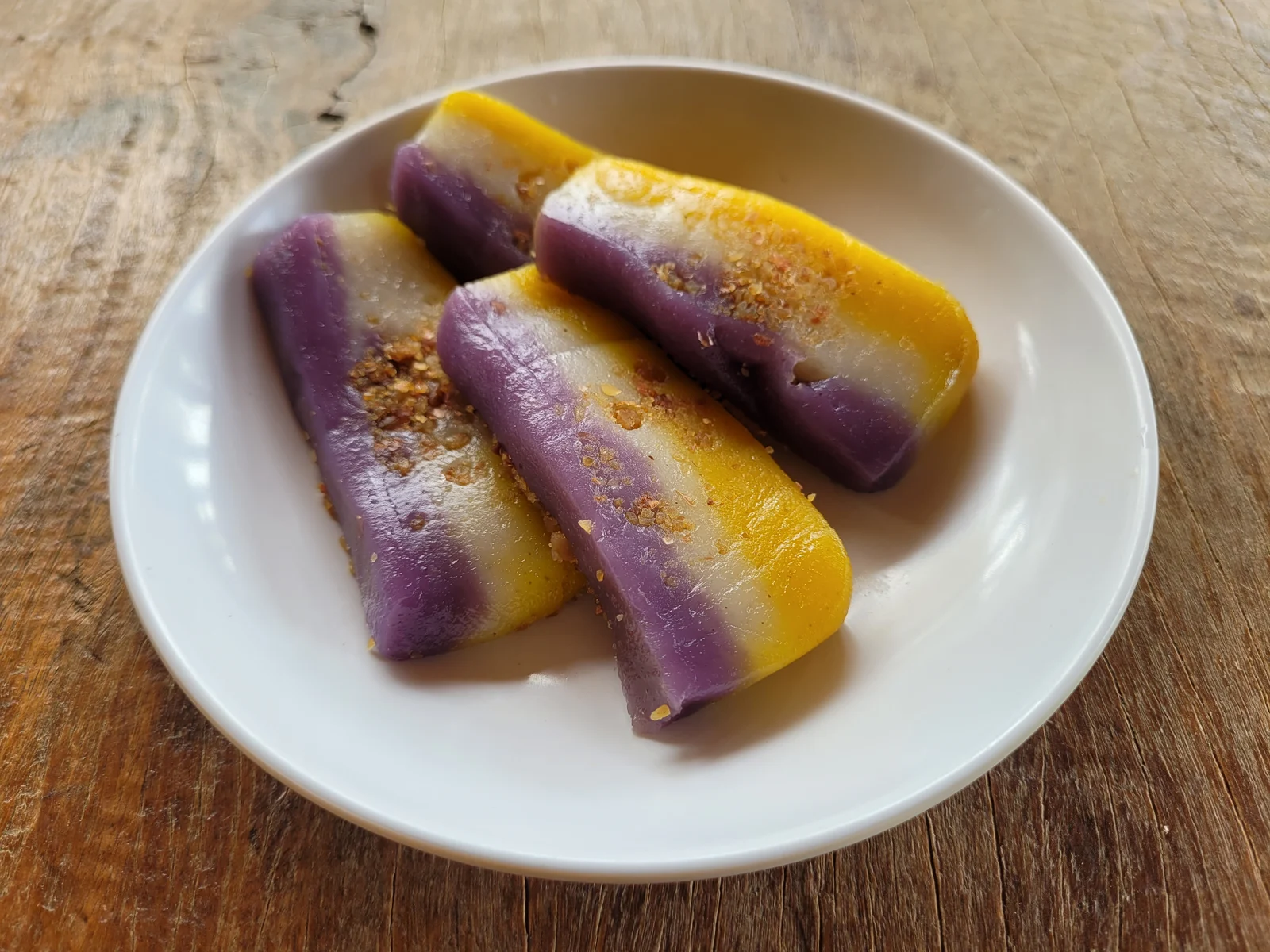
The purple steamed first ends up on top on the plate
The boundaries visible in a cut section form at the moment the next batter is poured into the same round mold. The mold is set on the steamer rack, and the ube batter is spread over the bottom first. The base of the mold is not set in the water; steam reaching it from below cooks the batter. When the surface has set and a skewer inserted in the center comes out free of batter, that surface can take the next batter. If the next batter is poured before the layer has firmed, the two mix and the boundary blurs, so each layer is steamed before moving on. Just as the Tagalog word sapin refers to a single sheet or layer of something stacked, each layer of this sweet also has its own place in the order in which it went into the mold.
The home recipe in Lasang Pinoy at Home uses a round pan with a solid bottom, 20 cm in diameter and at least 6 cm deep. The inside is greased with coconut oil and the base lined with paper. After the first ube layer has steamed for about 15 minutes, the second, white batter is poured gently over the back of a spoon. This slows the flow and keeps a thin stream from landing directly on the steamed surface. The second layer also steams for about 15 minutes, then the batter mixed with jackfruit is added in the same way. The final layer is given 20 to 25 minutes, and the cook checks that the heat has reached the center. The longer final time is a guide for steaming layers in this pan with this formula; it is not a time determined by the type of fruit.
A single-layer sweet can be steamed from start to finish without lifting the lid once the mold is in. For sapin-sapin, the lid is removed each time new batter is poured, so the water below must not run dry in between, and water that has gathered on the inside of the lid must not drip onto the batter. In this example, any shortfall is made up with boiling water, and condensation on the lid is wiped off away from the mold. If water falls on an intermediate layer, the next batter poured there may be diluted at that spot, and if condensation collects on the last layer, it leaves marks on the surface. Managing both the water and the droplets each time the lid is opened is part of the work of building layers by steaming.
When all three layers have been steamed, the heat is turned off and the pan is left covered for 10 minutes, then taken out and cooled for about 60 minutes. The edge is loosened and the cake turned out onto a large plate; once the paper on the base is peeled off, the purple layer that was steamed first is on top. The last layer seen in the steamer becomes the bottom on the plate, so changing which color is steamed first also changes which layer the latik sits directly on. Cutting from the center to the edge into 12 wedges with a lightly oiled blade keeps the sticky batter from dragging on the knife, and every piece shows all three layers in cross-section, from the center side to the outer edge.
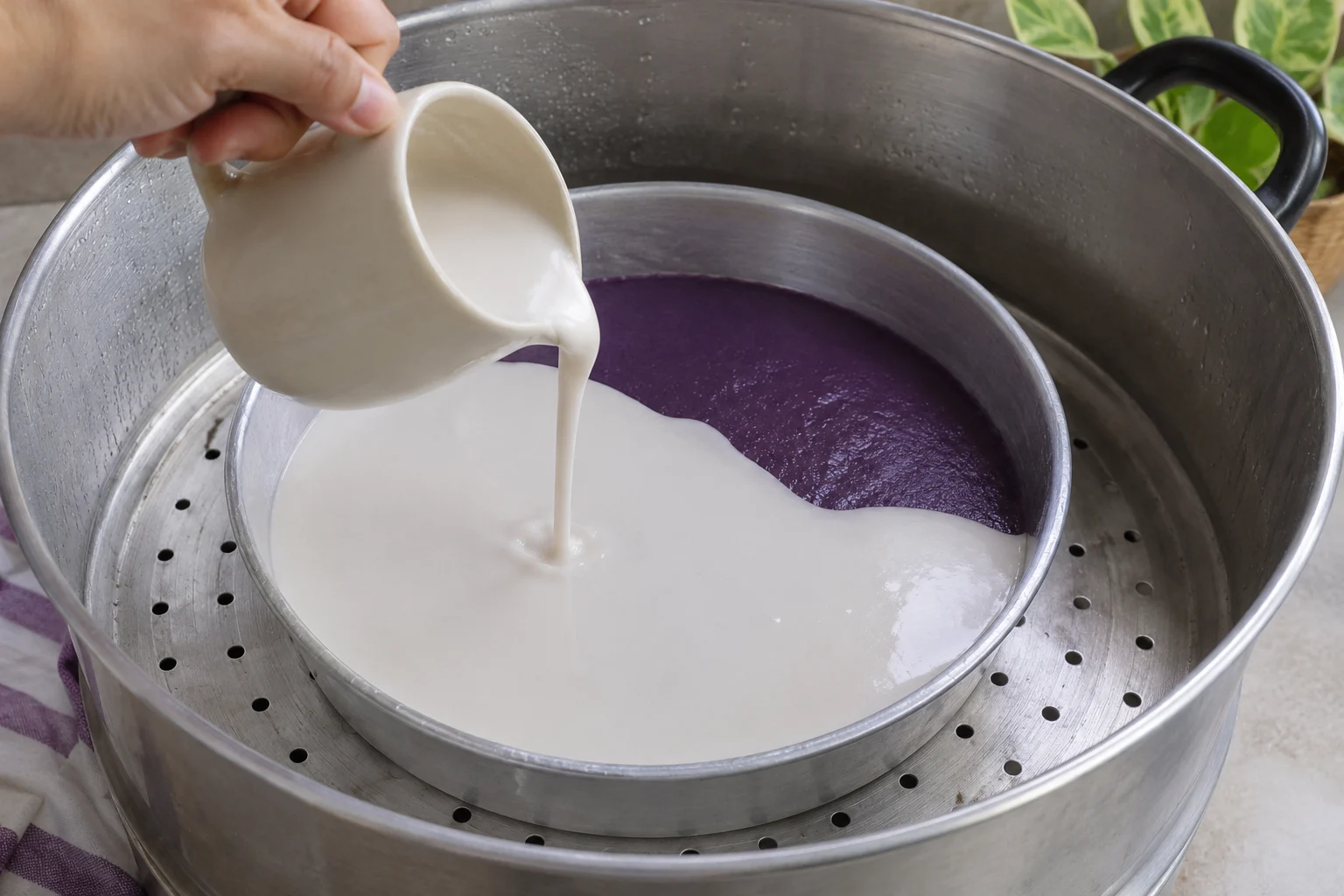
With a white batter in between, the difference between tuber and fruit shows
Before it is divided into three colors, the batter is made by mixing the flour and sugar evenly. In the earlier recipe, 240 g of glutinous rice flour, 400 ml of unsweetened coconut milk, 200 ml of water, 140 g of sugar and 2 g of salt are combined. The batter is strained to remove lumps and divided into three equal parts by weight, so the flavors can be varied from batters of even thickness. For the purple batter, 60 g of boiled, unsweetened ube is mixed with 20 ml of water and added; if the color is pale, ube extract is added. For the yellow batter, 50 g of ripe jackfruit, chopped or mashed, is mixed in, and the white batter between them is used just as it was set aside.
About 80 g is added to the portion with ube and water, and 50 g of fruit to the jackfruit portion, so the weights going into the pan differ from the three equal parts at the time of division. The thickness and mouthfeel of the finished layers also differ. Smoothly mashed ube spreads through the entire purple batter, while chopped fruit gives small pieces that are felt when bitten. If the jackfruit is also mashed before mixing, its aroma spreads while the sense of pieces is weaker. Neither goes into the white layer in the middle, so it separates the purple and yellow in the cut section while keeping the stickiness and aroma of the rice and coconut batter.
Steamed glutinous rice flour batter forms no baked crust, and it is springy and sticky to the bite. There is no rule that the layers containing fruit or tuber and the white layer must share the same texture, and even when their softness differs, the three layers can be cut without peeling apart. The relationship between color and texture also changes with the method. In an example on the home-cooking site Kawaling Pinoy, the batter is coconut milk with sweetened condensed milk added, ube and jackfruit extracts are used, and the layers are steamed in the order purple, yellow, white. This example uses a pan about 20 cm in diameter but about 5 cm deep, steaming each layer for about 10 minutes. Turned out onto a plate, the purple is again on top, but the white is at the bottom.
The same site also gives quantities for the version that uses fruit pulp: about ½ cup of boiled, mashed ube for the purple, ¼ cup of chopped jackfruit for the yellow, and ¼ cup of shredded macapuno for the white. Macapuno is a coconut with soft flesh, and the white layer, too, keeps fine strands that can be felt when chewed. Even for the same purple, a layer with mashed tuber added and one flavored with extract differ in the solids added to the base. The white may likewise be smooth from coconut milk alone, or it may have the sweetness of condensed milk with pulp over it.
The method of setting differently colored liquids in turn can be carried over to sweets that do not use glutinous rice flour. In gelatin-based variations presented under the name sapin-sapin, the color boundaries remain, but the ingredient supporting the layers changes. Even with three colors, the mouthfeel differs from the stickiness of steamed glutinous rice flour. In a method that steams a batter of coconut milk and glutinous rice flour and gives the ube portion only flavor, the texture of a rice sweet remains even without tuber flesh.
There are also examples that depart from the three layers with jackfruit. A utility model application from Cagayan State University at Lal-lo, published by the Intellectual Property Office of the Philippines, describes a sapin-sapin that incorporates sweetened seeds of a relative of breadfruit. Glutinous rice batter is layered in three, and sweetened seeds are also placed on top of the last layer. Mixing jackfruit pulp into the batter brings its aroma into the cross-section, but in this example, where seeds are also placed on top, the texture of another ingredient appears on the surface as well. The publication describes one method, filed in June 2019, and it does not tell us whether this formula is widely used in markets or homes in Cagayan.
Toasty flavor made in a pot apart from the steamer
In methods that top the sweet with latik, coconut cream is put in a pot, separate from the batter steamed in the round mold. As it is cooked down, the water decreases and oil comes out. The solids separated from the oil are stirred as they brown, then strained out, giving toasty grains that the steamed batter does not have. In the confectionery procedure in Lasang Pinoy at Home, they are taken out at about 15 to 25 minutes, when golden. When the aim of heating coconut is to extract oil, a pot like the one in the photo below is used, and in some cases the solids are roasted even darker.
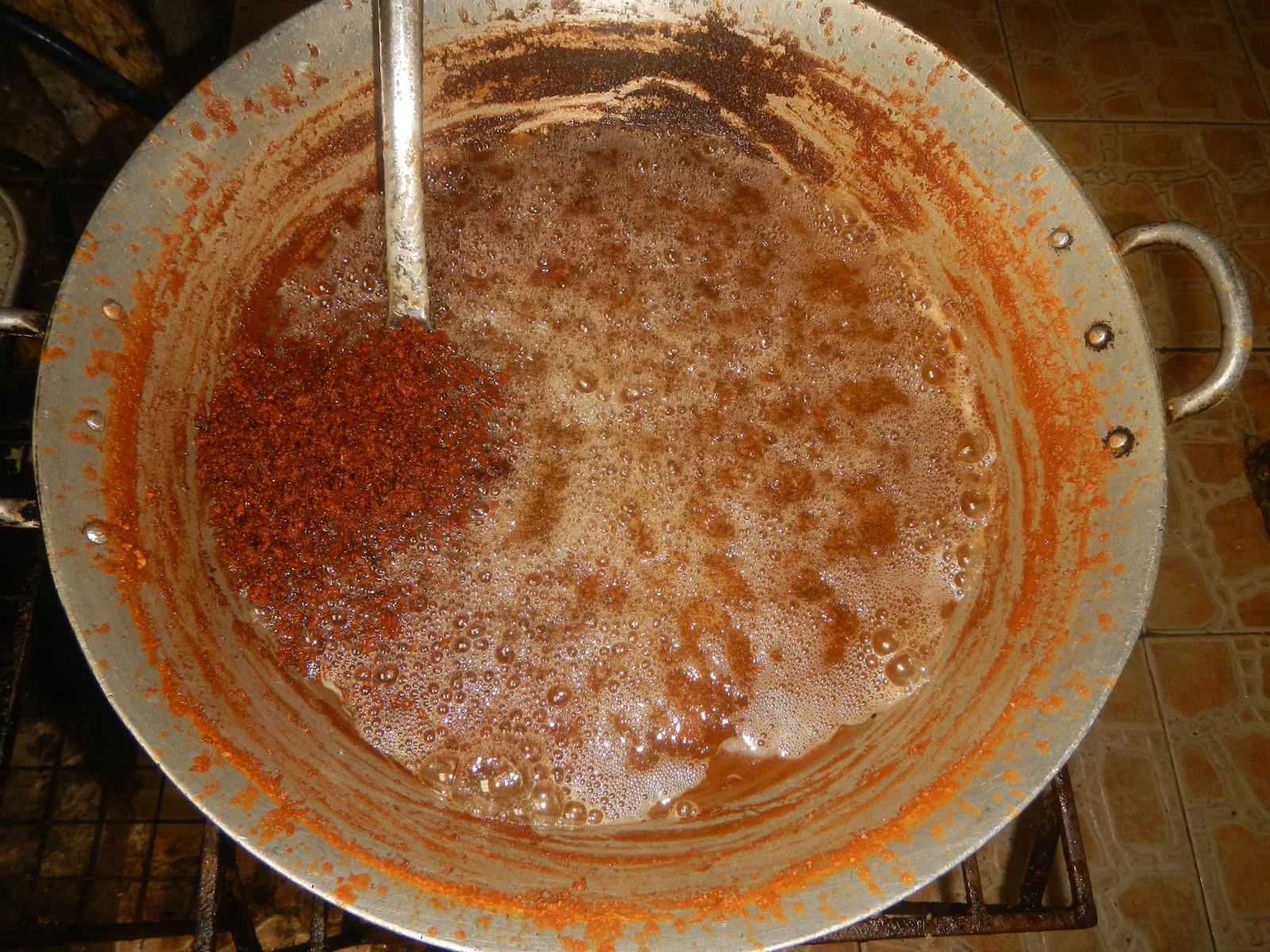
If roasted dried coconut flakes are used in place of latik, the fibers remain when the grains are chewed. When latik is made from coconut cream, there is a method of keeping the separated oil as well, brushing a thin coat of it over the purple surface after the cake is out of the mold, and then scattering the solids. A whole cake set uncut with the purple layer on top first shows the color of the ube and the coconut grains. Cut into a tall piece that can be seen from the side, it lets the diner eat the toasted grains on top together with the steamed layers of fruit and rice in a single bite.
Layers in the steamer, and sweets laid out at the market
The ICH Courier piece introducing makers in Muntinlupa shows equipment that steams kakanin over burning firewood. Whether the round mold goes into a home steamer or a wood-fired workshop is used, sapin-sapin involves handling the mold each time new batter is added. More layers mean more times of opening the lid, pouring, and waiting for the batter to set. Among rice sweets, puto bumbong is steamed one piece at a time in bamboo tubes, and bico is cooked in a pot while being stirred, so the stages that take time differ in each. What the photo of the wood-fired equipment shows is one example of a workshop’s heat source and scale; it does not reveal whether each layer was steamed at the same heat or for the same time.
At Dolor’s Kakanin in Malabon, rice sweets including sapin-sapin are arranged on a bilao, a round tray. According to GMA’s report, bico, kalamay of corn or ube, kutsinta, sapin-sapin, sweets made with cassava and others are each made separately, and up to seven kinds are arranged on one tray. Seen from directly above, the color boundaries on the finished assortment trace inner and outer arcs. In sapin-sapin steamed one layer at a time in a round mold, the color boundaries run horizontally across the cut section. Both round presentations are sometimes introduced under the name sapin-sapin, but where the colors change on an assortment, it is not only the tuber or fruit formula but the sweet itself that has changed.
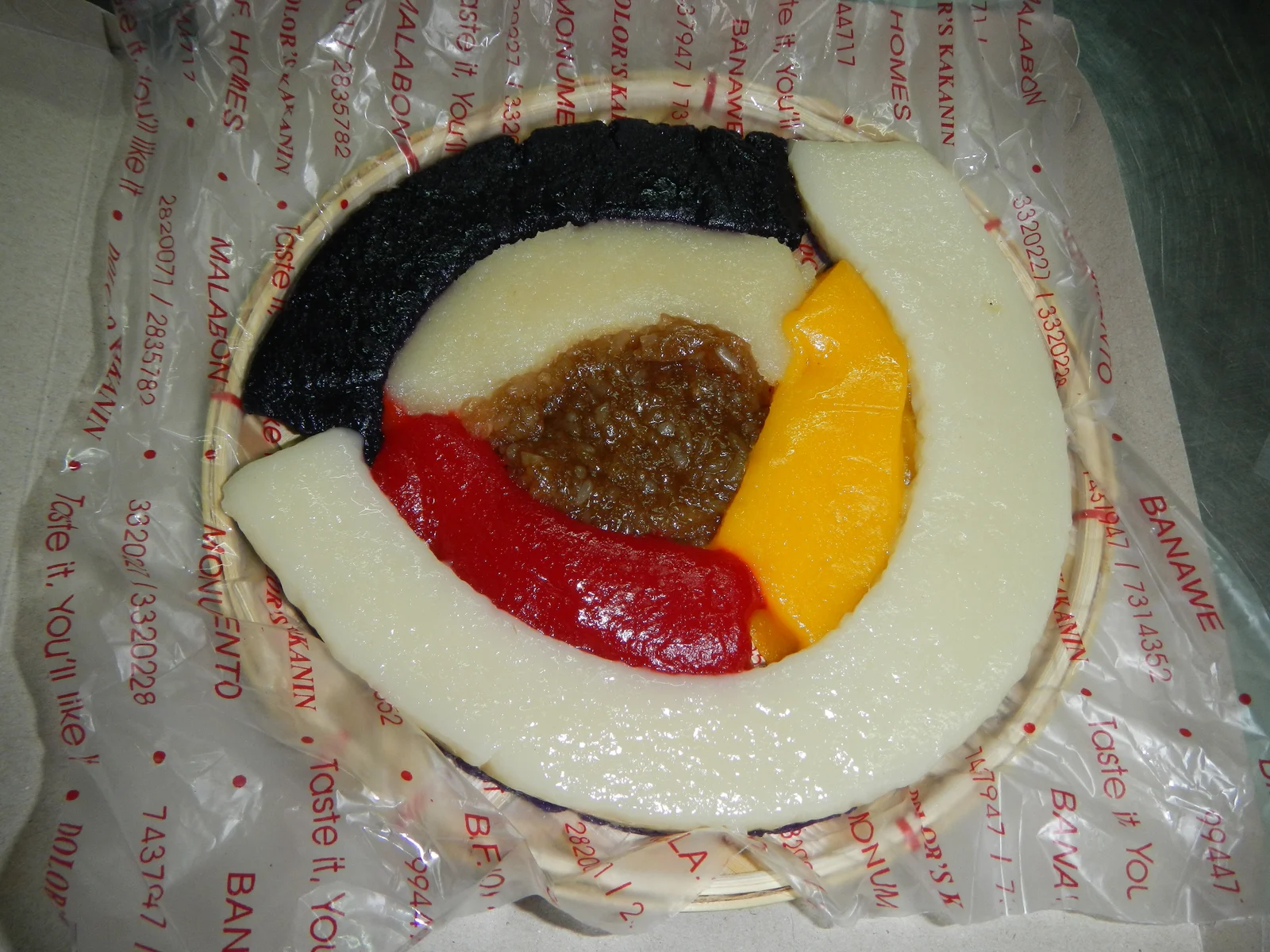
John Lerry Ramos, a store representative, recalled in the GMA report that his predecessor went around selling palitaw and other sweets at the market, then increased the rice sweets he made and began arranging them on the bilao. The 1930s mentioned in the same report refers to the start of this trade. Some culinary sources name Abra as the birthplace of sapin-sapin, but neither the history of the Malabon way of selling nor the steaming equipment in Muntinlupa lets us trace a connection to Abra or the period when the method of steaming three layers was established. The ICH Courier article, which describes both people who carry a bilao and sell on the street and shops that take orders, shows that there is a range in how kakanin are sold.
The weddings and Christmas mentioned in the same article are occasions when kakanin, the rice sweets as a whole, are served. For serving sapin-sapin by the piece, Kawaling Pinoy gives examples of pairing it with coffee, tea or chocolate as an afternoon snack or after a meal, or with a cold drink containing sago pearls and gulaman jelly. If it is cut into wedges that run through all three layers, each plate gets a little of the rice’s stickiness and the distinct aromas of ube, coconut and jackfruit. On a large bilao at the market, a piece sits beside sweets made from rice by other methods, so people sharing them can compare the steaming and textures.
Glossary
- Kakanin
- A general term for Filipino sweets made with rice or rice flour. Methods differ by item and include steaming, boiling, simmering and baking.
- Ube
- Purple yam. In sapin-sapin, there are examples in which it is boiled, mashed and mixed into the batter.
- Jackfruit (langka)
- A fruit whose ripe flesh has a strong aroma. Here it is chopped or mashed and mixed into one layer.
- Latik
- Here, the brown grains left after coconut cream is cooked down and the oil has separated.
- Bilao
- A round tray also used when several kakanin are arranged for sale.
- Macapuno
- A coconut with soft flesh. In some methods it is shredded and mixed into the white layer.


