


SweetloreEncyclopedia of World Sweets (834)

Inutak
Inutak
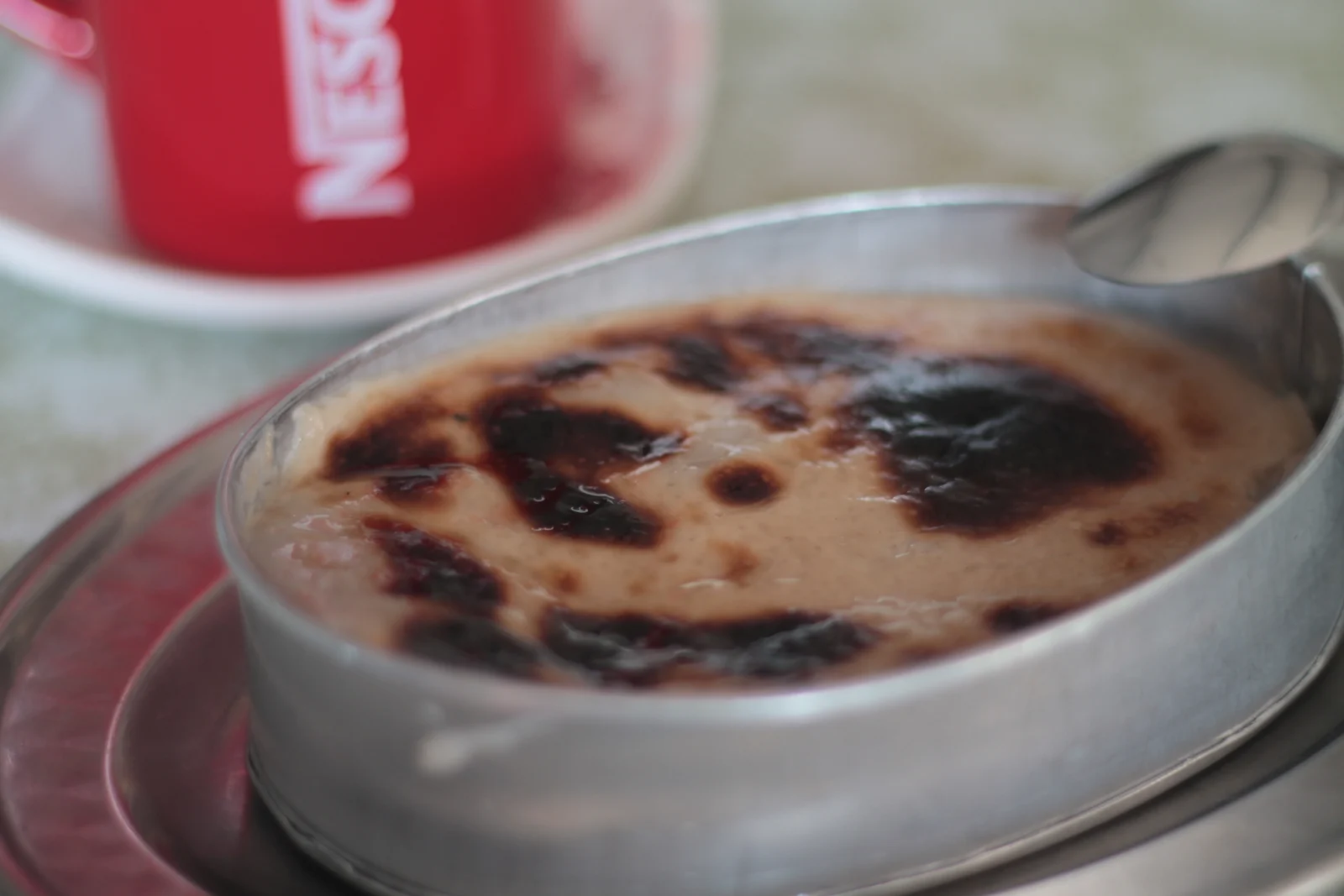
Two soft layers of rice and coconut, with browned spots from top heat
Desserts / Taguig and Pateros, Philippines

In a shallow metal dish, patches of toasted brown float on the surface. Slip a spoon in at the edge of a patch, and soft white rice batter rises from beneath the thin browned crust. Draw the spoon down to the bottom and it also picks up a layer made with ube, the purple yam. Inutak, known in Pateros and Taguig in the Philippines, is a sweet made from rice and coconut milk, with strong heat applied to the top. In the two-layer version, white and purple, the rice is thickened in a pot, batters of different colors are layered, and coconut milk is poured over the top and baked to create the browning.
Thickening the rice in a pot before layering purple and white
In the home method from Foxy Folksy, 1 cup of glutinous rice flour is combined with 1/2 cup each of regular rice flour and sugar, plus a little salt. 1/2 cup of the coconut milk is set aside for the topping, and the rest is mixed into the flour. Because the rice is ground to flour and dispersed in liquid, no shape of cooked grains remains when the batter is taken up with a spoon. The glutinous rice gives stickiness, and the added regular rice flour helps the coconut-milk batter become a paste that can be spread and layered with a spatula. It is cooked over medium heat, stirring, until thick; the vanilla is added and the heat turned off. By the time it goes into the pan, the rice batter has already thickened.
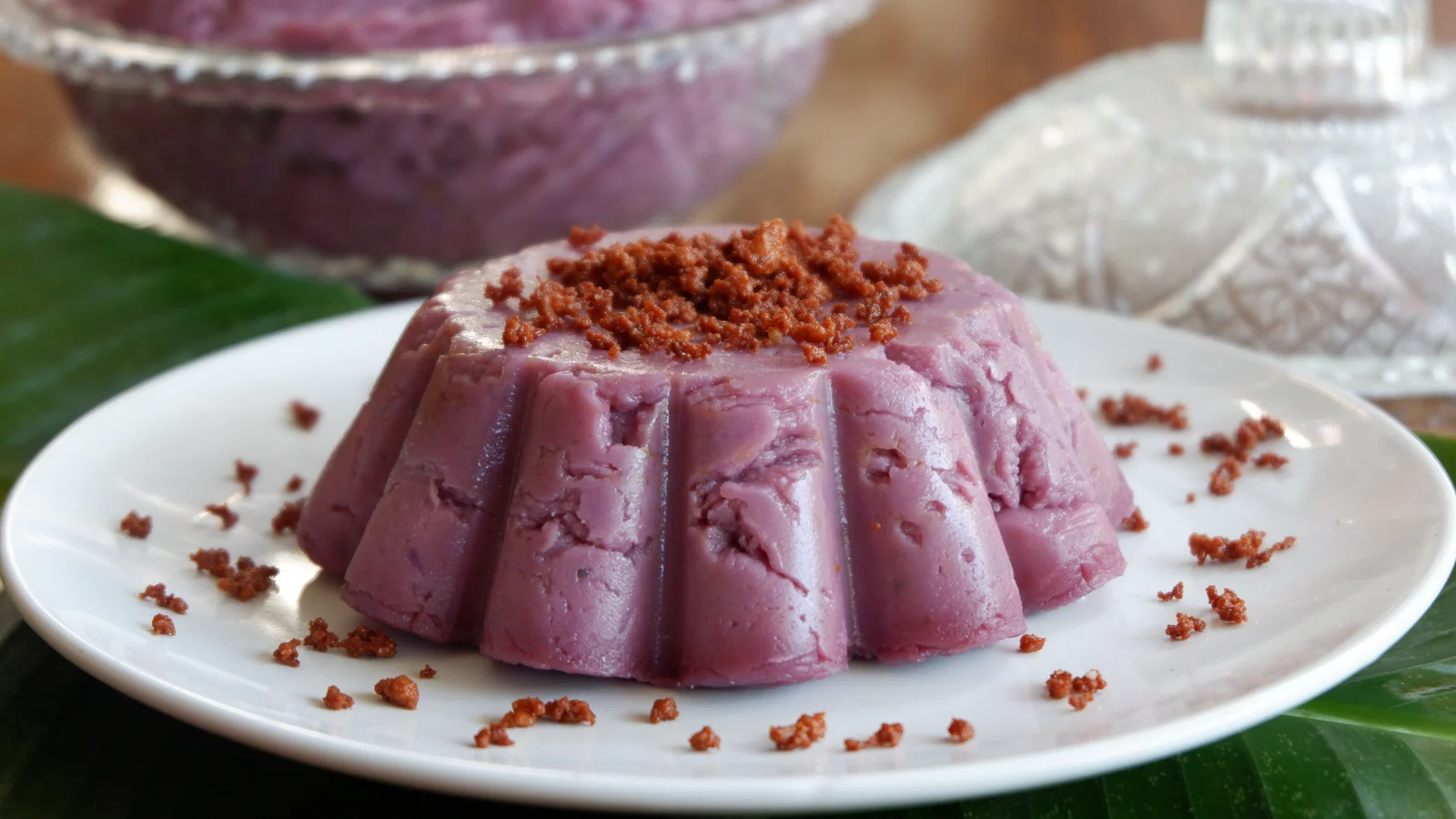
In the home recipe, about half of the batter is set aside at this point, and 1/2 cup of ube halaya is mixed into the warm batter. Halaya is a sweet paste made from purple yam. A few drops of ube flavoring, to add aroma, are optional. The batter in the pot does not turn purple because the rice itself is purple. When halaya is mixed in, the yam solids and flavor come along with the color. The white batter is taken straight from the pot in which the flour was dissolved and cooked, while the purple layer is made by mixing halaya into a portion thickened to the same stage. In this version, the work of cooking two pots from scratch to the same firmness is combined into one.
Even with the same two colors, the Pateros recipe presented by Edward David Mateo in the Philstar calls for 510 grams of glutinous rice flour, 280 grams of sugar, 755 milliliters each of thick first-pressed and thin second-pressed coconut milk, and 2 lightly beaten eggs. These are first mixed into the same liquid and strained, then divided into two before any heat is applied. Pandan leaves go into one half, and ube flavoring and purple coloring into the other; each is mixed and then thickened over low to medium heat. The ingredient list also includes fresh ube paste or ube halaya. Because the flavoring and coloring are named explicitly in the method, the strength of the purple cannot tell us how much ube was used.
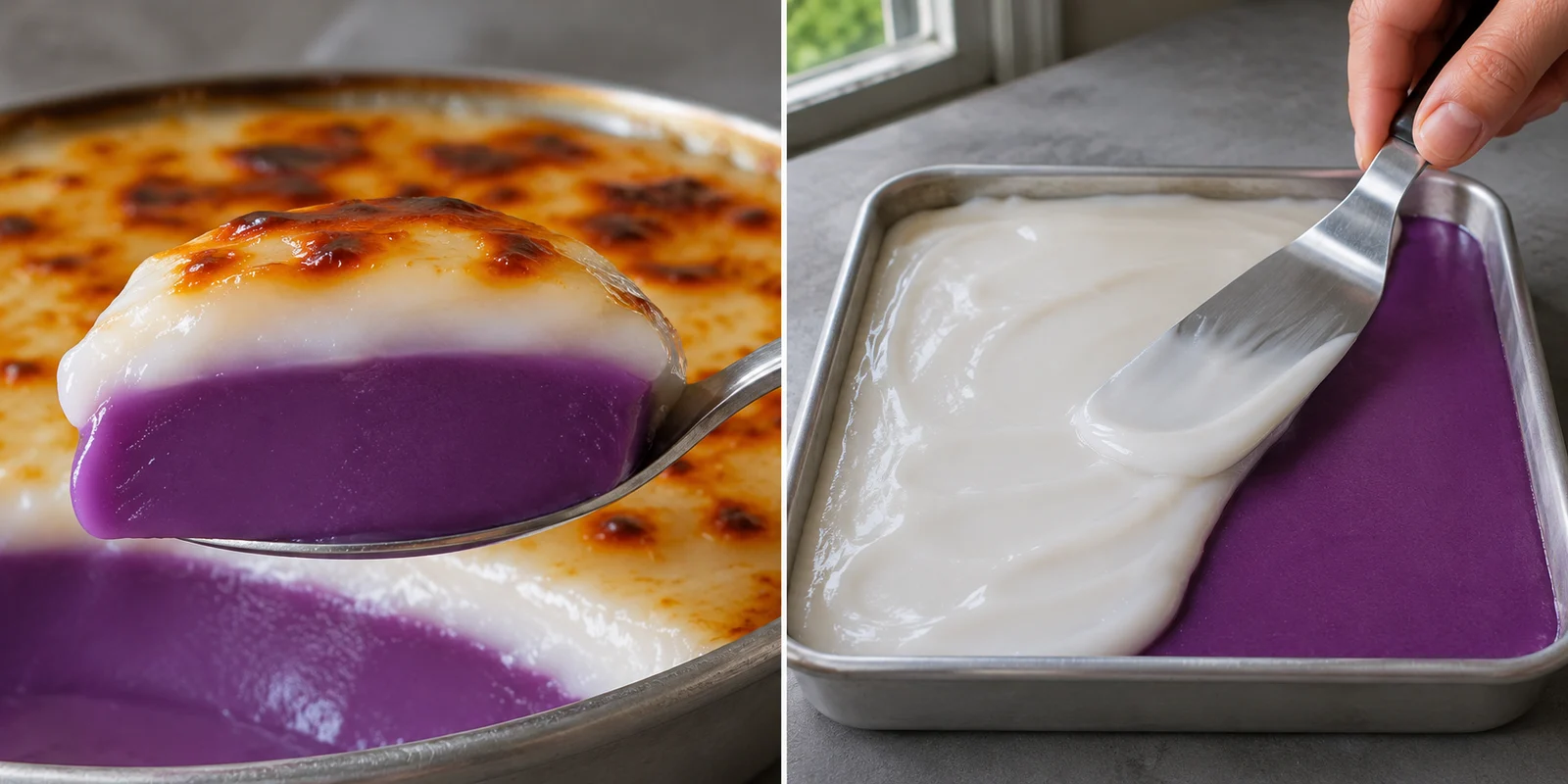
In Mateo’s recipe, the purple batter is spread first in a shallow aluminum pan, leveled, and left to settle. Meanwhile the remaining batter, with the pandan leaves, is cooked in a separate pot, thickened without drying out, and poured over the purple. Neither is a liquid that flows out at once, so one waits for the bottom layer to settle and then spreads the white batter gently over it. If the white is too loose, it sinks into hollows in the purple; if it has stiffened, both layers tend to be pulled along when the spatula is lifted away. Foxy Folksy lightly oils the pan and, when the batter is very sticky, spreads it with an oiled spatula. Whether the boundary between the two colors remains visible on the spooned surface depends partly on how separately they were spread before heat was applied.
In Mateo’s ingredient list, the method begins by measuring the thick first-pressed kakang gata and the thin second-pressed gata separately. Both are poured with the eggs onto the rice flour, strained, and then divided in two. Unlike a formula in which only the thick milk makes the white top and only the thin milk makes the purple, the pressed milk goes into both the upper and lower batters. What differs from pot to pot is the leaf, coloring, or flavoring added afterward. In addition, the thick gata for just before baking is set aside separately. Although the white surface may look as if it were made entirely of the same coconut, the thin browned film that clings to the spoon and the rice-flour portion beneath it are made at different stages, in different pots and pans.
Pouring coconut over the white layer and baking from above
Once the white batter is smoothed, the coconut milk set aside for the top is poured over it. Foxy Folksy adds sugar and a little regular rice flour and warms it just until the sugar dissolves before pouring. In the oven, it goes on the top rack and bakes at 200 degrees until the surface bubbles and brown spots form. In Mateo’s version, thick coconut milk is placed on top and browned with a top broiler or a cooking torch. The purple layer is not colored and then scorched further with fire. Because a separate liquid is placed over the white layer at the end of cooking, the browning coconut and the white rice portion occupy different positions.
The MICHELIN Guide, which presents inutak as originating in Pateros, describes the baked portion as shrinking and having a soft, flan-like texture. Some versions, like Mateo’s, add eggs, while some home recipes bake the top in the same way without listing eggs among the ingredients. What resembles flan is the mouthfeel as the spoon passes through; the step of thickening the rice in a pot is common to both. Even when heat is applied until the coconut on the surface bubbles, the white and purple batters beneath keep the thickness built in the earlier pot. Mateo suggests, if desired, topping the browned surface with soft coconut flesh or shredded macapuno. Where ube is worked in between the layers, this is a finish added to the side the spoon touches first.
The shallow container mentioned in the MICHELIN Guide is an example about 1 inch deep. For home cooks, the batter is made in a square or rectangular pan of 1.5 to 2 liters, or divided equally among three shallow metal llanera, the kind also used for leche flan. Even with the same capacity, a different width and depth changes the thickness of the same amount of batter. Spread wide and shallow, it is easier to take the browned coconut surface, the white batter, and the purple bottom in a single spoonful. One large dish can be portioned to match the number of diners, while with llanera each can be handed over individually without cutting the browned surface.
Among the establishments the MICHELIN Guide features are Cabel, which serves inutak as a dessert on its menu, and Roa, which cuts glutinous rice and ube into bite-sized pieces and tops them with salted egg cream that is then torched. The latter is described as a dish in which the topping placed just before baking is changed from thick coconut milk to a different cream. In both, the aromatic finish goes on top after the layers are built, so as the spoon goes in, the browned part and the rice part come in that order. The saltiness and the flavor of the cream on top are the particular features of the bite served at that restaurant.
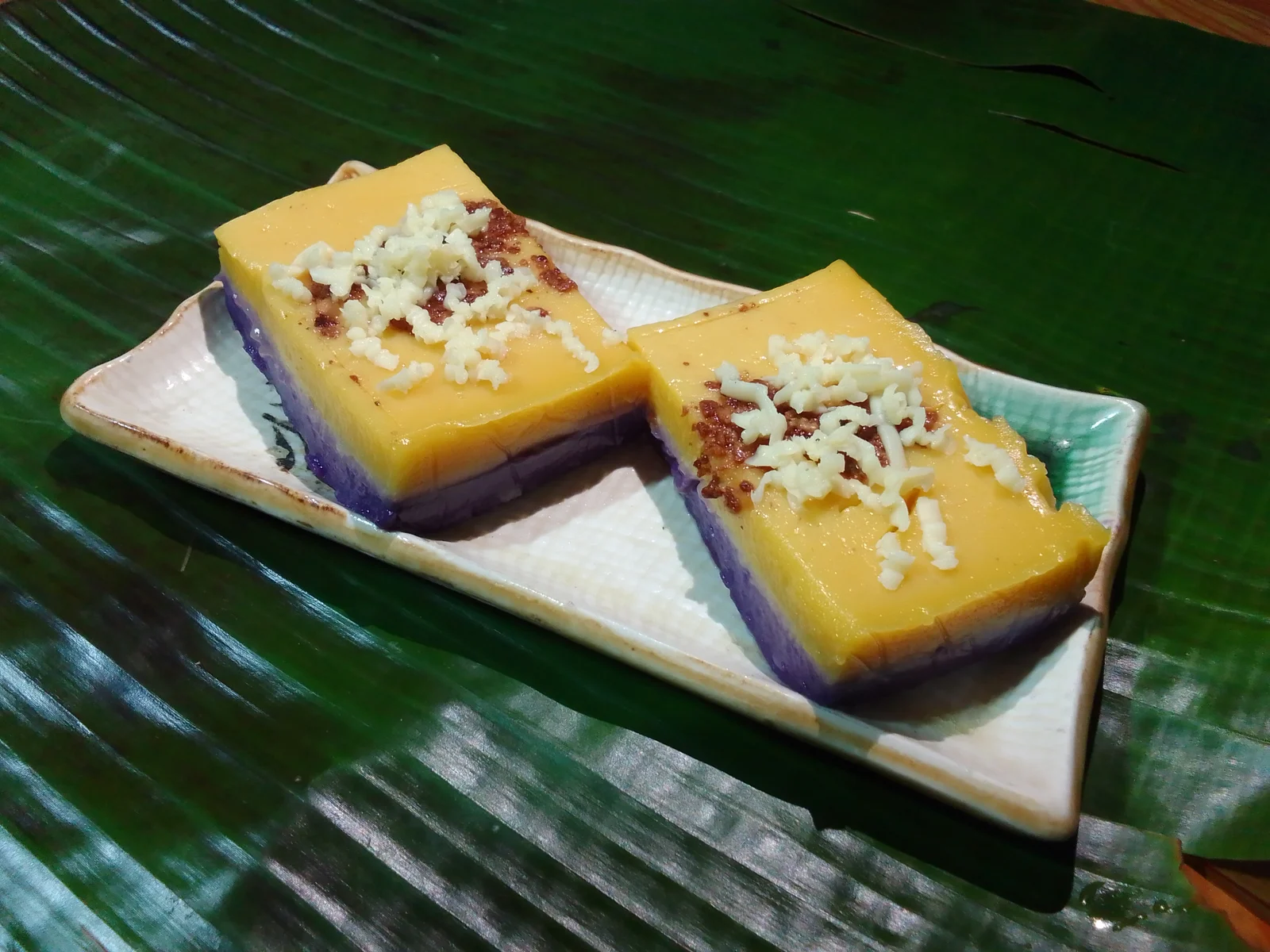
There is also sapin-sapin, which makes layers of different colors from rice flour and coconut milk. In the sapin-sapin recipe presented, each layer is poured as the previous one settles and is cooked one layer at a time in a steamer. For inutak, batter already cooked in a pot to a sticky consistency is spread in a pan, and after all the layers are stacked, the top is baked. Even when a similar purple appears in cross-section, the order in the steamer and the position of the toasty flavor in the mouth differ. If toasted coconut flakes are scattered over sapin-sapin, the flakes touch the tongue; with inutak, the spoon goes in together with the browned spots on the top surface of the white portion.
What is served alongside in Pateros and Taguig
The Philstar and the MICHELIN Guide present it as a sweet of Pateros. The local outlet Taguigeño names both Pateros and Taguig, and noted that the sales outlets it knew of as of 2019 were in the center of the town of Pateros. Another 2012 article presenting a Taguig product describes inutak made with ground glutinous rice and thick coconut milk, slowly baked over charcoal and served warm. The top rack of an oven and a charcoal fire handle heat differently. What that article shows is that warm inutak made with charcoal was presented as a specialty of Taguig. Records bearing on which town made it first and records bearing on where diners of the time actually bought it can each be traced separately.
The name is linked to utak, the Tagalog word for brain. The Philstar takes up the brown patches on the baked surface, and Taguigeño the shape that swells with heat and its softness, as the source of the name. When the flat white of freshly poured milk becomes a browned surface of varying depth from place to place, one can see how such a comparison arose. No dated source naming who first used the name appears in the recipe and sales articles covered here.
A 2013 report connected with Taguig describes Maria Cristina Marcelino, who adapted a recipe she had made at home and turned it into a business. What the writer found was a product sold in boxes at a shopping center in Manila. Besides the usual one, there were flavors such as cacao tablea, macapuno, corn, and jackfruit. What the maker adds changes the flavor beneath the browned surface too. Portioned in small molds, it suits not only eating a spoonful at a time at home, but also packing in a box, carrying it elsewhere, and opening it there.
The 2012 article quotes a flyer from the shop Cristina’s Inutak, which suggests eating the charcoal-baked sweet warm as it is, or pairing it with salabat, a ginger drink, or hot chocolate. The writer sampled it at a stall at The Fort, bought a box, took it back to work, and brewed coffee. The following year’s report also mentions a product combining several flavors in one box. With small containers that keep the browned surface intact for each person, those opening the same box can each choose a flavor and put the spoon down to the white batter and the ube at the bottom.
In the Pateros entry of a tourist guide to Metro Manila, ground glutinous rice is combined with coconut milk and cream, baked over charcoal, and served warm with cheese-flavored ice cream on top. Taguigeño’s example is vanilla ice cream, and with the home recipe from Foxy Folksy one cools it slightly and pairs it with tea or coffee. Even when it is eaten with cold ice cream on top, the work of layering the white and purple batters in the dish and browning the coconut has already been done. A shallow spoonful takes the ice cream and browned surface first; going to the bottom also brings up the rice and ube beneath. How it is paired, at a shop or at home, changes the temperature and aroma in each spoonful.
Glossary
- Kakanin
- A general term for Philippine sweets made from rice, rice flour, and the like. Inutak is a type in which a rice batter is layered and the surface is baked.
- Ube halaya
- A sweet paste made from ube, the purple yam. Added to batter, it brings the flavor of the yam as well as its color.
- Gata
- Coconut milk, the liquid pressed from coconut. In inutak, it is mixed into the rice flour, and in some versions a thick portion is poured over the top and baked.
- Llanera
- A shallow metal mold used for leche flan and similar sweets. It is also used in versions in which inutak is baked in small portions.


