


SweetloreEncyclopedia of World Sweets (834)

Khao Tom Mat
Khao tom mat
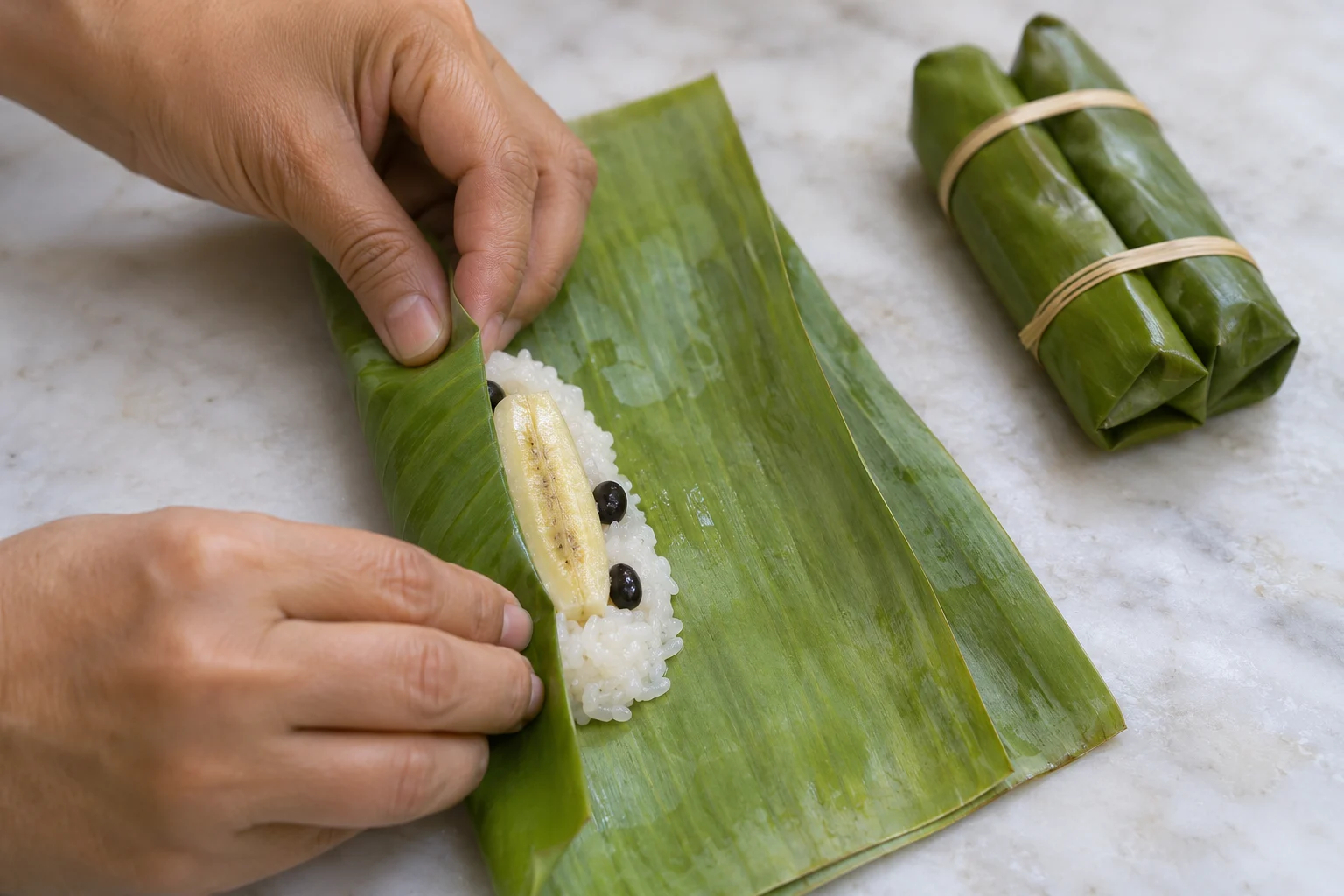
Wrapping banana in glutinous rice, tying the leaf and steaming
Desserts / Thailand

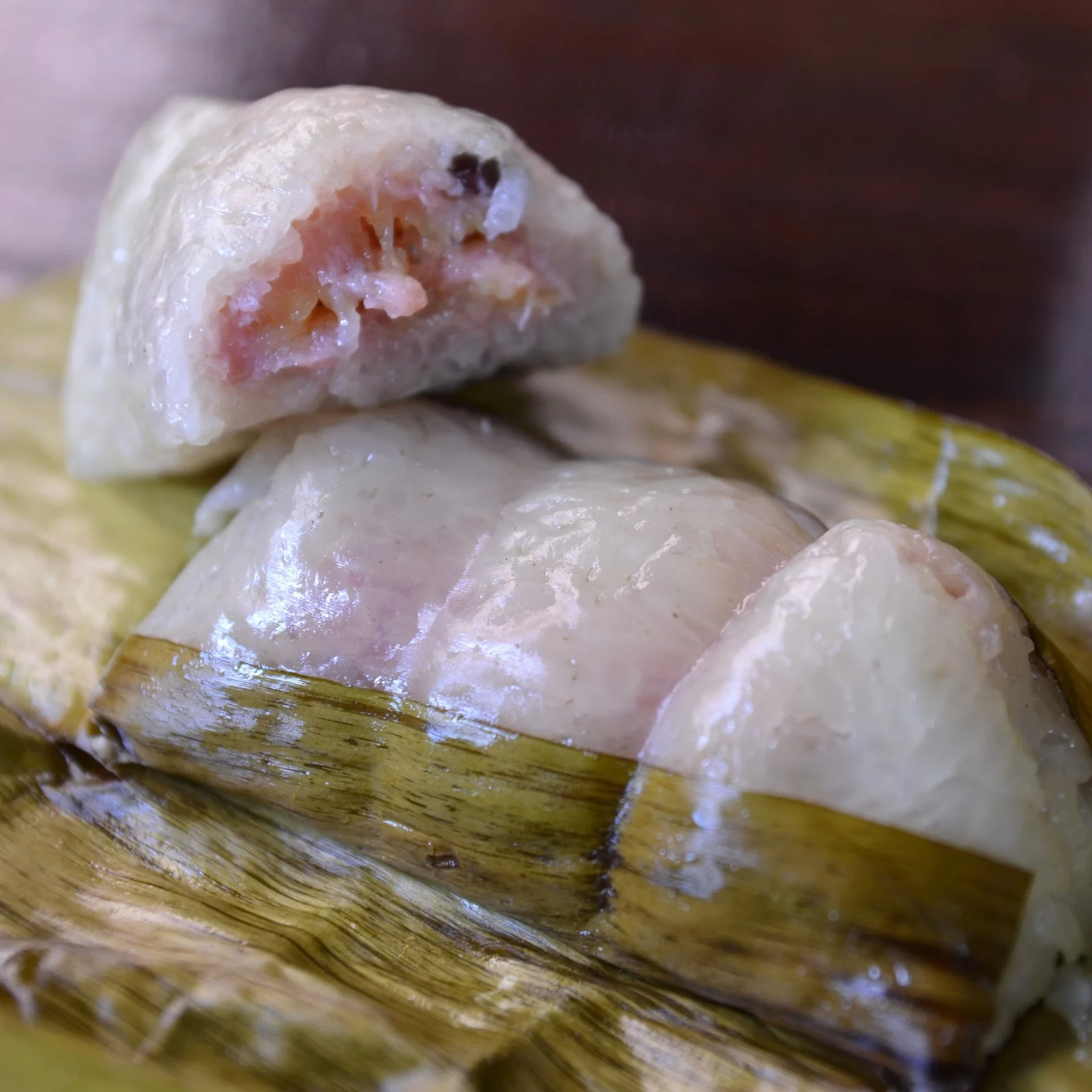
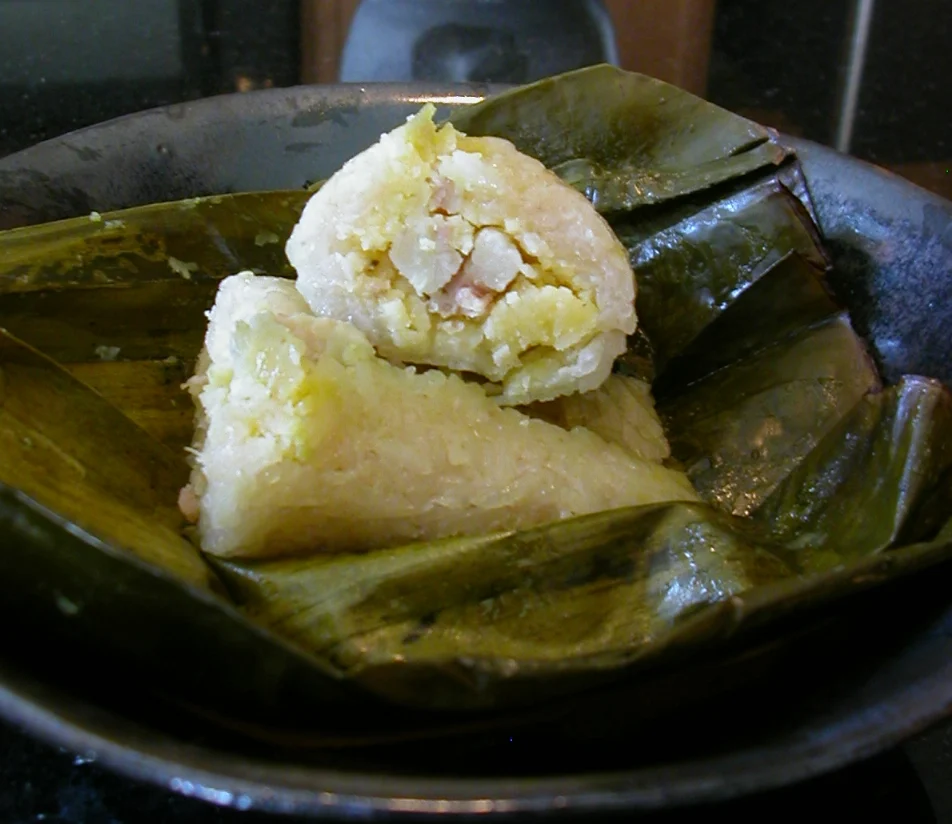
When the bamboo strip is untied, the two leaf parcels can be lifted apart one at a time. Opening a banana leaf reveals glossy glutinous rice cradling softened banana flesh. Thailand’s khao tom mat (ข้าวต้มมัด) is a leaf-wrapped glutinous rice parcel of this kind. In the sweet central Thai method, the rice is first stir-cooked in coconut milk, and ripe bananas and black beans are used. In the north, there is also a method in which rice and peanuts are wrapped in the leaf and then boiled. The way the leaf is tied may look similar, but the aroma of the rice when it is opened, and whether sweet fruit lies at the centre, depend on the pot work before wrapping and on what goes inside.
Cooking the Rice Down to Make a Bed for the Fruit
The recipe presented by Kamphaeng Phet Rajabhat University uses 2 cups of soaked glutinous rice, 2 cups of thick coconut milk, 1/2 cup of white sugar, 2 teaspoons of salt, 9 ripe nam wa bananas, and black beans soaked overnight. The 2 cups of rice are measured after soaking, so they are measured differently from versions that start with 2 cups of dry rice. The bananas are peeled and halved lengthwise. If the rice forming the outer layer is flattened, a long piece of banana is set in the middle and covered with more rice, the outline of the banana remains when the parcel is opened. Preparing the rice and the fruit separately gives each bite both a part where the grains cling together and a part of soft fruit.
The university’s recipe sets a brass pot over low heat, dissolves sugar and salt in the coconut milk, and then adds the glutinous rice and black beans. The mixture is cooked while being stirred and taken off the heat once no excess coconut milk is visible. An article from ThaiData, quoting another shop, gives a version in which the coconut milk is boiled first and the rice is added once the oil begins to separate. This varies the heat in the first half of the step that transfers fragrance and sweetness to the rice. A home cook’s account also advises moving a soft spatula in one direction and not pressing hard enough to crush the grains. Because the rice is heated further once it is in the leaf, rice at the glossy stage holds together enough to keep the shape in which the banana is set, and the grains remain distinct.
The placement of the black beans also varies. In the Kamphaeng Phet example, the soaked beans are added to the pot of rice. In another home example, beans soaked overnight are boiled for 30–40 minutes and then placed on the leaf before the rice. Beans placed on the leaf first end up on the outside of the parcel and are easily seen on the surface of the rice when it is opened. If they are mixed into the rice in the pot, beans may also appear on the cut face. A commercial formula introduced by ThaiData uses 500 g of new-crop glutinous rice with 500 mL of coconut milk and 230 g of sugar, and one example uses steamed mung beans and roasted white sesame in place of black beans. In sweetly seasoned rice, the ends away from the banana are sweet too, whereas in a formula with less sugar the sweetness rises when the fruit at the centre is bitten. How the beans and sugar are put into the rice changes the flavour from place to place.
In TrueID, which carries a recipe for selling, Khrua Phitphiphai adds the rice once the salted coconut milk has come to a boil. Sugar is added when almost no liquid remains; after further mixing, the rice is turned out into a leaf-lined container and left to cool. This differs from the Kamphaeng Phet recipe, which dissolves sugar and salt at the start, in the point at which the sugar meets the rice. In this commercial example, rice, banana, and beans and sesame are layered on the leaf, a little more rice is placed on top, and the parcel is closed. Before wrapping, the moisture is checked to see that the rice prepared in the pot can support the filling placed on the leaf.
Folding Two Leaves and Tying Two Parcels
Two banana leaves are layered for wrapping. In a home example in which the glossy sides are placed together, one spoonful of rice is spread, the cut banana is set on it, and another spoonful of rice is put on top. The edge of the leaf is folded back, and the sides are folded and tucked in. Two parcels of the same shape are made and put together, and the pair is tied at two places with a thinly split strip of bamboo. In some examples the bamboo is soaked for 2–3 hours to make it easier to bend. With two leaves layered, the fold at one end can be covered by the other leaf. The knots are placed where the folds of the leaf will not open in the steaming pot and where the pair can be lifted as it is.
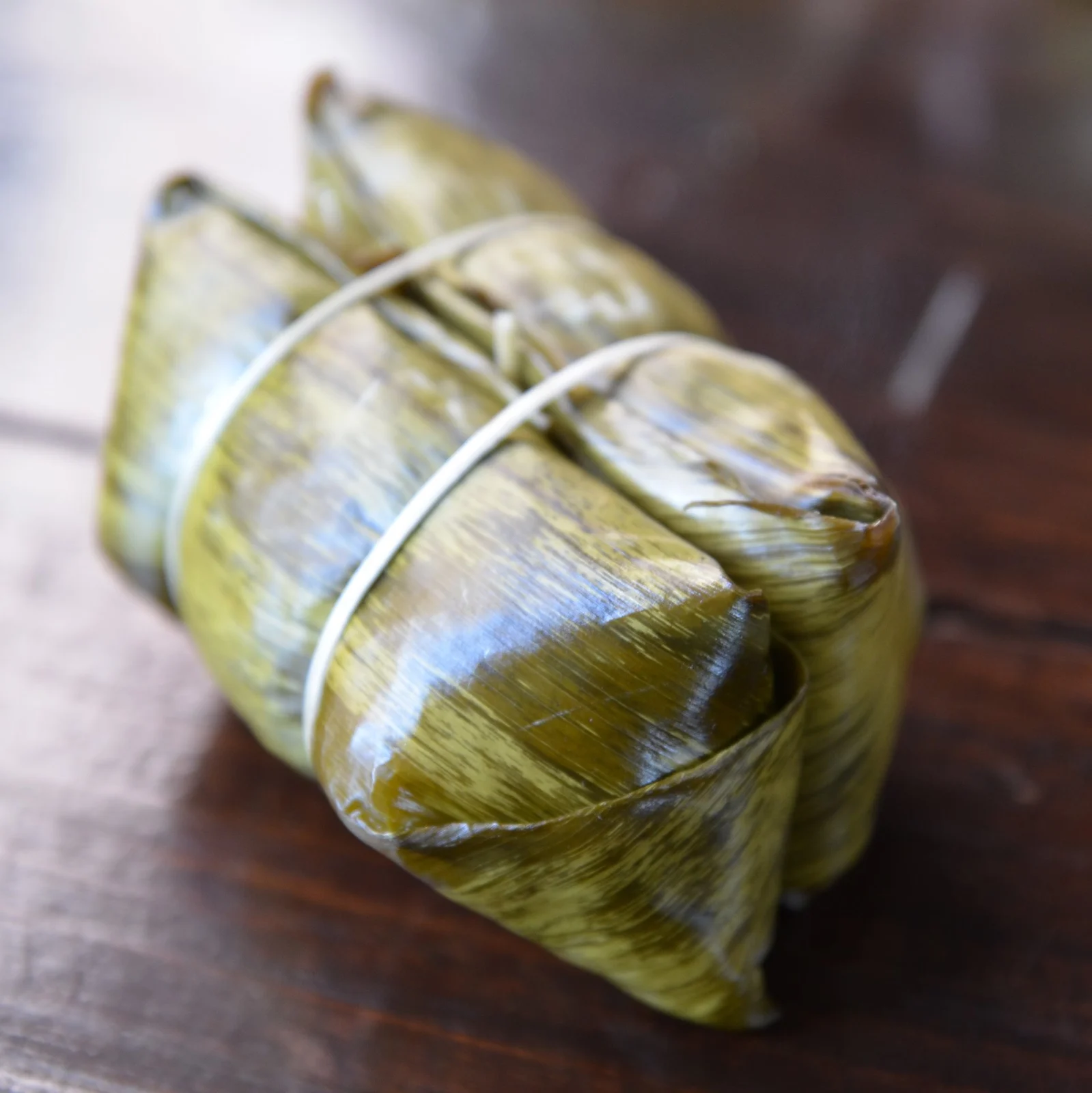
The same TrueID cook instructs that the less glossy sides of the two leaves be placed facing each other on the inside. The cook also shows that banana fibre can be used for tying in place of bamboo strips. Which side of the leaf goes up or down is not the same as in another home example. Choosing for themselves which side to use and which material to use for the band, cooks carry the two parcels to the steamer already tied. Because there are two surfaces, the leaf side that is touched when the parcel is picked up and the side that receives the rice and opens, lifting the leaves at once also shows each fold.
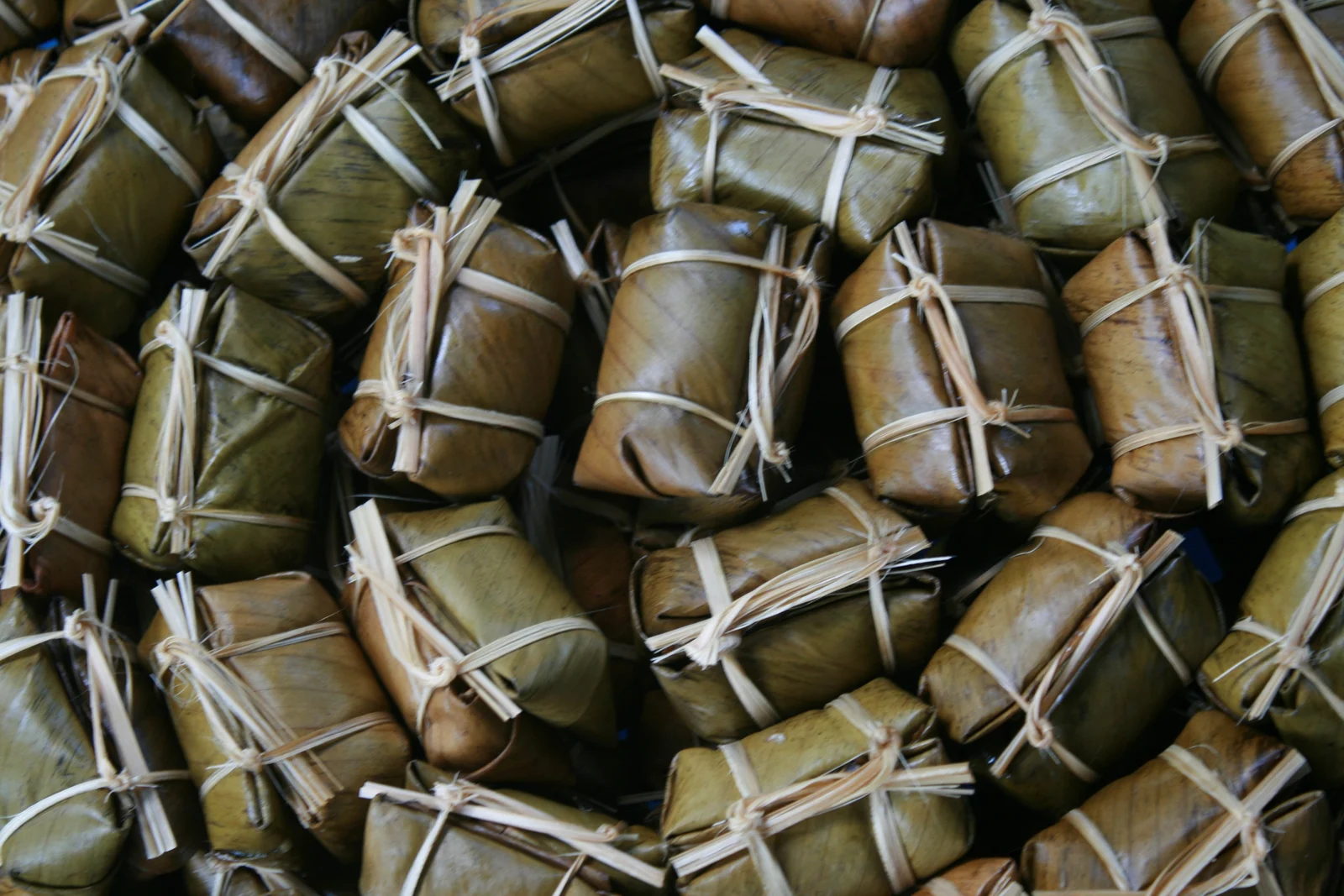
The Kamphaeng Phet recipe wraps in the leaf and steams over boiling water for 30–45 minutes. Another home method ties the two parcels together and steams them for about 1 hour 45 minutes to 2 hours. These figures are not standardised for how moist the rice was after preparation, the amount of rice in each parcel, or even how the leaves overlap. Regional material from the Ministry of Culture describes, in the central region, cases where two parcels are tied together and boiled, and cases where they are packed untied into a steamer and steamed; in the latter, they are arranged so that they touch their neighbours in the steamer. Seeing tied parcels in a photograph does not by itself tell whether they went into the boiling water or were placed above it. The parcels are heated until, when taken out of the leaf, the rice grains hold together and the fruit sits at the centre. While warm, the scent of coconut rises; once cooled, a piece is easier to pick up as a single unit.
Lanna: Wrapping Peanuts and Boiling
Khao tom tua din, presented by the Lanna Folklife Museum of Chiang Mai University, uses soaked glutinous rice that has been drained; raw peanuts or nam wa banana are placed in the leaf, and 2–4 parcels are tied firmly together and boiled. Compared with the central-region example, which steams rice seasoned with coconut milk together with fruit, the peanut version has beans to bite along with the rice. The Ministry of Culture material also lists northern examples that contain both, and examples wrapped in leaf without added sugar or coconut milk. Separately, there is khao tom hua ngok, which is cut into bite-size pieces after the leaf is opened and topped with shredded coconut. Even for two parcels with a coconut flavour, the point of the mouth that meets the coconut differs, depending on whether it is used at the stage when the rice absorbs the cooking liquid or shredded coconut is added to a cut piece.
The museum says it is made for ceremonial food and as a snack for guests at the New Year, at the beginning and end of the Buddhist rains retreat (Khao Phansa and Ok Phansa), and at funerals and merit-making events. A custom also survives of putting an empty parcel, made of folded leaf alone, into the pot. The leaf is folded just like a parcel containing rice, and it is said that adding the empty parcel helps the cooking go well. As another northern example, the Ministry of Culture material describes a method of gathering 4–5 parcels and boiling them with the head and tail tied. The empty parcel is described as a custom performed in the hope of a good result, not as the outcome of measuring changes in the heat of the pot. Whether the same custom appears in the steamed central-region examples is likewise to be checked against each regional source that records the event.
Among the southern examples the Ministry of Culture presents, one covers banana with white glutinous rice, wraps the outside in banana leaf, and binds it with string or ties the ends. It is called nyao ho kluai. Even in the same southern direction, what is wrapped here is glutinous rice and banana, while luk yon has a different example containing only black beans. Where several parcels are tied together and put into the pot in Lanna, the number grouped also varies. Even if the handling of the leaf is known in each region, the number of parcels, the added fillings and the places where they are tied can be compared by looking at which region’s record they appear in.
Leaving the Leaf Long for Almsgiving
The Kamphaeng Phet material sets side by side the fact that khao tom mat was made as an offering to temples and the fact that it can be bought at markets outside the town. Because it can be handed over still in its leaf, it can be carried without touching the rice directly by hand. If the two form a bundle, the tie can be undone and each handed to a person with its leaf still on. By contrast, a news report on the almsgiving held around Wat Phra Phutthachai in Saraburi Province on 27 October 2026 features a different parcel, khao tom luk yon (ข้าวต้มลูกโยน). The form made here is small: a pandan leaf is rolled into a cone, with an end left long so it can be held. It encloses glutinous rice cooked down in coconut milk, ripe banana and black beans, is fastened with a clip, and is steamed for a further 7–10 minutes. In the almsgiving custom the temple has revived, people take hold of the long end of the leaf and present it as an offering.
As another example of luk yon, the Ministry of Culture material also describes a form without banana, in which black beans and glutinous rice are wrapped in a different kind of leaf and several parcels are linked and boiled. It adds a story that people who gathered to offer food to the Buddha threw the parcels from a distance. The pandan form now used in Saraburi, with its end raised, can be observed as a way of making that is easy to obtain locally and to present as an offering. The report recorded a modern event that falls in the Ok Phansa period, and its role differs from that of a source that fixes the era in which the event of the story took place.
Reading the Work Before and After Tying Through Regional Names
Khao means rice, tom means to boil, and mat means to tie. In the name khao tom phat, used in the central region, phat conveys the action of stir-cooking the rice in coconut milk. The Ministry of Culture material records that in the north and northeast, soaking rice is called "ma." In the northeast, there is a method of stir-cooking in coconut milk as in the central region, and a method of mixing raw glutinous rice with black beans or peanuts, sprinkling it with salt water, and wrapping it in leaf. The same material explains that the aroma on opening also differs between parcels that use banana leaf and those that use pandan or tong kwao leaves. Even where the names are similar, each example shows whether the rice is cooked beforehand, what is wrapped in which leaf, and whether the parcel is finally boiled or steamed.
The Thai Ministry of Culture lists this sweet as an intangible cultural heritage entry of Buddhist Era 2557 (2014). Its booklet records both the use as an offering and as a food to carry, and the fact that the way of making it differs by region. Parcels tied at home, parcels handed out by street stalls, and small parcels taken to temples also differ in where the leaf is held and how it is shared out. Rather than applying a single formula to the registered name, reading in sequence the occasions for eating and for carrying that called for a leaf parcel shows how much room cooks have to vary the filling and the form.
Laos also has a khao tom in which glutinous rice is steamed inside banana leaf, and sources that group it under a broad name include fillings such as taro and meat, which differ from sweet fruit. In photographs of Lao leaf parcels, once opened, the shape of the rice follows the leaf, and the filling can be seen in the cut face. Which came from which cannot be told from the shape of the leaf, but placing a single portion of rice inside a thin leaf makes it possible to compare how it can be carried as it is and divided among separate people. In the sweet central parcel, when it is opened, rice cooked in coconut remains around the fruit, and beans placed on the leaf first show on the surface. What appears when the tie is undone is the procedure by which that number of parcels was wrapped, and the filling arranged around the rice.
Glossary
- Nam wa (กล้วยน้ำว้า)
- The name of a banana used in Thailand. In the Kamphaeng Phet recipe, ripe bananas are split lengthwise and wrapped inside the rice.
- Khao tom phat (ข้าวต้มผัด)
- The name for the type in which glutinous rice is stir-cooked in coconut milk and then wrapped in leaf.
- Lanna (ล้านนา)
- A historical and cultural region of northern Thailand, including Chiang Mai. Here, the example in which a leaf parcel containing peanuts is boiled is discussed.
- Khao tom luk yon (ข้าวต้มลูกโยน)
- A rice parcel in some cases made with the leaf left long. In Saraburi, it is linked to a temple almsgiving event.


