


SweetloreEncyclopedia of World Sweets (834)

Cartola
Cartola dessert Pernambuco
Butter-fried banana topped with warm cheese
Desserts / Pernambuco, Brazil

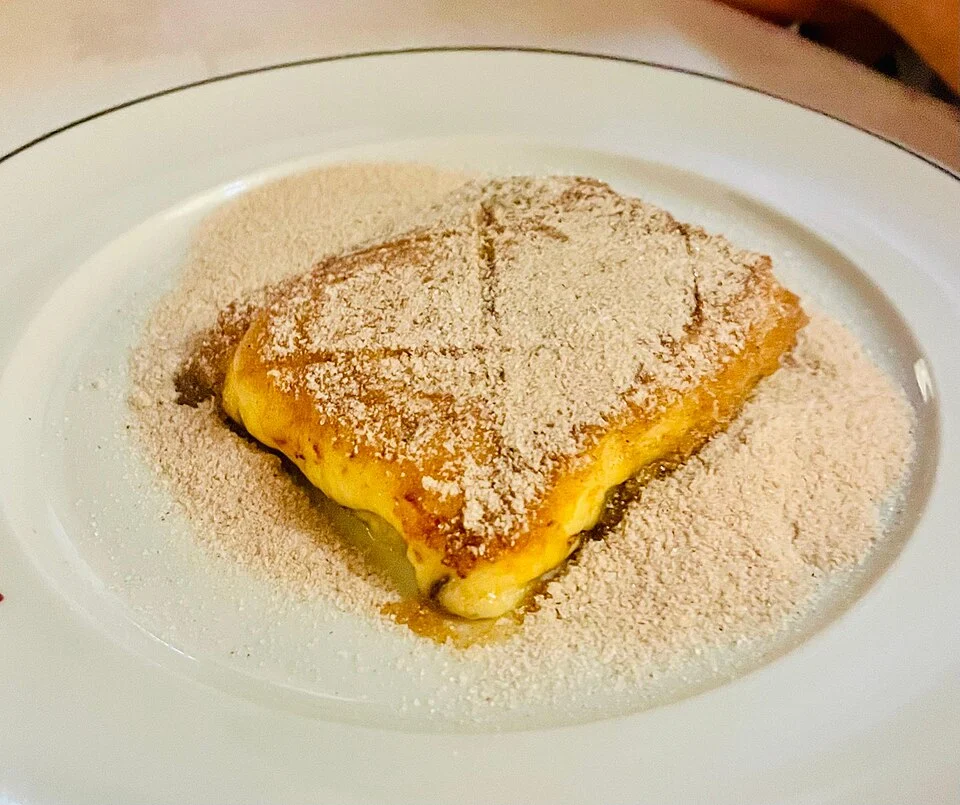
Beneath the sugar and cinnamon, baked cheese lies over warm banana. Cartola is a dessert from Pernambuco, in northeastern Brazil. The banana is browned first, and cheese warmed separately is placed on top. When a knife goes in, one tastes the sweetness of ripe fruit and the saltiness of milk in the same bite. Because it is served right after the layers are assembled, how ripe the banana is and how far the cheese is warmed show up in the texture on the plate.
Browning the Ripe Fruit
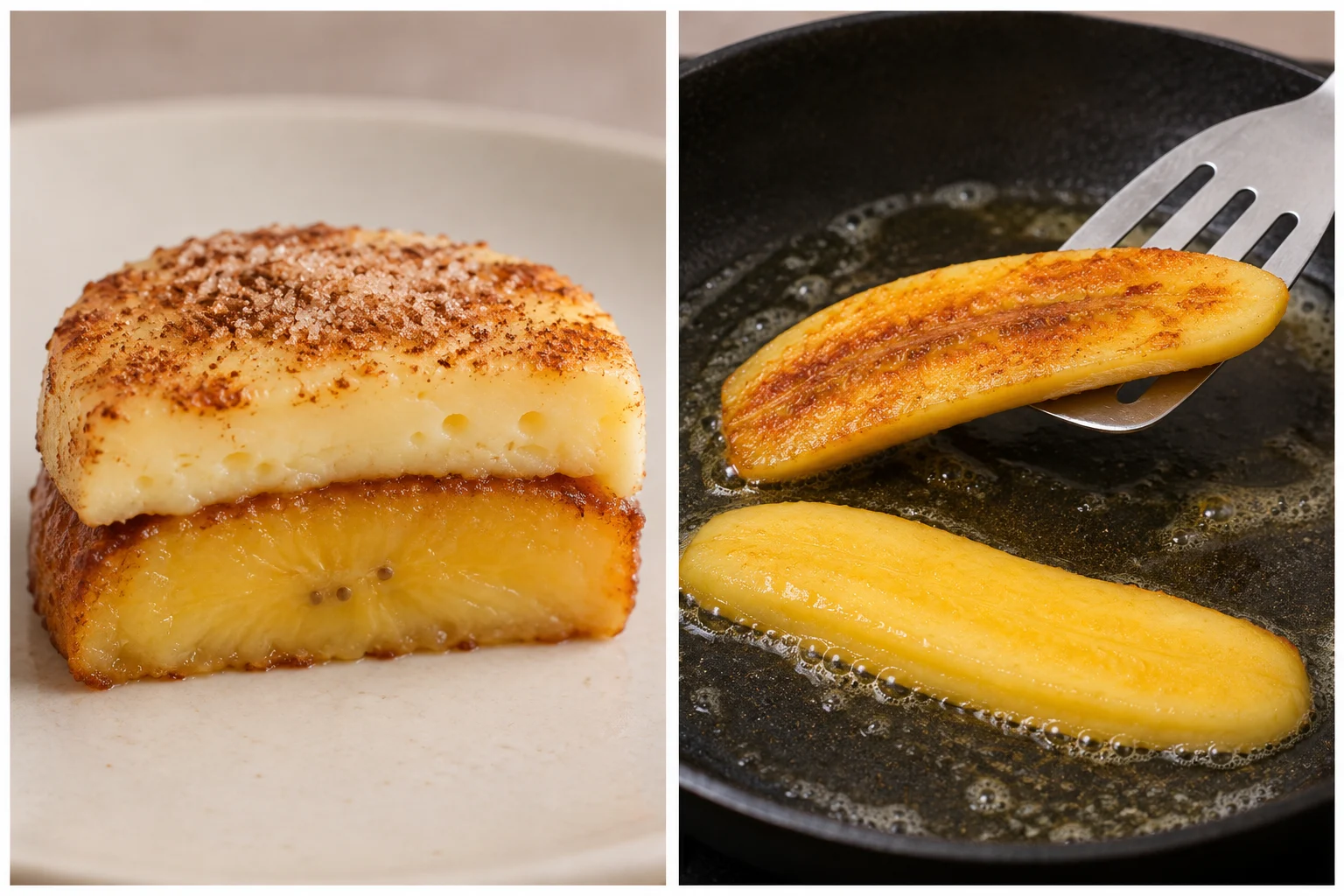
Instituto Brasil a Gosto, which researches food culture, gives a method in which ripe banana-prata are halved lengthwise and fried in butter on both sides. Halving lengthwise exposes a long cut surface of flesh, which browns easily against the pan and becomes the face that takes the cheese on the plate. Unlike a presentation that scatters round slices, this one lets the length of the fruit show, with a slightly smaller slice of cheese laid over it. There is no step of wrapping the banana in cheese before cooking; the flesh side is browned, and the dish is then assembled on the plate.
A guide for the heat is that the surface of the flesh browns and the half still holds its shape when lifted. In the version that uses butter, the surface of the fruit is browned in the melted butter in the pan, the banana is moved to a plate, and the cheese is then cooked over the same heat. Freshly fried banana has a thin browned surface over flesh that chopsticks or a fork can enter. When thick, warm cheese is placed on it, the knife passes differently through the fruit and the dairy layer even with the same pressure. The large difference in texture despite the short procedure arises because banana and cheese are cooked separately, so each keeps both a cooked surface and its own inner texture.
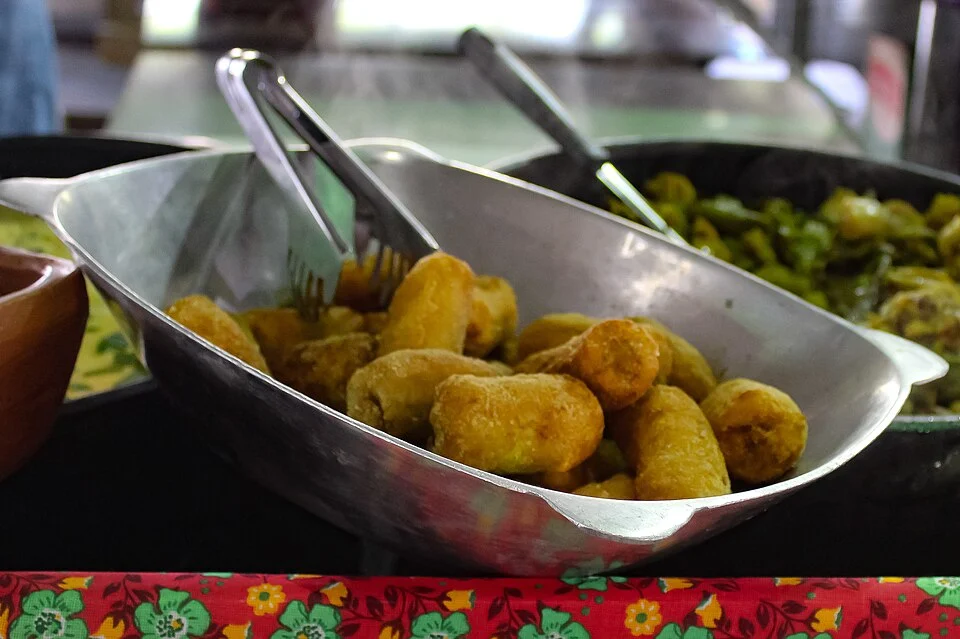
In a study of banana-prata published by the Brazilian Agricultural Research Corporation, the starch in the pulp of green fruit, about 19–22%, fell to about 2–3% in ripened pulp, while the proportion of total sugars rose from about 1% to about 18–19%. These are values from an experiment in which the fruit was ripened under set conditions. They are not measurements of the sugar on a restaurant’s plate, but they show why the recipes specify ripe prata.
Even within the same variety, firm green fruit and ripe fruit differ in sweetness and pulp composition before any cooking.
In the same study, fruit that had been stored in polyethylene bags before ripening had less starch, more sugar and softer pulp during ripening. For internal quality after maturity, the study reported that raising the relative humidity during ripening had no effect. In cartola the banana is not mashed or sieved; it is cooked and moved with its lengthwise-halved shape intact, so both holding its shape when lifted and crumbling easily in the mouth are involved. Whether browning becomes easier cannot be determined from ripening experiments alone. What the restaurant’s instructions confirm is the procedure of cooking the flesh until it colors and cooking the cheese separately.
Because the flesh is already sweet when it is used, the finishing sugar serves not only to add to the fruit’s sweetness but also to spread the cinnamon widely over the surface. The recipes of Leite and of the institute do not fix the amount of finishing sugar in grams. Where the sweeter spots fall when one eats depends on how much powder is sprinkled and how the layers are stacked on the plate.
Warming the Cheese, Then Sprinkling Sugar and Cinnamon
The institute’s recipe for four people uses six bananas and four slices of cheese 5 mm thick. After the bananas are fried in butter and moved to a plate, the cheese is browned on both sides in the same pan. Because the cheese surfaces are browned first, there is no need to wait for the cheese to soften while it heats together with the fruit. Considering that the time each takes to color differs with the ripeness of the banana and the thickness of the cheese, the point of cooking the two separately becomes clear.
In the recipe from Leite published by GNT, by contrast, one thick slice of cheese goes with each banana. The banana and cheese are cooked separately, the still-hot cheese is placed on top, sugar and cinnamon are sprinkled over it, and it is served at once. The institute’s figure of 5 mm does not appear in the restaurant’s version, and the number of cheese slices per banana also differs. Both recipes cook two ingredients and stack them, but in Leite’s version the cheese that defines a single portion is thick, and the process extends to serving it while still warm.
The statement of reasons for a bill submitted to the state legislature in 2009 describes browning ripe banana-prata golden in butter and covering the whole fruit with cheese heated over the fire. Set beside the two recent recipes, which brown the cheese surfaces and transfer the cheese one slice at a time, it shows the difference between a presentation that displays the shape of the cheese and one that covers the fruit. In the legislative document, the browning of the banana and the way the cheese covers it are written in the explanatory part of the bill; the provision by which the state recognizes the dish does not specify the cooking method or the thickness of the ingredients.
The institute’s recipe mixes sugar and cinnamon in whatever amounts one likes and sprinkles them on last, and Leite’s version uses refined sugar and cinnamon to finish. The bill’s statement of reasons gives granulated sugar, sprinkled so as to cover the cheese widely. None of them involves adding sugar and simmering the banana. Added at the end, the sweet powder stays on the cooked surfaces of the two ingredients and registers on the tongue separately from the fruit’s sweetness. With a coarse-grained sugar there is also room to leave a granular feel on the surface.
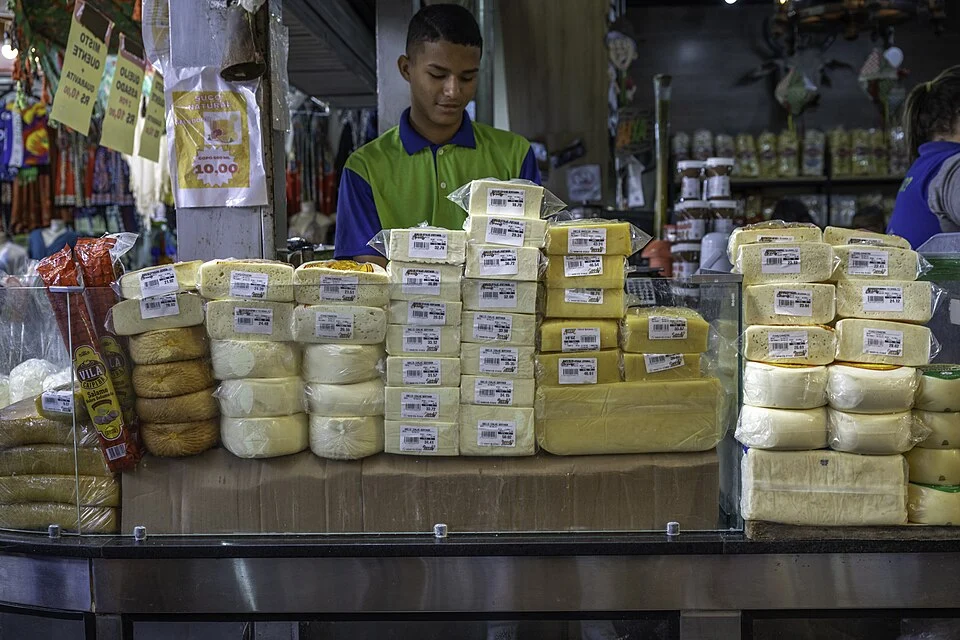
The queijo de manteiga placed on the soft banana involves a cheese-making step in which milk is curdled and then heated. Under the Brazilian Ministry of Agriculture’s standard, part of the whey is removed from milk coagulated with acid, the curd is washed with hot water or warmed milk, and that portion is heated and manteiga da terra or manteiga de garrafa is added. It is then shaped and cooled. The standard describes the texture as soft and fatty-feeling, the color as pale straw, and the flavor as mild and close to butter. Because flavor and saltiness vary, changing the amount of cheese in cartola also changes the proportion of milky taste and saltiness relative to the sweetness of the fruit and the sugar.
Manteiga de garrafa, as used here, is a product made mainly of milk fat, and it is also an ingredient added during the processing of the cheese. The butter put into the frying pan in a recipe and the fat added to the milk curd when the cheese is made have different roles in the process. The institute’s recipe specifies butter as the frying fat and lists queijo de manteiga separately as an ingredient. Once this distinction is clear, one avoids misreading the word manteiga in the name as meaning that ordinary cheese is spread heavily with butter.
The same standard also includes queijo de coalho. This is a cheese in which milk is set by rennet or similar coagulating enzymes, and the standard gives it a medium firmness and elasticity. The institute notes that some people use this cheese for cartola, and the Fundação Joaquim Nabuco’s account of Pernambuco cooking includes both cheeses in its range of examples. Whichever is chosen, the form of banana topped with warm cheese remains, but the dairy product’s production method and elasticity are not the same.
This dessert has no step of chilling to set or resting for the flavors to meld, so the time from cooking to serving also bears on the texture. Serving the hot cheese immediately in Leite’s version is probably meant to keep on the plate the warmth of the two separately cooked components. The flavor of the cheese, and sometimes its saltiness, joins the sweet cooked banana, and the scent of cinnamon rises from the top. Even in this brief finish of simply stacking three layers, the ripeness of the fruit, the thickness of the cheese, the grains of sugar and the interval before serving change the impression of the plate.
The Sugar Estate Story and State Cultural Heritage
Legislator Pedro Eurico, who introduced the bill, put forward the theory that this dessert originated in the kitchen attached to the main house of an estate that produced sugar, and explained that the ingredients and techniques of Portuguese settlers, Indigenous peoples and enslaved Africans overlapped in it. In the same legislative article, the food culture researcher Letícia Cavalcanti, while describing it as a recipe originating in Pernambuco, said that where and when it was first made cannot be determined. The explanation that ties it to the estates is a source showing how the legislator positioned the food culture.
State Law No. 13,751 of 24 April 2009 recognizes cartola as intangible cultural heritage of Pernambuco. In an article issued by the state legislature in August of the same year, the decision was reported together with two of the state’s sweets, bolo de rolo and bolo Souza Leão. Although the three items appear in the same article, they differ in form: a rolled cake, a baked cake, and a banana dessert assembled on the plate. The date and the object of the recognition can be verified from the wording of the law and the legislative article, and the dish’s ingredients and detailed method can be supplemented from the bill’s statement of reasons and the restaurant recipes.
In Portuguese, cartola means a top hat, a hat with a tall cylindrical crown. In the legislative article, Eurico says that the name was probably given because the height of the cheese on the banana and the dark color of the cinnamon on the surface suggest a hat. Looking at versions that place a cohesive piece of cheese on top, rather than merely scattering thin baked cheese, one can imagine an explanation tied to appearance. Even when it was spoken in the legislature, the origin of the name was presented as conjecture, and no source naming the person who coined it or when was cited.
From a Recife Restaurant to a Highland Town in the Northeast
Regarding Leite in Recife, the institute introduces it as a restaurant that opened in 1882 and makes this dish. The bill’s statement of reasons also mentions Leite’s dish, conveying, as an account from the owner at the time, that although the kinds of ingredients are few, getting the quantities right is difficult. The restaurant’s opening year and the appearance of its cartola in a 2009 document are separate dates. Rather than treating the document as showing the menu at opening, one can read it as an example, from the Recife of the period when the legislature treated the dish as heritage, in which the dish was spoken of in connection with a specific restaurant.
A survey by the State University of Ceará found cartola at eating places in Guaramiranga, a highland town in that state. Conducted in March 2019, it examined the menus of seven establishments and also interviewed people connected with them. It records versions in which banana fried in butter is combined with queijo de coalho and sprinkled with sugar and cinnamon. What these share with Leite’s version in Pernambuco is that banana, cheese and flavored sugar are stacked on the same plate. The cheese varies among the surveyed examples, which shows that a dish known by this name also existed in another northeastern state.
Some of the surveyed establishments also added sweetened condensed milk, and the people interviewed thought customers preferred it that way. When condensed milk is added to a dish finished with dry sugar, it does not merely add sweetness; a viscous liquid touches the browned surfaces, so the mouthfeel changes as well. This is a practice confirmed in some establishments in the surveyed town. Because the account of Pernambuco also includes a version using coalho, comparing the cheese each establishment actually used and whether it added condensed milk makes the differences clearer than drawing a state-by-state line based on a single cheese.
Glossary
- Banana-prata (Prata banana)
- The banana variety used in the bill’s statement of reasons and in the recipes of Leite and Instituto Brasil a Gosto. Ripe fruit is used.
- Queijo de manteiga
- A soft Brazilian cheese made by heating curdled milk and adding milk fat. Used in the Recife version described in the main text.
- Queijo de coalho
- A Brazilian cheese set with rennet or similar coagulating enzymes. In the main text it appears in the account of Pernambuco cooking and in the Ceará survey.
- Manteiga de garrafa
- A product made mainly of milk fat. It is also an ingredient of queijo de manteiga.
- Engenho
- Here, a colonial-era estate and facility that produced sugar. It appears in the legislative account of the dish’s origins.


