


SweetloreEncyclopedia of World Sweets (834)

Cuscuz de Tapioca
Cuscuz de tapioca
Granulated tapioca soaked in coconut milk, then chilled and cut
Desserts / Brazil

Take a white slice into your mouth and what lingers is the scent of coconut and tapioca granules swollen with liquid. Cuscuz de tapioca is a Brazilian sweet made from cassava starch that has been processed into granules, then rehydrated with coconut milk or another liquid and pressed together. In Bahia, one method rehydrates the granules briefly in a white liquid strained from coconut flesh. In Itaguaí, in the state of Rio de Janeiro, another uses milk and boiling water and then chills the mixture in a mold. Two steps, how the granules are processed and what liquid they absorb, change the texture of the same white sweet.
From White Granules to the Liquid They Absorb
Before the sweet is shaped, starch extracted and refined from cassava roots is made into white granules. Research by Embrapa, the Brazilian Agricultural Research Corporation, documents the materials and the process. In one example of processing surveyed in the state of Pará, the starch is formed into small round grains and heated until they puff into white granules. The heating done when the granules are made is separate from the step in which they are rehydrated to make the sweet. Even when a recipe gives no oven or steamer instructions, the granules themselves have already been heated during manufacture.
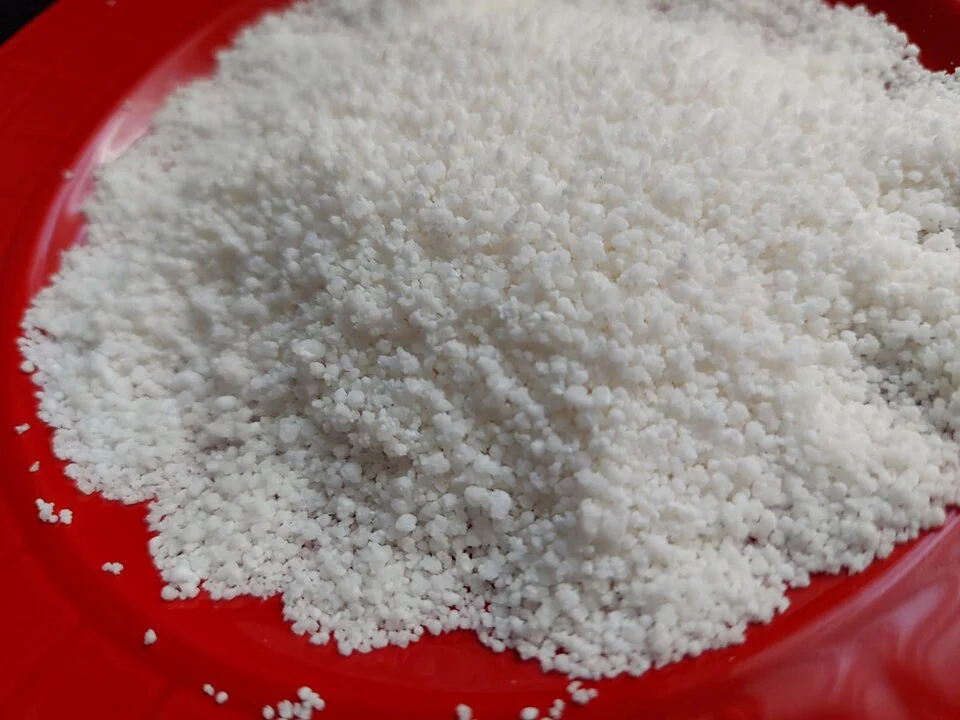
A study of granules from Pará reports that, in the Santa Isabel sample, the starch on the surface of the granules gelatinized with heating. In the Santarém sample, which was puffed directly at about 240 °C, mainly the starch nearer the center of the granule gelatinized. This is a study comparing how the raw material is made, and it does not show which of the two granules a Bahian shop used. Unlike starch dissolved directly in a liquid, the granulated tapioca that a recipe specifies is meant to be used as already-formed granules that absorb the liquid.
The version presented on Globo Repórter by Miryan of Bahia uses 500 g of granulated tapioca, one large dried coconut, 200 g of sugar and 500 ml of water, among other ingredients. The coconut flesh is blended with water and strained, and the liquid is poured into a bowl containing sugar and salt. The granules are added little by little and stirred slowly. Once the mixture is even, it is left to stand for about 10 minutes. Unlike recipes that begin by opening a can of milk, this cook’s process includes extracting the liquid from the flesh itself.
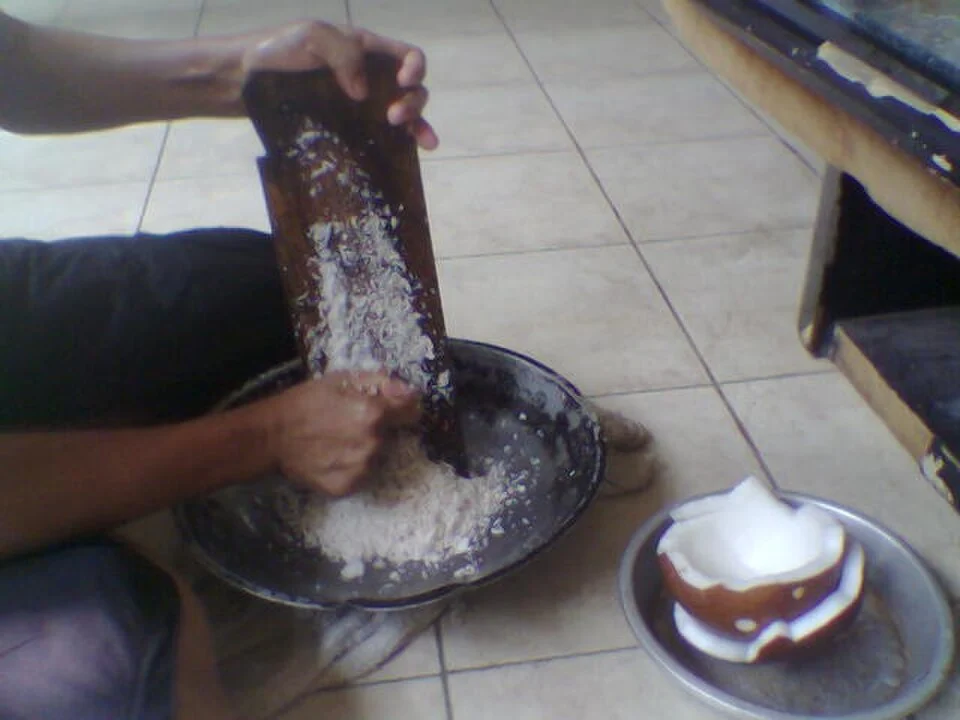
Miryan’s recipe says that some small pieces of flesh can be left in when straining. If only the liquid is used, what mainly reaches the mouth with a spoonful is the mass of water-swollen starch. If flesh is left in, fibrous coconut is mixed in as well. The program explains that refrigeration is not needed if the sweet is eaten right away, and that it can be turned out of the mold into another dish. It does not say that one must wait as long as recipes that call for long chilling.
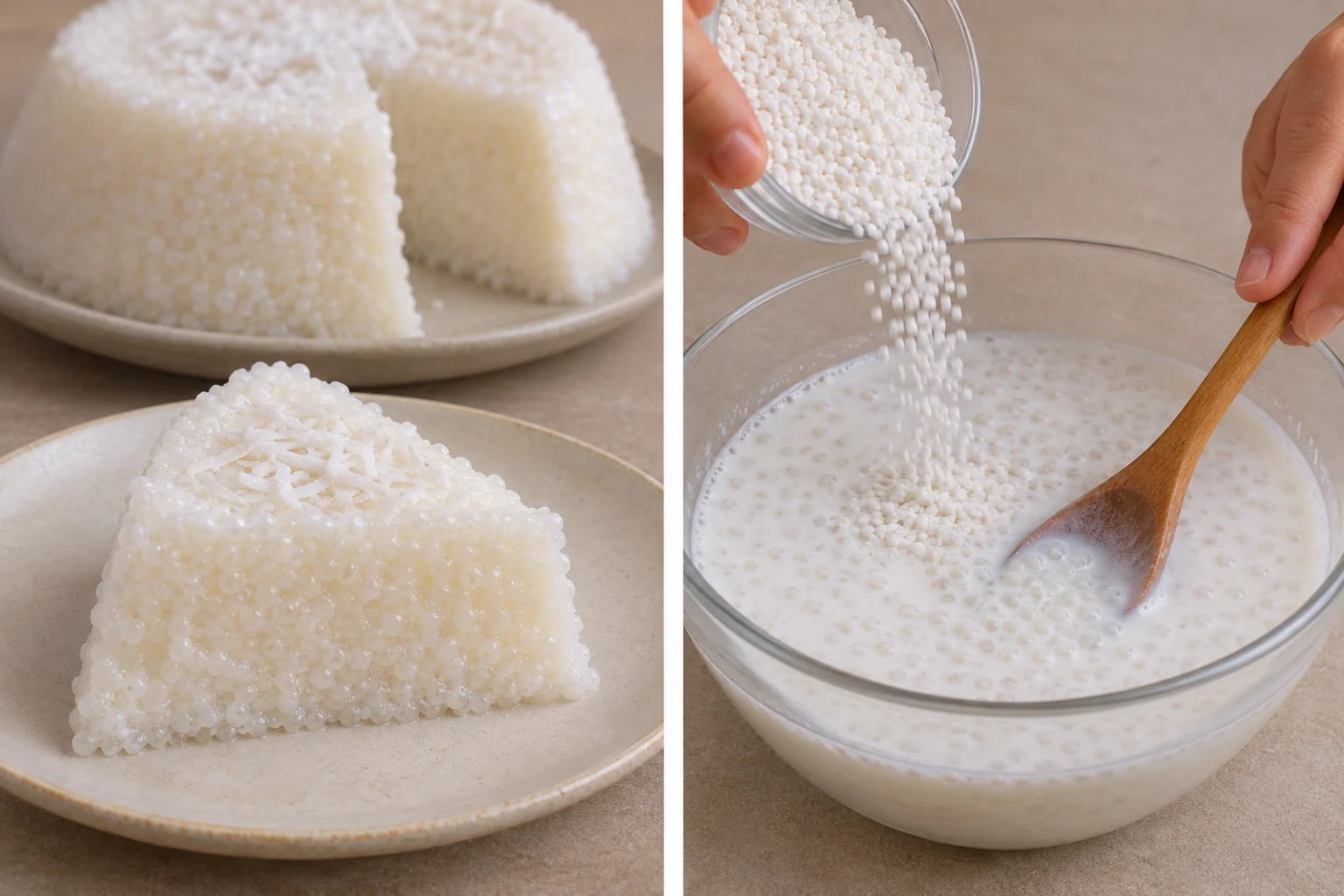
The recipe by Jorge Moreira Filho in a cookbook from the city of Itaguaí, in the state of Rio de Janeiro, combines 1 kg of granulated tapioca with 1 liter of skim milk and coconut milk, then uses about 500 ml of boiling water to bring the mixture to a half-paste state. It uses powdered or drip sweetener instead of sugar and also mixes in grated coconut. The mixture is spread in a mold, covered with a cloth, left for about two hours and then refrigerated for another hour. Compared with the Bahian broadcast recipe, which rehydrates briefly with liquid taken from the flesh, the type of liquid, its temperature and the time before shaping all differ.
In the Itaguaí recipe, the mixture is first poured into the mold and chilled in that shape.
The photograph in the cookbook shows the white sweet cut into pieces, with grated coconut garnishing a cut slice. Mixing everything well before transferring it to the mold is meant to rehydrate the granules as evenly as possible, unlike adding liquid to a mass of which only part has already set. When the granules have absorbed the liquid and set, and the sweet is cut, the white cut surface, with no browning, shows granules and fine bits of flesh.
The recipe that the food site World Food gives as a Bahian dish adds warmed milk to granulated tapioca, uses coconut milk and grated coconut, and is served chilled. Its ingredients differ from those of recipes such as the Itaguaí one, which lists skim milk and sweetener, but the two share the combining of hot liquid with granules and the allowance of time for chilling. Miryan’s broadcast recipe, by contrast, uses no milk and rehydrates briefly with a liquid made by blending coconut flesh and water. Even within the same state, the recipes are not fixed to a single method.
Rehydration takes time because the liquid must reach the center of each granule and soften it, and the mass must then hold together in the dish and become cuttable. Miryan’s recipe assumes the sweet will be eaten right away: once the liquid is added, the mixture is stirred evenly and then rested. In the Itaguaí recipe, the time under the cloth and the time in the refrigerator are separate. Comparing how granules absorb liquid by numbers alone would require the same granule specification, liquid volume and temperature, so the times here are compared as instructions in published recipes.
Cuscuz on the Vendor’s Stand and at the Morning Table
The size of a slice depends not only on the mold used for chilling but also on how much is served at a time when the sweet is sold. In the description of Bahian food in the anthology edited by Câmara Cascudo, puffed tapioca cuscuz is put into small molds and set out on the vendor’s stand. This is an example of making one portion in a mold before sale. Compared with the Itaguaí cookbook, in which a large flat dish is chilled and later cut into squares, the difference lies in whether the shape is decided first or the sweet is cut after it has set. The description shows one of the sweets seen on stands at the time and does not say when the sweet was first made.
A study of food culture that looked at Bahian breakfast tables records cuscuz made from corn, tapioca, carimã and other bases served with coconut milk, alongside warm tubers, fruit, beiju and bread. Besides the version sold slice by slice on a dessert plate, it shows the sweet being set out beside other foods at the table. What distinguishes the several cuscuzes here is not whether the same coconut milk accompanies them but the difference in base: corn or a cassava product.
The anthology edited by Câmara Cascudo also describes cuscuz set out with coffee and porridge on the tabuleiro served in the morning in Bahia. It was sold either carried by vendors or at fixed places such as markets. Compare the small-mold tapioca recipe that appears there with the Itaguaí recipe, in which the sweet is taken out of the refrigerator and cut piece by piece. The same task of preparing a shape before eating turns out to follow different steps at a stand and at home. The size of the mold is also tied to how many people are served and in what way.
A document on the work of the Baianas de acarajé of Bahia, compiled by Brazil’s National Institute of Historic and Artistic Heritage (IPHAN), introduces in its bibliographic commentary a source that lists cuscuz de tapioca as a food connected with Abaluaiê, a deity of Afro-Brazilian religion. The reference there is to its use within ritual. Even though the name is the same as that of the sweet eaten at a stand, this passage alone does not allow us to judge whether the sugar, milk and finishing are the same. The settings in which the name appears and the formulation eaten there can be confirmed separately.
A 1989 Brazilian tourism supplement lists sweet cuscuz as a use of tapioca obtained by processing cassava, alongside biscuits, porridge and doughs made from rehydrated starch. In the Bahia section of the same issue, a version topped with plenty of grated coconut is among the sweets. This introduction conveys the sweet’s name and finish but does not specify the temperature of the granules or the amount of milk. Taken together with the broadcast cook’s method and the Itaguaí cookbook, the older article lets us confirm the link between ingredients, and the later recipes let us confirm the actual order in which the granules are rehydrated.
A Slice Sold at a Festival Market, and a Slice Chilled at Home
A study by the Universidade Federal Fluminense on the São Cristóvão market in the city of Rio de Janeiro includes an interview with Joelma Motte, who makes and sells tapioca. It distinguishes between tapioca, in which moistened starch is cooked in a pan after the order is placed, and cuscuz de mandioca, which is made in advance, wrapped and set out on the counter. The latter, also called white cuscuz, was recorded as a cassava-based dough combined with coconut and salt. Even though the name is close to that of the Itaguaí recipe for a sweet made with granulated tapioca, a record from a place of sale cannot be read as if it were supplemented with milk and sugar formulations.
Motte says that white cuscuz and similar items sell during the São João festivities at the market. Because the same market stall may carry items cooked after the customer arrives and items prepared in advance, the steps before the customer receives the food also differ. For items made ahead and set out, being able to wrap them without losing their shape matters for sale. That the Itaguaí home recipe chills the sweet in a mold so that it can be cut is likewise a different serving form found in the same region.
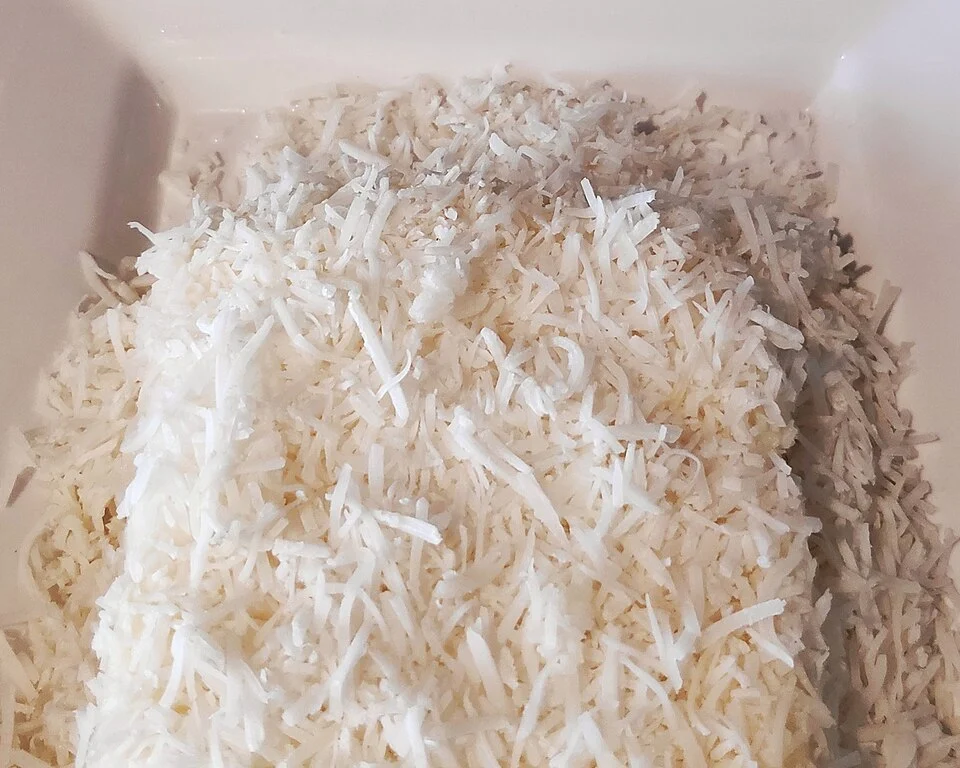
Before serving a white slice, Miryan sometimes prepares coconut milk separately from what went into the preparation and pours it over at the end. The white liquid used to rehydrate the granules and the liquid poured over the surface when the sweet is scooped up and eaten, even if both come from the same coconut, enter at different points. The Itaguaí recipe garnishes the top with grated flesh. In one version, liquid runs into the cut surface; in the other, a fibrous texture different from that of the granules remains on top. The choice of liquid at the preparation stage and what is added at the end change the shape and the mouthfeel of a slice.
The Rio cook Márcia Zoladz presents the cuscuz she saw on the street as a tapioca dough combined with salt and coconut milk, with sweetened condensed milk poured over it when served. Compared with Miryan’s recipe, which adds sugar at the preparation stage, this is a style in which the sweetness of the milk gathers on the surface. When the sweet liquid is poured on last, the sweetness differs between a bite from the top and a bite of the granules alone from below. Zoladz also lists breakfast and the afternoon snack as times to eat it at home.
In Zoladz’s own home recipe, if you want finer granules, you run the food processor briefly twice. Unlike grinding the granules to a powder, this is only enough to leave fine granules. The granules are spread thinly and evenly over the bottom of an aluminum pan measuring about 20 cm by 10 cm. Unlike Miryan’s method of adding granules little by little to the liquid in a bowl, the order here is to pour the liquid over the spread granules. Because they are spread flat, it is easier to make the layer of granules an even thickness from the edge of the pan to the center.
In Zoladz’s recipe, milk and coconut milk are warmed together with grated coconut, sugar and cardamom. The mixture is poured hot into the pan lined with granules, grated lime zest is scattered over it, and the pan is covered. The Itaguaí recipe also has the mold covered and left to rest, but there the granules are rehydrated with boiling water, and grated coconut is also set aside for garnishing the top. The aromatic zest and cardamom that Zoladz adds are the combination written in her recipe. Even though both show ingredients on top, they differ in the aroma transferred to the liquid and in how the aroma perceived just before eating is built up.
Glossary
- Cassava (mandioca, aipim)
- A crop from whose roots starch is extracted. The raw material of tapioca.
- Granulated tapioca (tapioca granulada)
- Cassava starch made into granules. In this article, it is made into a sweet by letting it absorb liquid.
- Coconut milk (leite de coco)
- In the recipes in this article, either the liquid made by blending coconut flesh with water and straining it, or the coconut milk called for in a recipe.
- White cuscuz (cuscuz branco)
- In this article, the name for cassava cuscuz that appears in the interview at a market in the city of Rio de Janeiro.
- Tabuleiro
- A vendor’s stand on which food is set out, or a container in which a sweet is shaped flat. What the word refers to differs by source.


