


SweetloreEncyclopedia of World Sweets (834)

Getuk
Getuk
Mashed cassava as strands, layers and fried sweets
Desserts / Indonesia, Central Java

Fine strands lie side by side, topped with white shredded coconut. This is getuk lindri (gethuk lindri), steamed cassava pressed out into thin strands. In Magelang, Central Java, you also come across boxed getuk made of layers of pink, white and brown dough. Farther west, in Sokaraja in Banyumas, there is a bite-sized fried getuk in a brown coating. Getuk (also spelled gethuk) is a Javanese sweet made by mashing a cooked tuber and sweetening it, and everything from its texture to the way it is sold changes depending on what is done after the mashing.
The Streaks Left on the Cut Face, and the Coconut Added at the Table
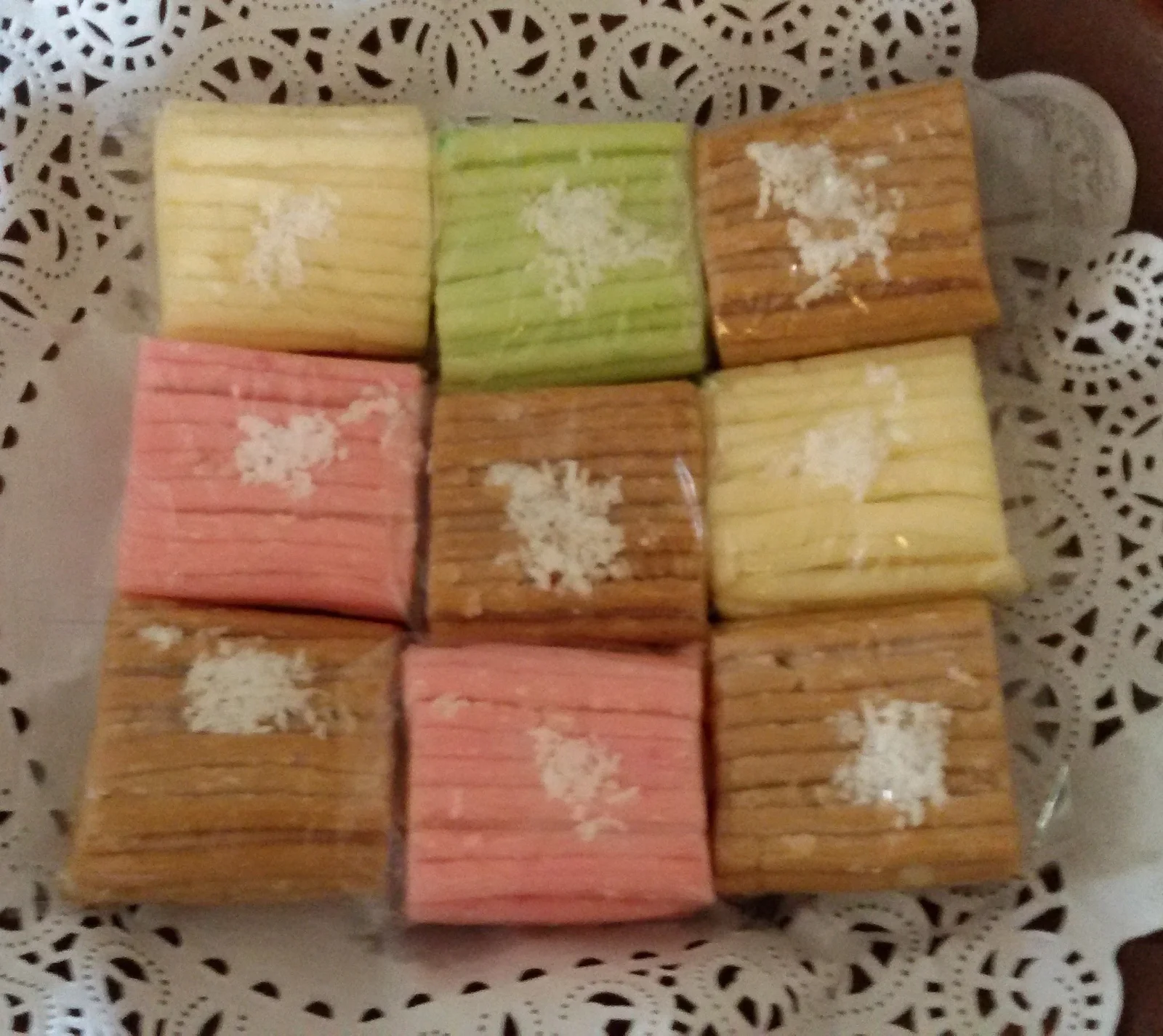
The Yogyakarta illustrated glossary of traditional culinary terms presents lindri as a sweet in which dough drawn out thin like noodles is gathered together and served with shredded coconut. If cassava is simply set in a mold as one mass, only the outside takes the shape of the mold. When it is pushed through narrow holes, each strand that makes up a piece has its own outline. The extruded strands are aligned in one direction before cutting, so seen from above the strands run across the piece, and their cut ends gather at the edge. Brown, green, pink and other colors are examples of coloring applied at the dough stage.
The cassava is peeled before steaming and heated until it is easy to split. In a recipe presented by the food certification body LPPOM, the steamed tuber is opened, the hard core running through its center is removed, and the flesh is finely mashed with sugar and salt. Removing the core from the heated mass leaves fewer long fibers in the extruded strands. Whether the mashed tuber is taken out of the mortar and gathered by hand or moved to a forming machine, the choice of which part of the tuber goes into the dough has already been made at this point.
In an entrepreneurship teaching text from the education authority, freshly boiled cassava is pounded with grated Javanese sugar sprinkled over it, and the brown result is called ordinary getuk. Javanese sugar is a brown sugar made by boiling down palm sap. In the lindri of the same text, white sugar, a coloring ingredient and vanilla are added, the mixture is finely ground, and it is passed through a noodle mold. One is a recipe in which brown sugar is worked through the whole tuber while it is mashed; the other extrudes finely ground dough. Even when a finished product looks brown, whether the color comes from the sugar added or from a coloring ingredient depends on the method.
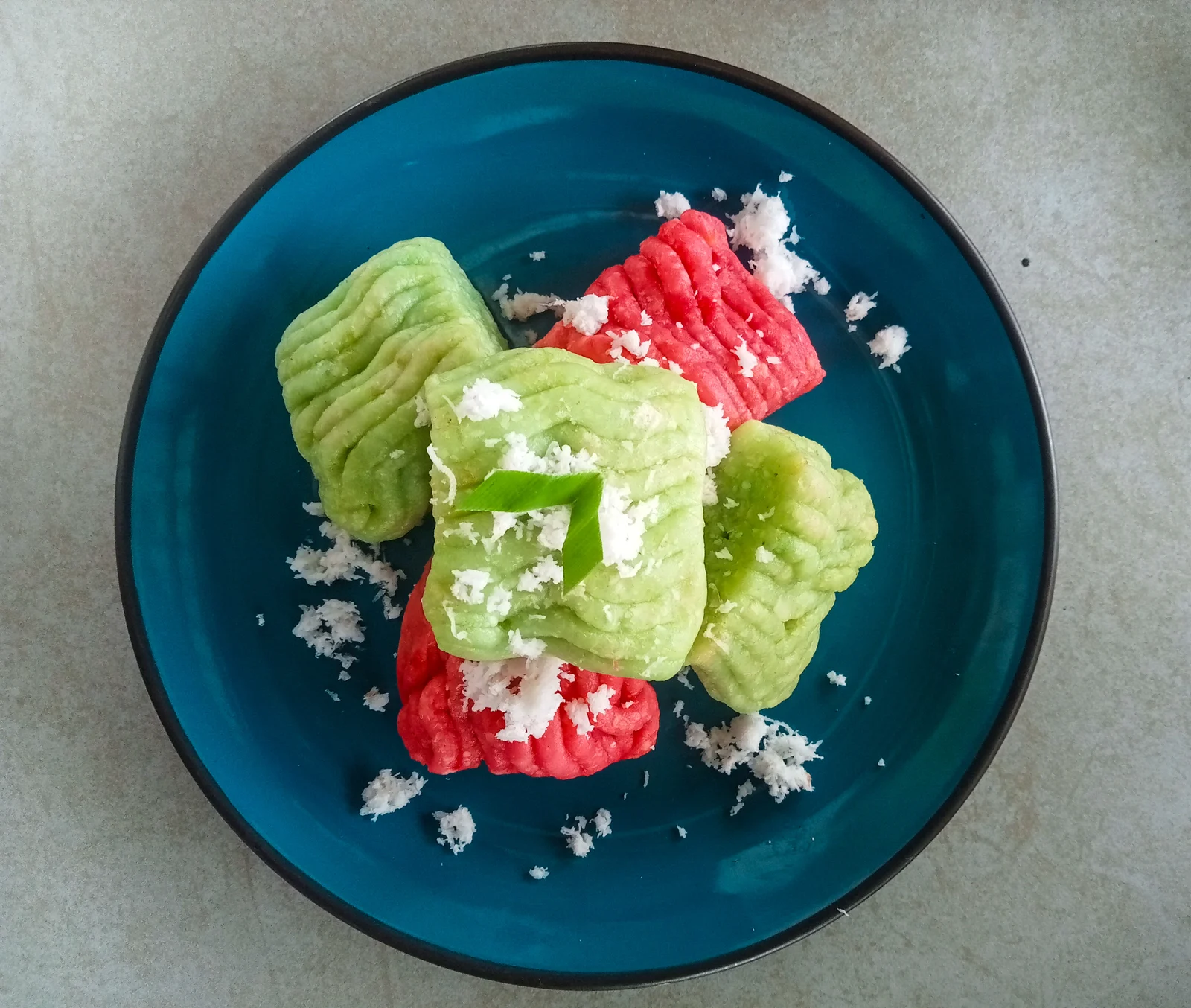
The children’s reader Anak Getuk, published by the Language Agency, has you boil 250 grams of sugar and 150 milliliters of water until thickened, then add vanilla and cocoa. Half of the shredded coconut and the syrup are mixed into 1 kilogram of mashed steamed cassava, which is passed through a meat grinder or a lindri forming machine and cut into pieces about 5 centimeters long. Salt is added to the remaining coconut, which is served on the outside. Some recipes add dry sugar, as in the teaching text; others work boiled syrup into the mashed tuber and leave coconut inside as well. The coconut served alongside on the plate gives the mouth, right away, a texture different from that of the dough.
How Magelang Layers Three Colors and Packs Them into Boxes
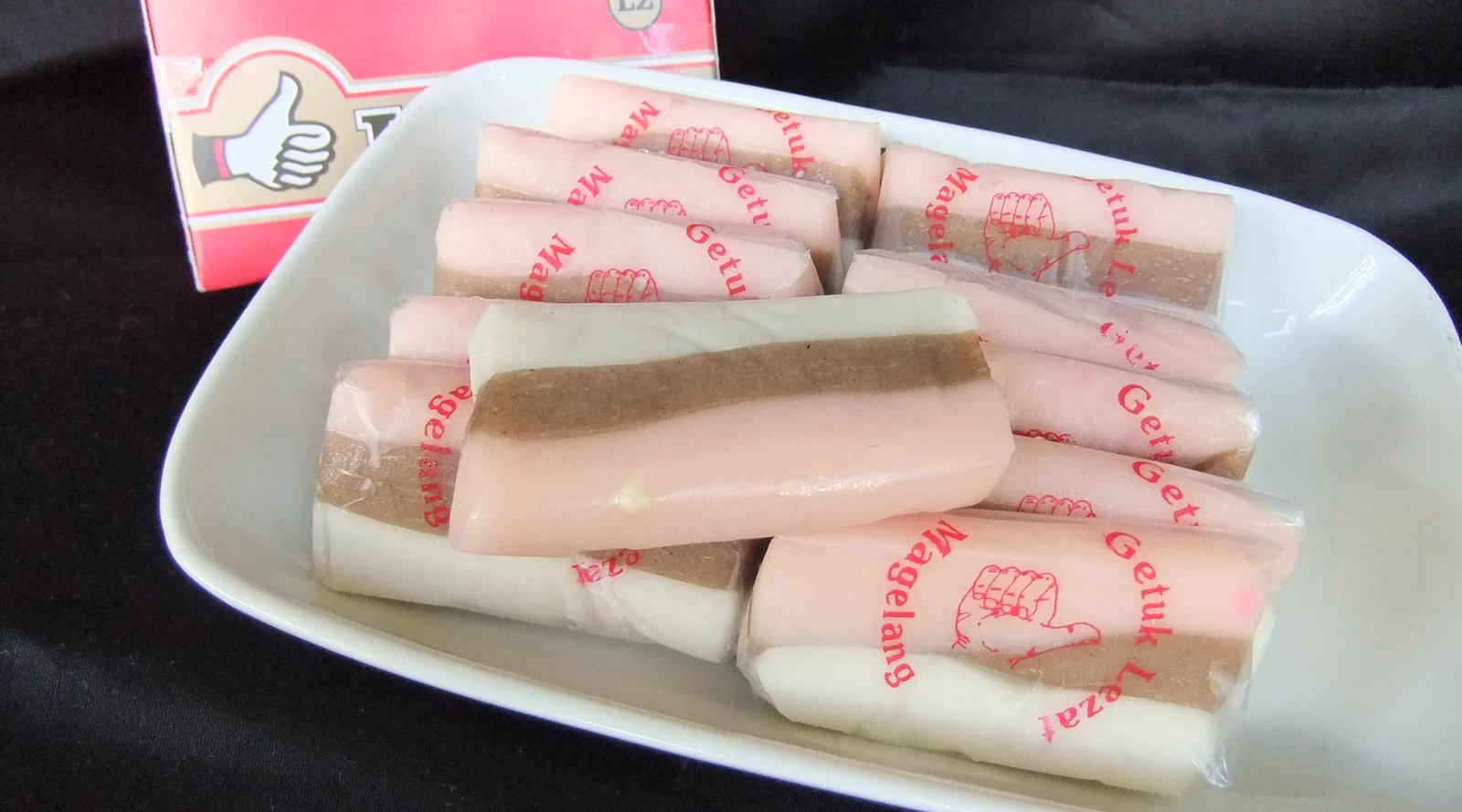
In the boxed three-color getuk, bands of color run along the evenly cut side. In an interview, the family behind Magelang’s Getuk Trio described the white as plain, the brown as cocoa and the pink as raspberry-flavored syrup. To make the color differences, the mashed tuber is divided, flavored and colored separately, and then assembled into a single piece. With lindri, strands bundled by color put a piece that is all pink and a piece that is all green side by side on the plate. In a trio, where three bands of color are layered, biting a piece from the side puts different doughs in the same mouthful.
According to Herry Wiyanto, the owner of Trio, his parents began making getuk in 1958. The machine his father built was meant to reduce steamed cassava uniformly fine. The shop’s guide gives 1958; the owner puts the year they began selling under the name "Trio" at 1963 and ties the name to a general store the family ran. By the owner’s account, the tuber was chosen with equal care: kinanti, a variety grown for about 11 to 12 months in sandy clay fields. Before matching the colors, the shop sourced raw material that could be ground equally fine every time, and prepared equipment to handle it.
The Wiyanto family’s story also recalls that in earlier Magelang, a blackish, whetstone-shaped getuk called getuk wungkal was breakfast for market traders and farmers. In the family’s recollection, the idea of Indra Samadana, the father, for a machine to replace the mortar grew out of an effort to make the texture of the tuber finer. In that household, the sweets, divided by color, were wrapped and made into souvenirs that could be carried out of town. This is how the work of coloring and the work of packaging came together in one product.
Getuk Eco, which locals introduce as having begun making three-color getuk in 1976, has records from a different workshop. A 2009 study by Sanata Dharma University describes the sequence: the tubers are peeled and washed, soaked in water, steamed for 30 to 40 minutes, and exposed to the air to release heat. In the thesis’s process diagram, the dough is divided into three, ingredients are added, and it is ground by machine; elsewhere in the text there is also a description of grinding first and then dividing in three. The workshop’s work is to steam the raw material and let the heat escape, divide it and add flavor and color, and shape the finely ground dough.
The shaped pieces are covered with bags for protection and packed 16 to a box for shipment to souvenir shops. At the time of the study, Eco used separate machines for grinding and for shaping, both assembled to suit their purposes. The look of a box comes from the colors of the divided dough, the shape of the pieces made uniform by machine, and the work of wrapping and counting. The study also records an approach of holding down production so that nothing goes unsold at the counter, and making more when orders arrive. To sell a steamed-tuber sweet in a form that can be taken home, the work of deciding how many go to a shop and when is needed alongside the work of preparing the boxes.
Karet and Tawangmangu: Mortar Work That Remains
In Karet, Magelang Regency, there is Gethuk Gondok. The family of Sri Rahayu, who started her own business in 1985, says she had helped with the family trade before going independent. In this household’s method, steamed tuber is pounded in a mortar, the fibers at the center are removed, and the dough is divided by color and put into molds. Separate batches use Javanese sugar, pandan fragrance or added chocolate, so each color has its own flavor. Another maker sold on the street before opening a stall in Rejowinangun Market. It is an example of family work becoming something that can be bought at a market.
Gethuk Take of Tawangmangu is a business that Edy Susanto and Tri Suharsi started in mid-2016. The couple chose jarak towo, a variety that grows well in the area, and as orders grew they began buying from farmers in Ngargoyoso and Jatiyoso as well. In the provincial government’s 2021 report, the tubers were steamed over firewood and pounded by hand in a mortar. Besides the plain version, there are versions made with ginger, brown sugar, jackfruit, durian and cheese. It is a case of keeping the wood-fired steaming and the pounding going while adding ingredients that suit the tuber and sources of supply.
In Sokaraja, the Mashed Dough Goes Back on the Heat
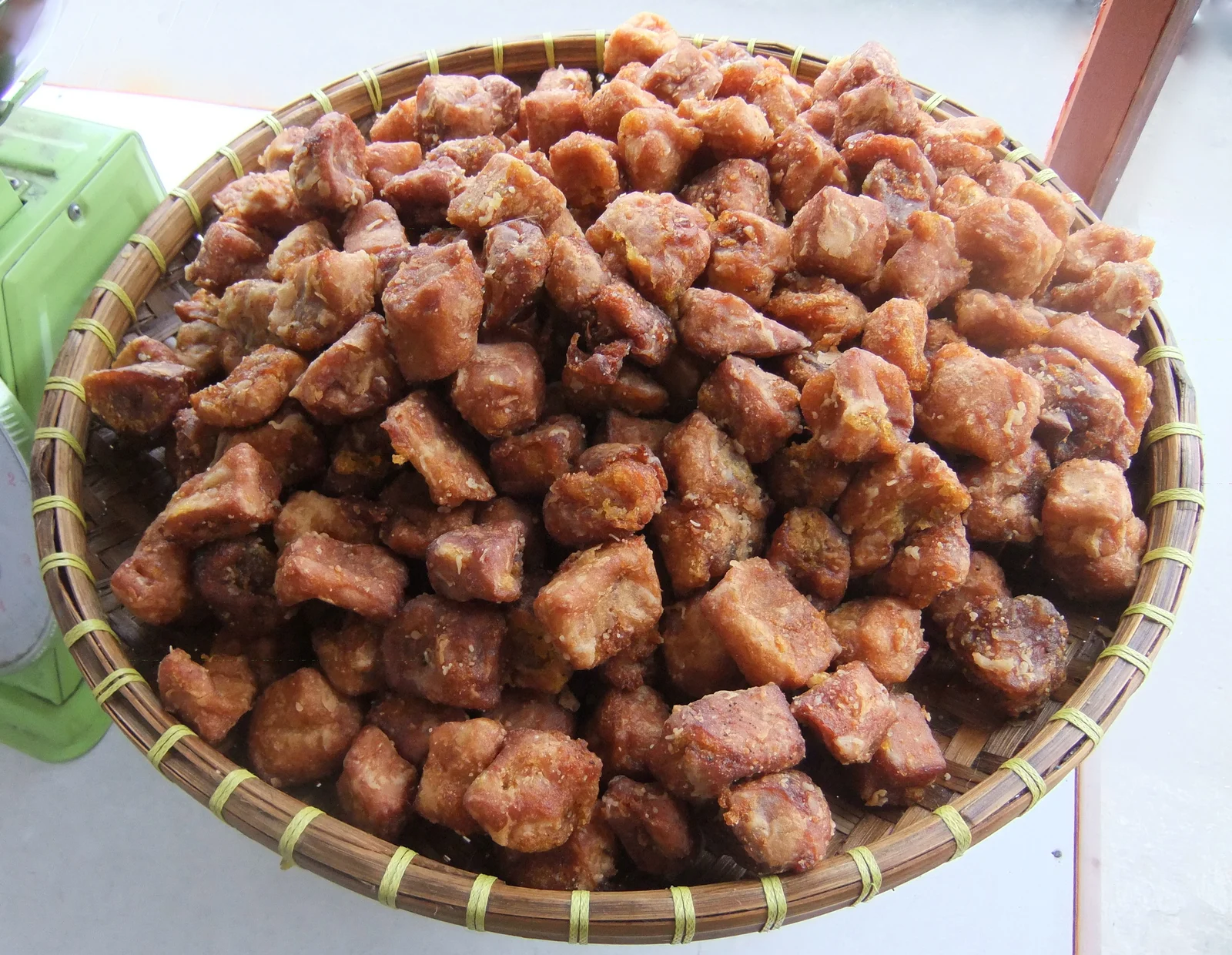
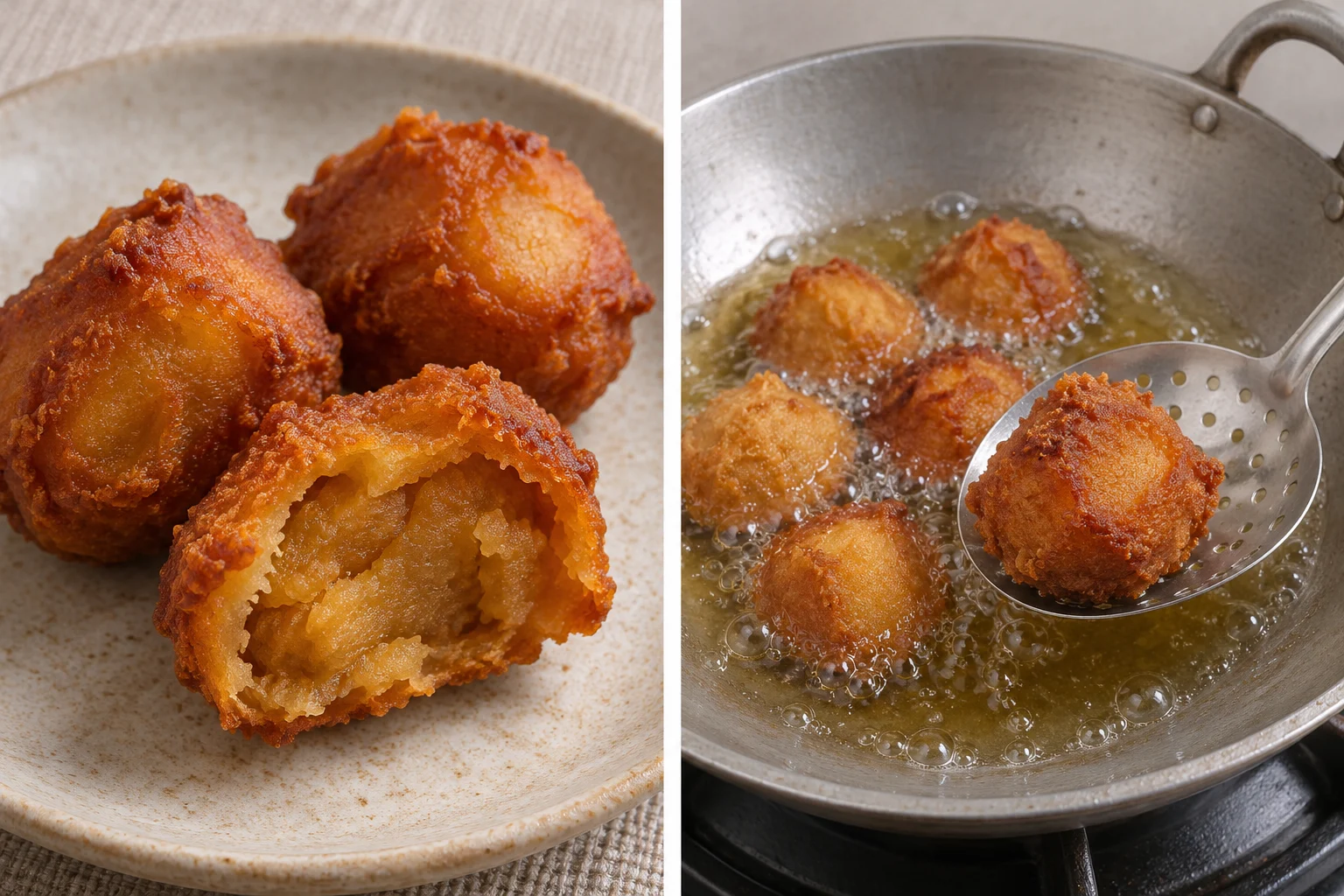
Sokaraja’s getuk goreng (fried getuk) has arenga palm sugar (gula aren) mixed into steamed, mashed cassava. The dough is divided into small portions, coated with flour and fried in hot oil until brown. Broken open, it shows a fried coating enclosing a mass of tuber carrying the sweetness of the palm sugar mixed into the dough. The step of adding flavor and color first stays inside; the step of going into the oil creates the color and crispness of the surface. Just as the strands on the surface of a lindri tell of the tool that pressed them out, the coating of fried getuk bears the mark of being heated a second time after shaping.
A provincial tourism document presents, as dating to 1918, the story that at the shop of Sanpirngad, who sold rice meals, fried leftover getuk was served and customers liked it. According to the national intangible cultural heritage materials, in the town it is told as an event from before the 1920s. The same materials also mention that brothers served rice and side dishes with cassava getuk on the side, and that Sanpirngad sold meals to cart pullers in the morning. In the provincial account, it was first served free at the shop, and after about six years they began charging. His son-in-law Tohilin took over, and the takeaway souvenir of fried sweets packed in besek, a woven bamboo container, also became known. With the added step of coating, a sweet served on a meal plate became something to pick up in a container and carry out of town.
A Piece from the Market, and Sweets Shared in the Square
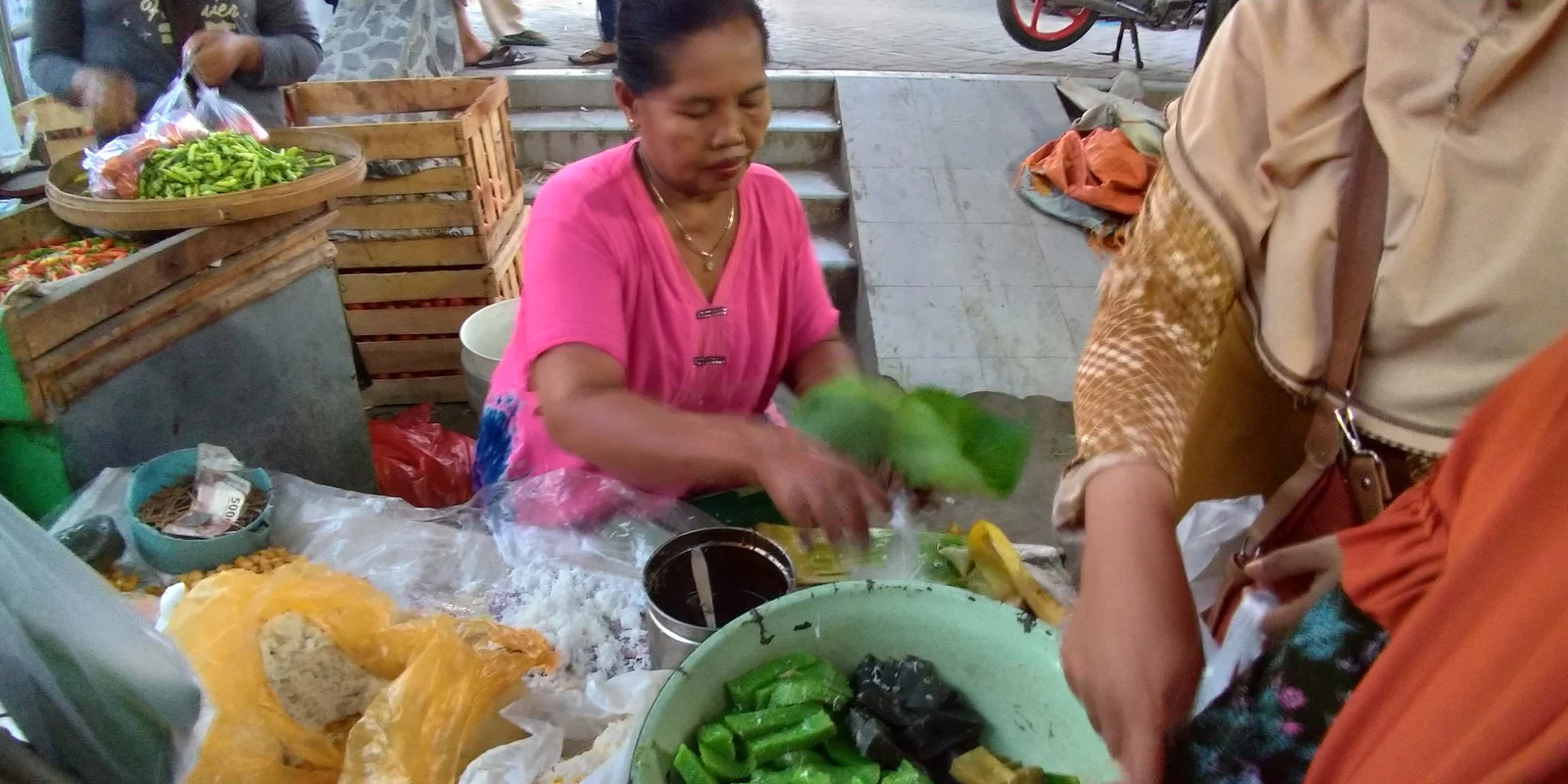
In Magelang’s shops, cut getuk is packed in boxes. At the city’s commemorative event Grebeg Getuk, it is piled into portable mountain shapes in the square. These mounds are called gunungan. In 2024, after a series of performances re-enacting the history of Magelang, the people gathered took the sweets from one large mound of getuk and four small ones. The city also held getuk sales and displays at the same time, and recorded that products from surrounding areas such as Banyumas and Karanganyar were brought together. An event where citizens take from a mound together and a sales area where one picks a piece from each region’s goods came together in the same square.
In the city’s 2025 records, two mounds of getuk were joined by mounds of agricultural produce and other goods brought from 17 districts in the city. The history of Magelang staged in the square and the origin accounts passed down in the families who make and sell the sweets each have records that can be consulted. What the anniversary-event report conveys is how many people in today’s Magelang share this sweet. In a shop’s box, sweets packed to the same weight and size go to each customer; in the square, a piece at a time reaches people’s hands from the same mound.
The Yogyakarta glossary also lists gethuk enthik, which is made with taro. Hear the name of the tuber and you can trace the ingredient; look at a plated piece and you can trace the work that followed. Lindri, where fine strands are gathered, was cut after passing through the holes of a machine. In Magelang’s boxed sweet, where the bands run straight, dough prepared with separate colors and flavors comes together in a single piece. In Sokaraja’s, where a small coating clings to each bite, you taste together the surface that passed through the pot of oil and the interior of tuber mixed with palm sugar.
Glossary
- Singkong
- The Indonesian name for cassava. It is steamed and mashed to make the dough for getuk.
- Gethuk lindri
- Getuk in which mashed cassava is formed into thin strands and gathered together.
- Getuk Eco
- A maker of Magelang’s three-color getuk.
- Getuk Trio
- A Magelang maker and product name known for pink, white and brown getuk.
- Herry Wiyanto
- The owner of Getuk Trio. In interviews he described his parents’ business and the history of its production.
- Kinanti
- A variety of cassava that the owner of Getuk Trio says is used in the product.
- Getuk goreng
- Getuk in which shaped dough is coated with flour and fried. Known as a souvenir of Sokaraja.
- Gula aren
- Sugar derived from the arenga palm. It is mixed into the dough of Sokaraja’s fried getuk.
- Sanpirngad
- The shopkeeper whom the Central Java provincial account names as the person who began selling fried getuk in Sokaraja.
- Besek
- A woven bamboo container. In Sokaraja, fried getuk is packed in it.
- Gethuk Take
- The product name of a getuk made in Tawangmangu.
- Edy Susanto
- One of the makers who started the Gethuk Take business in Tawangmangu.
- Tri Suharsi
- A maker who started the Gethuk Take business together with Edy Susanto.
- Jarak towo
- The variety of cassava used for Gethuk Take.
- Grebeg Getuk
- An event held in Magelang to coincide with the town’s anniversary. Mounds of getuk are shared out in the square.
- Gunungan
- Food and other goods piled into the shape of a mountain. At the Magelang event, getuk and agricultural produce are piled up.
- Gethuk enthik
- Getuk made with taro.
- Gethuk Gondok
- The name of a getuk traditionally made in Karet, Magelang Regency. Some shops are run by families that have passed down the method.


