


SweetloreEncyclopedia of World Sweets (834)

Gooey Butter Cake
Gooey butter cake
A St. Louis butter cake with browned edges and a sticky center
Cakes / United States, St. Louis, Missouri

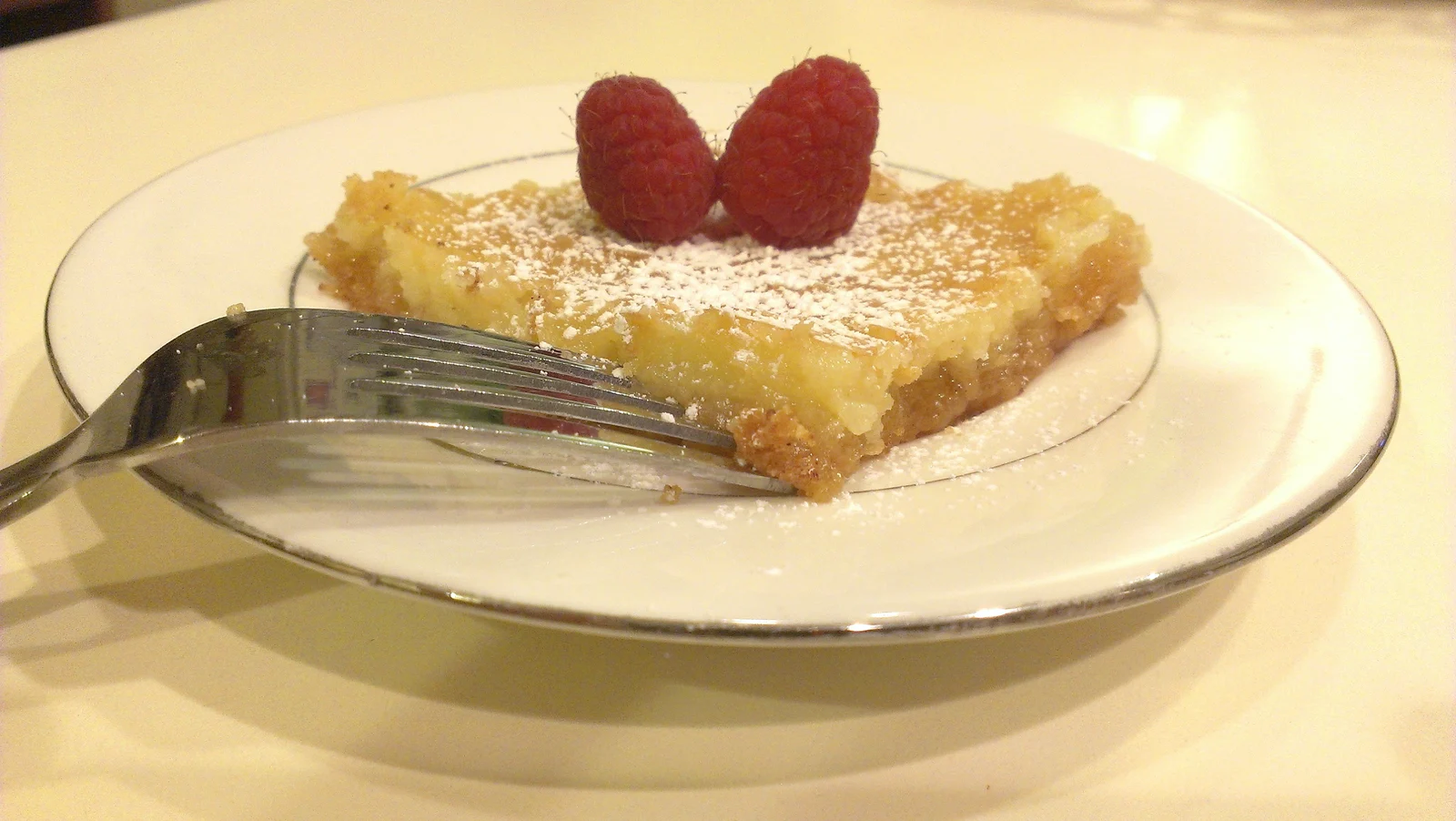
Gooey butter cake is a flat cake made in St. Louis, Missouri, in the United States. A base is pressed into the bottom of a square pan, a topping rich in sugar and butter is poured over it, and the two layers are baked together. In versions made with yeast, the lower layer has a texture close to bread. The topping is taken out of the oven while its edges have browned but the moist center still jiggles, so even after the cake is cut, it stays soft and sticky. In English, "gooey" describes this kind of softness and stickiness, as in the topping.
A Risen Dough Holds the Butter Layer
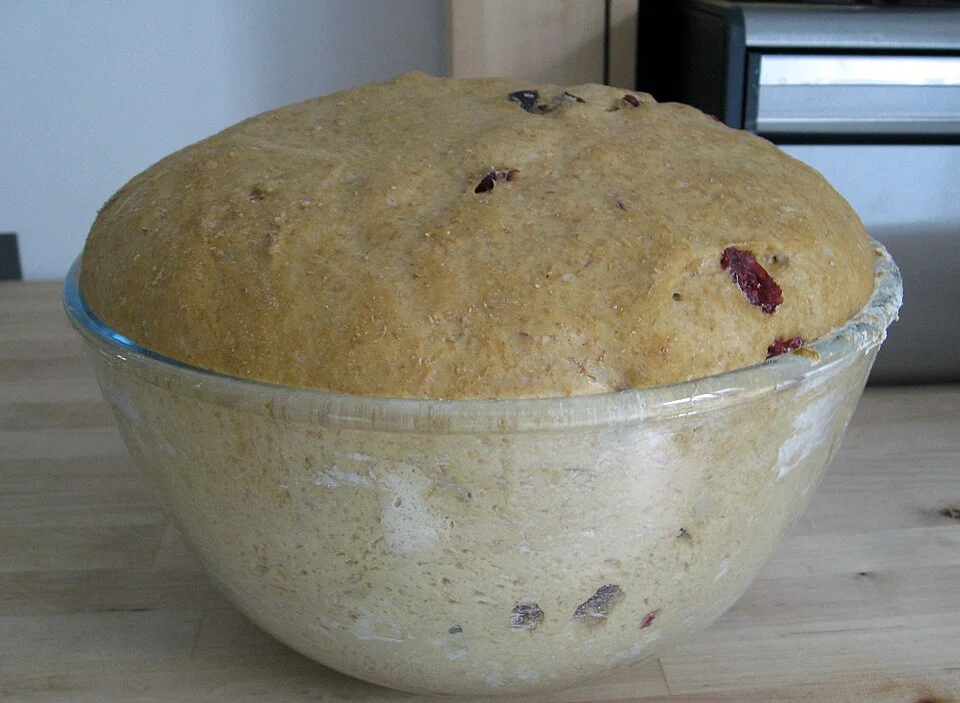
To make a base close to a sweet bread, a dough that is left to rise first and a topping that is poured on afterward are prepared separately. In a recipe published in The Washington Post in 1981, the sugar and shortening for the base are mixed with salt, and then eggs, flour, yeast dissolved in warmed milk, and vanilla are added in turn. The dough is kneaded and left in a warm place for about one hour, then divided in two and pressed into two 9-inch (about 23 cm) square pans. The edge is raised partway up the sides of the pan to keep the topping from running under the dough. The bottom is pricked with a fork to keep the base from puffing up in spots as it bakes and pushing up the upper layer.
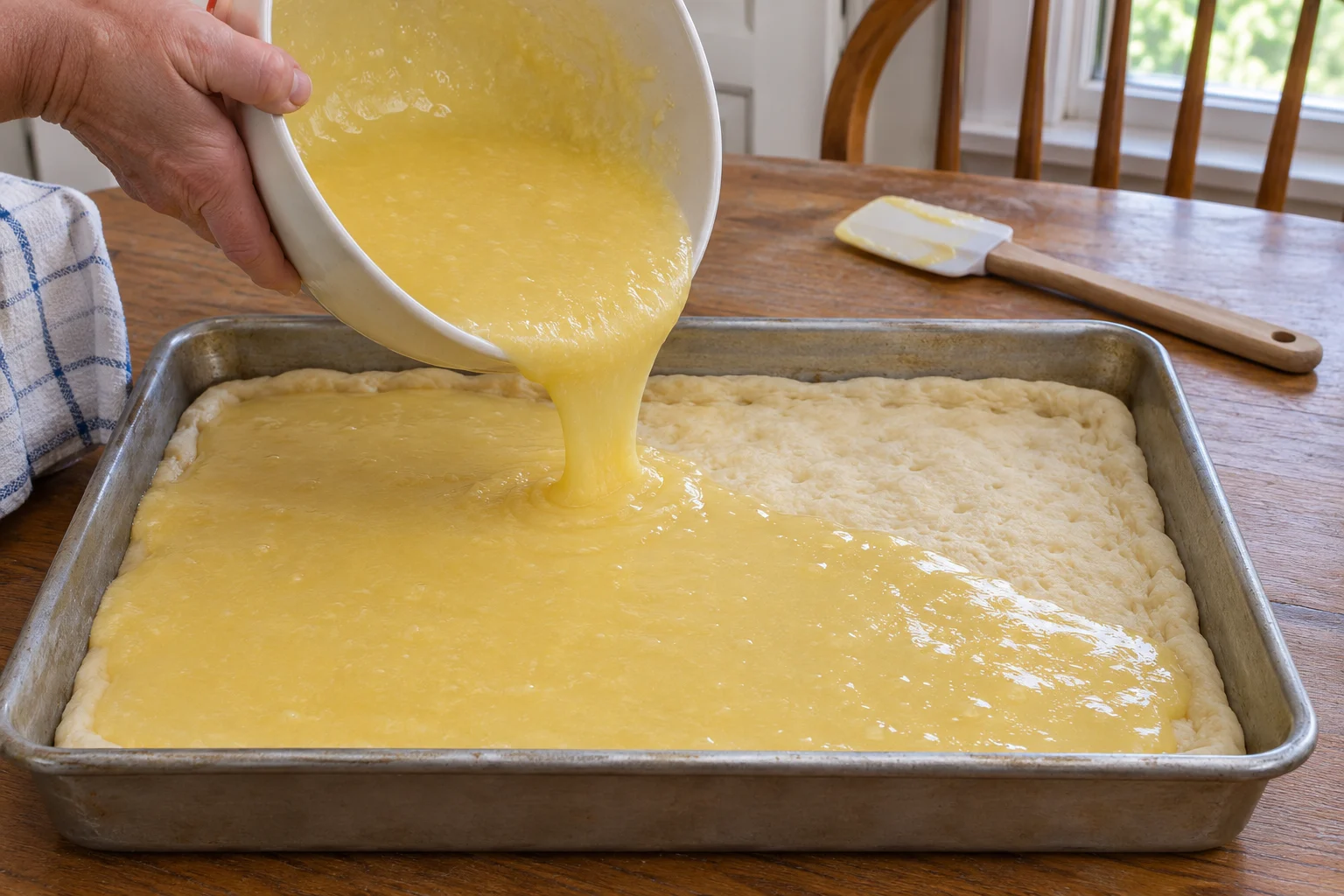
In the same article, the topping is made by mixing sugar and butter, then adding eggs, light corn syrup, flour, water, vanilla, and other ingredients. Although both the base and the topping contain flour, the topping has more sugar and butter relative to the flour, so it does not bake as firm as the base. Corn syrup is a liquid sweetener made from corn starch. After the base is pressed into the pans, the topping is divided equally between the two, left for 20 minutes, and baked at 375°F (about 191°C) for 30 minutes. Alongside the time and temperature, the recipe adds a warning that overbaking makes the topping lose its stickiness.
Joan Niesen, a food journalist who grew up in St. Louis, replaces the shortening in the base with unsalted butter. Once the mixed dough becomes stretchy, she spreads it evenly with a spatula in an ungreased rectangular pan about 23 × 33 cm and about 5 cm deep. Unlike the 1981 method, the thickness of the base is set in the pan before it rises. In her kitchen it takes about 3 hours in a warm place for the volume to nearly double; the guide is that a gentle press of the finger leaves a mark that slowly springs back. For the topping, corn syrup is combined in advance with unsweetened condensed milk and vanilla. Separately, butter, sugar, and eggs are mixed, and flour and a liquid containing the unsweetened condensed milk are added alternately. The result feels thick when scooped with a spatula and flows when tilted, and it is spread over the risen base.
Taken Out When the Edges Have Colored and the Center Still Jiggles
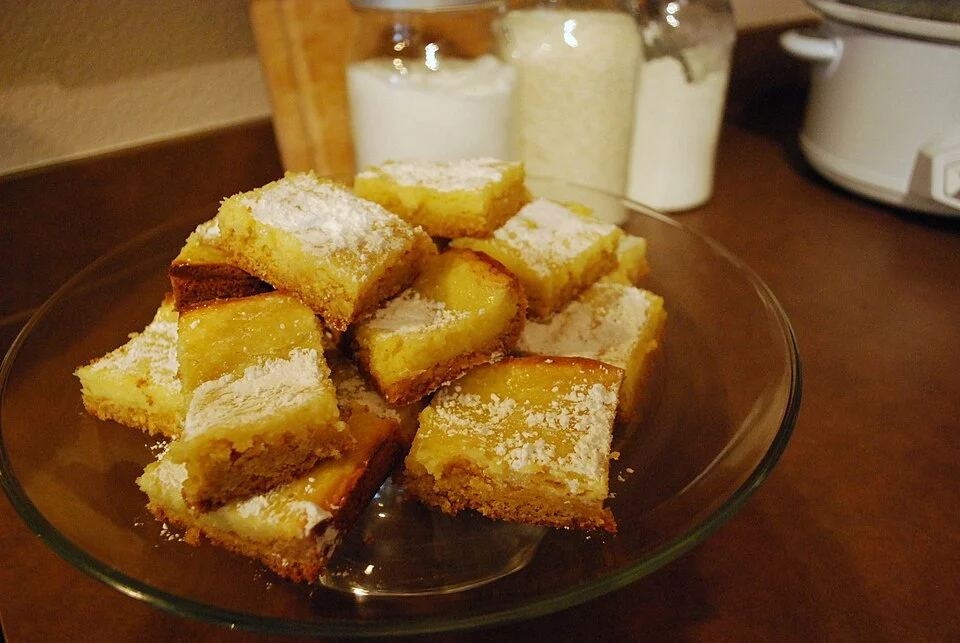
Niesen bakes the cake at 350°F (about 177°C) for 45 to 50 minutes. When the edges are a deep golden brown and the center has taken on a little color but still jiggles, she moves the pan onto a rack and lets it cool completely. The pan dimensions, whether unsweetened condensed milk or water is used, and whether the dough rises before or after it is pressed into the pan all differ, so the two baking times and temperatures are tied to their respective methods. Heat reaches the edges near the pan first, and they brown further. Waiting until the center matches the edges in color and firmness can cost the cake the stickiness that is meant to remain.
As it cools, the cake sinks slightly from how it looked when baked, and Niesen dusts it with powdered sugar and cuts it into small squares. Even within a single cake, a piece that includes the edge has deeply browned parts, while a piece taken from the center gives more of the soft, sticky topping. Unlike a layered cake, in which a thickly baked cake is cut and then spread with cream, layers of different firmness form here when the base and topping bake together in the same pan. Because the base is risen with yeast, the pieces can be served individually even though the topping is soft.
A Two-Layer Cake Made with Home Cake Mix
At home, a method that replaces the yeast-raised base with a store-bought yellow cake mix has also become widespread. Paula Deen mixes one egg and melted butter into the mix and presses it into a rectangular pan. The topping is made by beating cream cheese until smooth and adding two eggs, vanilla, melted butter, and powdered sugar. The same amount of butter goes into the base and the topping, and once the two batters are layered, the surface is smoothed. There is no time spent waiting for the dough to rise, and unlike versions made with corn syrup, the topping gains the tartness of cream cheese.
Deen also uses 350°F but gives 40 to 50 minutes as a guide, taking the cake out while the center is still a little soft. Even with a powdered mix below and a cheese batter above, the cake shares with the yeast-dough versions the quality of keeping baked edges and a soft center in one pan. Niesen grew up eating this cake at St. Louis potlucks, barbecues, and birthdays, and what she remembers is a piece like a square-cut cookie, sweet and dense, with sugar cracks across the surface. A yeast-dough version she came across separately had a lightly sweetened, bread-like base and a honey-colored, creamy topping, clearly separated from each other. Even under the same name, there are versions remembered for their bread-like texture, and there are people who remember a dense piece from a potluck.
A St. Louis Sweet Sold as Coffee Cake
One account says that a baker who baked bread and pastries in south St. Louis in the first half of the 20th century got the proportions wrong and ended up with a cake softer than usual. Gooey Louie, a local business, tells of too much sugar being added in the 1930s. In another interview, the story is linked to Johnny Hoffman of St. Louis Pastries Bakery in the 1940s, and the daughter of John Koppe, the owner of Koppe Bakery, has also given later testimony about a cake her father was making around the same time. The bakery she knew stood at the corner of California Avenue and Arsenal Street in south St. Louis, and people changing buses stopped in. The storyline of a mistake in the recipe leading to something sellable is similar, but the person who made it, the year, and what was mixed up do not agree.
Meanwhile, Niesen’s research reports that in the late 1940s local newspapers ran advertisements under this name. Many sold it at 50 cents a piece, and some were listed as "Gooey Butter Coffee Cake." Coffee cake here means a sweet baked good to go with coffee. The ingredients in the recipe published in 1981 include no coffee, and vanilla goes into both the base and the topping. The name in the advertisements shows how the cake was expected to be eaten in the shops of the time.
In 1981, food editors from newspapers around the country who had come to St. Louis were served this cake alongside dishes such as fried ravioli. Phyllis Richman wrote that she noticed the chewiness when biting into it more strongly than a flowing softness. Because the newspapers also printed the recipe, readers far from the piece served in the city could learn even the point at which to stop baking. Haas Baking, a local company that expanded from baking bread and rolls into supplying frozen products, was also known for this cake. When it closed in 2012, a trade publication named it among the early sellers of the cake in the city. What that record shows is the company’s place among the many shops that have sold it; it does not settle which shop baked the first one.
Butter on a Baking Sheet in Germany, a Soft Layer Poured On in the Eastern United States
Butterkuchen in Germany is a cake in which yeast dough is stretched on a baking sheet, topped with butter and sugar, and baked. In the guidelines of the German Food Code Commission it falls under yeast-dough fine bakery wares; the fat in both the dough and the topping is butter, and the amount, counting the butter in both, is at least 30 kg per 100 kg of cereal products and starch combined. In the St. Louis example of 1981, the base contains shortening, and a topping containing eggs and corn syrup is mixed separately and poured on. The two are alike in layering butter flavor over a yeast-risen dough, but they differ in where the fat is put and how it is applied.
In a recipe published by the German broadcaster SWR, small pieces of butter, sugar mixed with cinnamon, and sliced almonds are scattered over the risen dough on the baking sheet, and liquid cream is poured over after baking. In a spelt version from a baking school in Hanover, a topping of butter and marzipan is spread flat. Even within Germany, the way the topping is applied varies. Combining yeast dough and butter, or lining up similar words, does not allow a single path of transmission to the St. Louis cake to be fixed.
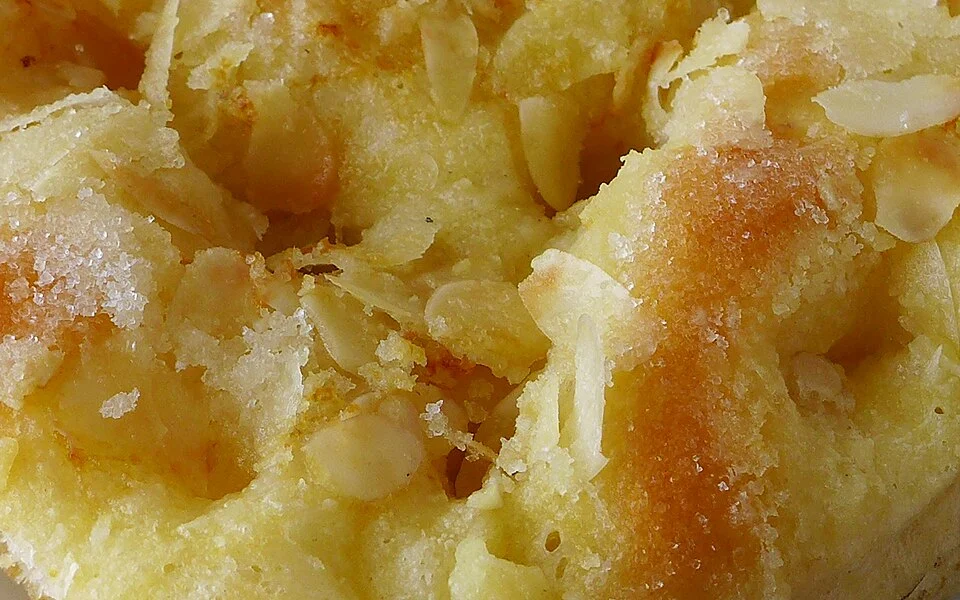
Butter cake also exists around Philadelphia in the eastern United States. Mike Madaio, who visited shops in Newtown Square and Strafford, writes that there was a soft butter topping over a yeast-dough base, with a light browning on the surface. In one shop’s version the center was thick; in the other, both base and topping were thin, and there were also items with fruit. Comparing the two shops shows that even in this eastern American cake, which combines a thin base with a soft butter layer, thickness and fillings differ from shop to shop.
A Cake Cut into Squares, and a Souvenir Eaten with a Spoon
Jackie Huebbe, who runs the soda shop Little O’s in St. Charles, Missouri, says she inherited the recipe of City Bakery, run by her husband’s great-uncle Otto in Union, Missouri, which tops a yeast-dough base with a topping made with corn syrup. The yeast method survives not only in old newspapers; in one case it was passed down to another family business.
For Debbie, who runs Gooey Louie, the cake that her great-grandmother Ann Duffy baked at home whenever she visited St. Louis led her to start the shop. In 2006 the shop took the cake, cut as it was at home, to an event at the Missouri Botanical Garden featuring local products. Besides large cakes, it also makes single servings packed in small containers with a spoon. The soft center layer can be handed over cut into a square on a plate, or scooped from the container to eat. The shop also has versions combining chocolate and hazelnut, and lemon and blueberry.
A cake cut to share at a potluck, a snack eaten with coffee, a small souvenir with a spoon. The amount and the container change with the occasion, but the cake keeps a soft topping. Local shops also sell by delivery, so outside the city there is a way to order a cake the shop has baked. Just as people once learned the recipe from the newspaper and baked it at home, another way remains: preparing the two doughs yourself and putting a St. Louis cake on your own table.
Glossary
- Gooey
- An English word describing a soft, sticky state. For this cake it refers to the texture of the baked butter layer over the base.
- Coffee cake
- A sweet baked good eaten with coffee. The recipe does not necessarily contain coffee.
- Corn syrup
- A liquid sweetener made from corn starch. In yeast-based versions, it is added to the butter batter poured over the base.
- Yellow cake mix
- A baking mix sold in the United States for pale yellow cakes. In home versions, eggs and butter are mixed in and the mixture is pressed into the bottom of the pan.
- Butterkuchen
- A German yeast cake made with butter. In some versions, butter and sugar are placed on dough spread on a baking sheet and baked.


