


SweetloreEncyclopedia of World Sweets (834)

Kue Putu
Kue putu
Palm sugar enclosed in a bamboo tube, sold from door to door with steam
Desserts / Indonesia, including Java

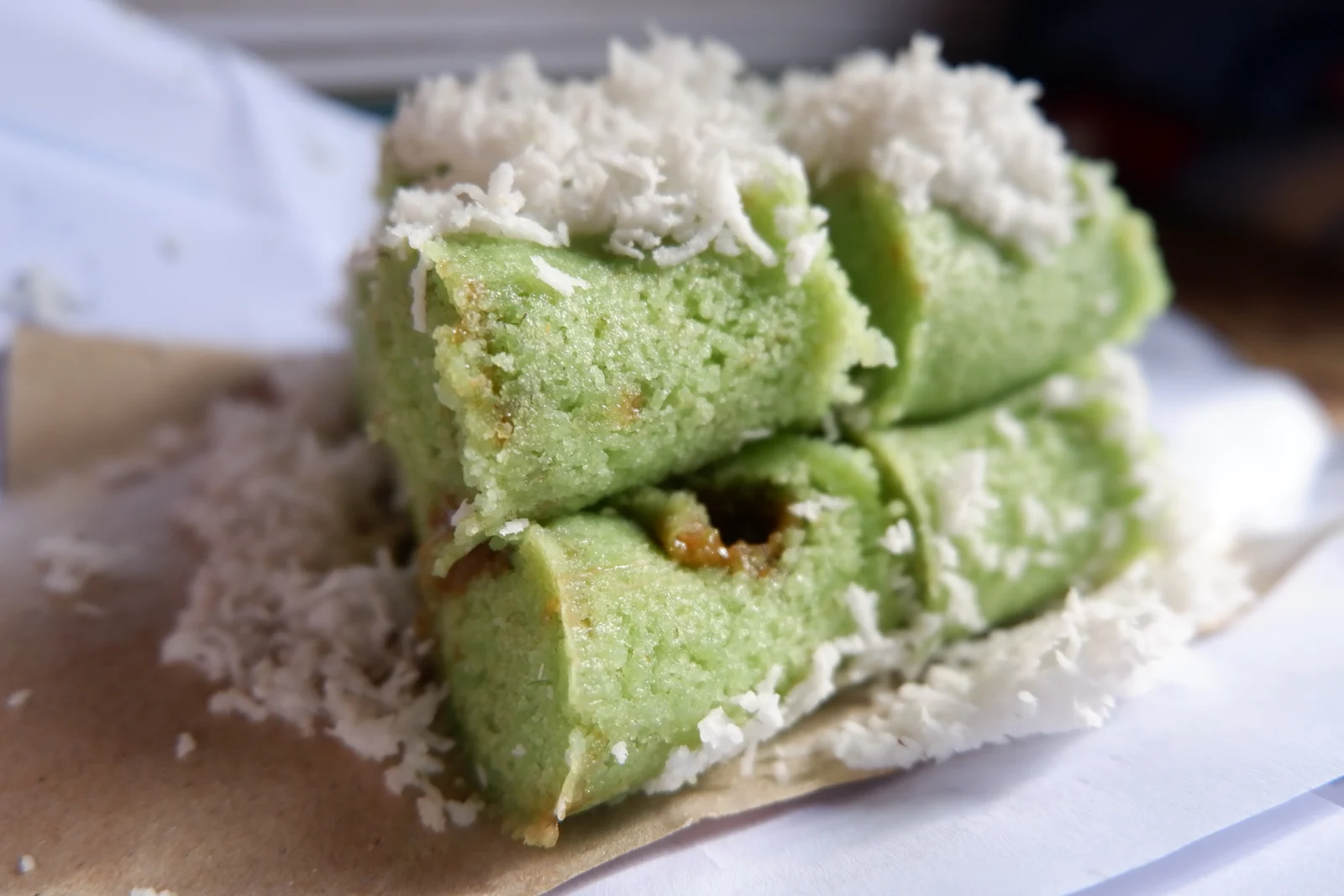
When you break open a kue putu pushed from a slender bamboo tube, melted palm sugar shows between the pale white or green grains of rice flour. The tube is filled with rice flour that has been moistened with water and worked into fine crumbs. Served with grated coconut beside the short steamed cylinder, it combines a crumbly, loose texture with the fibers of the coconut flesh and a moist, sweet core. At mobile stalls in Java, the sound of the cart venting steam, like a whistle, is often heard before the shape made by the bamboo tube is seen.
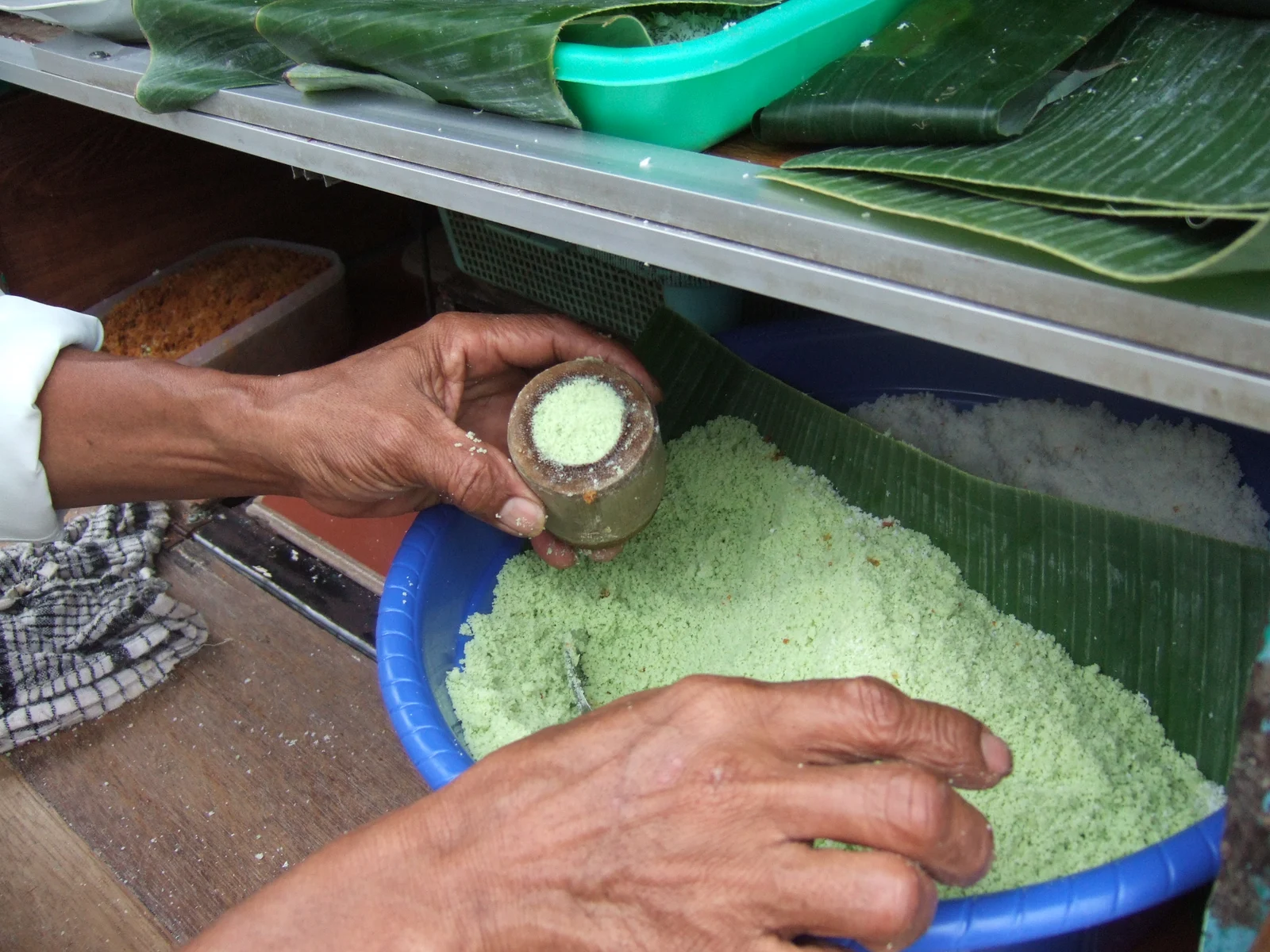
Loosening the Rice Flour and Placing Sugar in the Middle
The rice flour is not fully dissolved in water but moistened a little at a time. In a home recipe published by the General Elections Commission (KPU) of Nduga Regency, 250 g of rice flour is mixed with pandan juice and water until the flour becomes damp, fine crumbs. Separately, 150 g of palm sugar is prepared and shaved fine so that it melts when steamed. The green liquid that colors the surface of the flour is at the same time the water that binds it. Adding more juice changes not only the color but also how the loosened flour holds together when pinched.
In the children’s book from the Language Agency, salt and pandan leaves are boiled, and the warm liquid is added to the rice flour a little at a time, mixed by hand, and passed through a coarse sieve. If the flour is filled in when it does not run on the work surface and holds together lightly when pressed, gaps remain between the grains when hot steam reaches it. If large lumps remain, steam reaches the core and the surface of a lump differently. Adding water, breaking up the mixture again and only then filling the tubes is preparation for getting steam through the whole of a small tube.
The Indonesian Language Agency’s book describes the rice flour used by vendors as coarse grains that have been partly cooked beforehand. A home recipe in the same book calls for 800 g of rice flour and 600 ml of water with six pandan leaves, and gives 300 g of grated coconut, steamed separately, for finishing. The book presents separately a method that lets vendors shorten the steaming time and the home procedure of putting sifted rice flour into the tube.
Fill the bamboo tube with flour to about halfway, place the shaved palm sugar in the middle, cover it with more rice flour from above, and press lightly. When the sugar softens with heat, its brown color passes into the flour around it. If sugar is mixed through all the flour from the start, sweetness reaches every bite from the first. With a core, you first bite into the rice flour and the coconut outside, and only then reach the deep sweetness in the middle. Packing flour above and below the sugar to enclose it, rather than pushing it against the tube wall, helps keep the melted sugar from flowing out. The flour is pressed lightly so that it takes the shape of the tube without being packed too tightly.
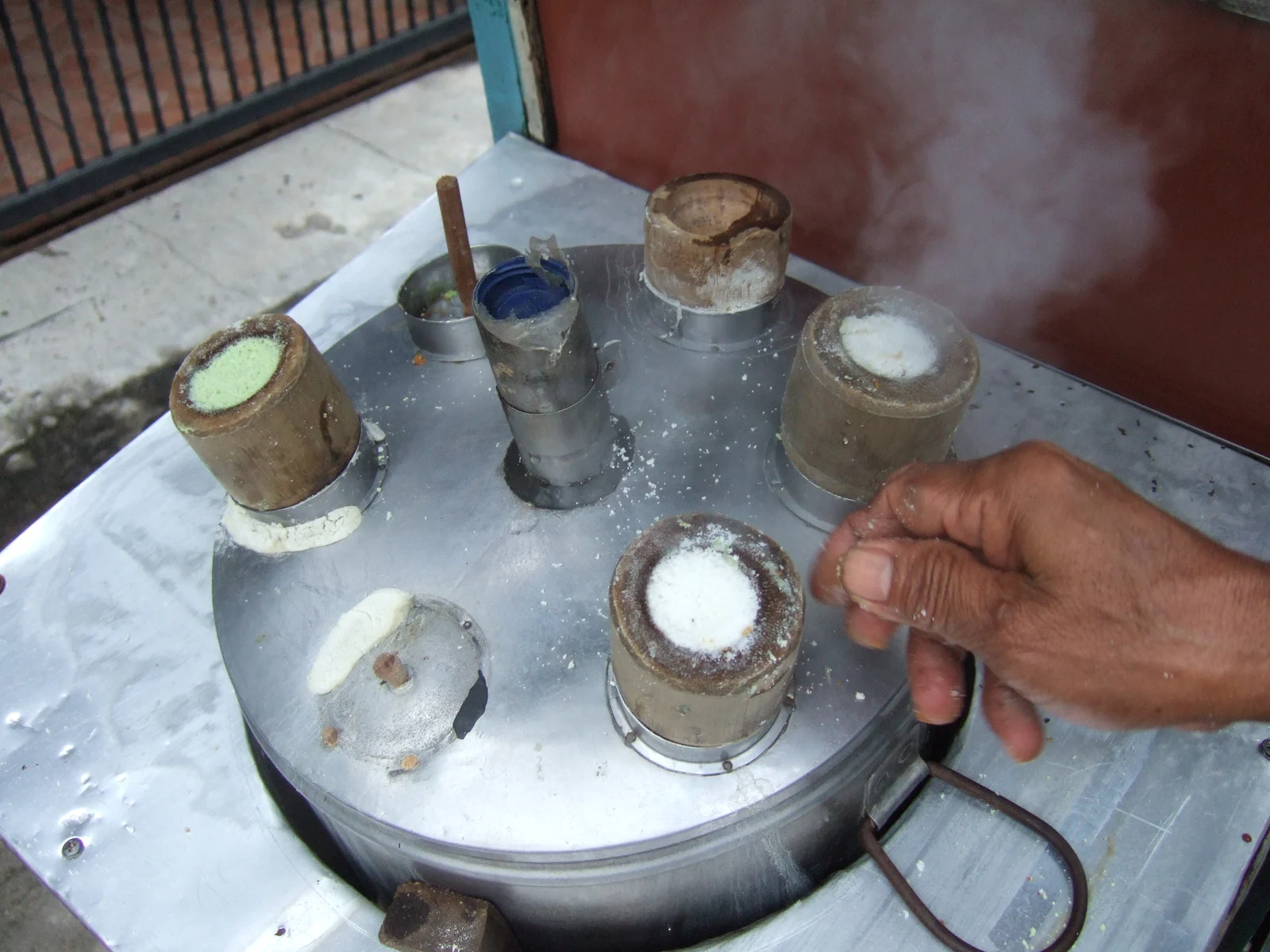
Standing the Bamboo Tubes over the Steam Holes
In the name putu bumbung, bumbung here means the bamboo tube. Using a short-cut tube as the mold, you can push from one end after steaming and release the slender cylinder without breaking it. In the Language Agency’s book, a banana leaf is placed against the bottom of the tube so that the flour does not fall out, and the tube is stood over a hole in the steamer. The water is brought to a boil first, the tubes are then set in the steamer, and steam is passed through from beneath the tubes for about ten minutes. The home method published by Nduga Regency gives about five to seven minutes. These are not the results of two experiments with matched flour, molds and sizes, so the procedures and times can be read as guides for each example.
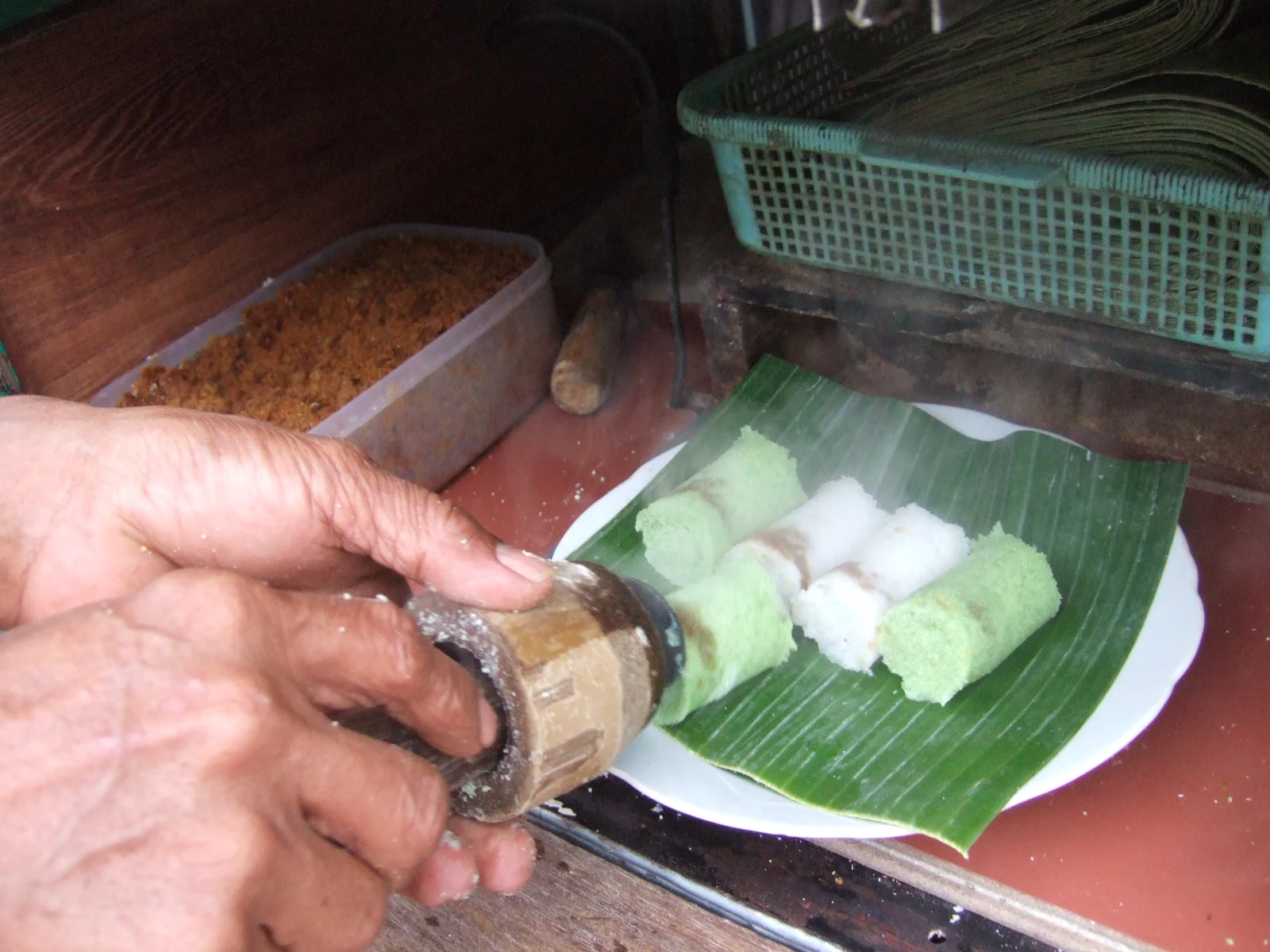
When the steaming is done, the putu is pushed out from the far end of the tube. For the coconut served around the outside, one method steams shaved coconut flesh separately after mixing in a little salt. The result places the saltiness that touches the tongue before chewing, the texture of the coconut flesh and the sweetness of the sugar at the center in different parts of a single cylinder. For households where bamboo tubes are hard to find, the Language Agency’s book also gives a method of wrapping the flour and sugar in banana leaf and steaming it. Changing the implement that holds the sweet changes its outer shape, but steaming moistened flour and pairing it with sweet sugar remain possible.
Hearing the Sound and Calling the Vendor Over
According to the Language Agency’s book, even when no customers are present, the vendor makes a whistle-like sound as hot steam escapes, to announce his presence. The sound comes from the stand where the vendor keeps water boiling while steaming the sweets one batch at a time. The introduction by the Nduga Regency elections commission mentions mobile vendors met at night. The children’s book also covers not only vendors who push carts but also those who carry their equipment on a pole, those who use bicycles or motorcycles, and those who sell from rented spots. A household can steam the same sweet at home, but when the vendor is to be stopped in a lane where people walk, carrying a means of boiling water and being able to make the sound is part of the work.
In Singaraja, on the north coast of Bali, Roni, who comes from Cirebon in West Java, walks the streets selling with his equipment on a carrying pole. When someone calls him over, he sets down his load and makes the order on a small stool. In an interview with the broadcaster RRI in September 2024, he said he had been doing this since 1984. Tasrif, who sells rice flour and palm sugar steamed in bamboo tubes in Baubau on Buton Island, southeast of Sulawesi, also said in a 2025 RRI interview that he had sold in the town for 21 years. Buyers notice him by the sound from the gaps in his steamer, and his sweets come both plain white and lightly colored with pandan.
Roni’s interview also gives a concrete afternoon route from the Banyuasri market to Jalan Kartini. Roni says some customers looked for a vendor carrying his goods on a pole rather than a shop reached by motorcycle. The amount of rice flour Tasrif of Baubau carried around in a day was about seven liters, according to what he said at the time of the interview. The method is the same, calling customers by sound and steaming what sells on the spot, but which roads can be taken and how much material can be carried vary with the means of carrying and with each business.
Yuli Kurniawan, who conducted interviews in Semarang, recorded the account of Paryadi, a vendor in the Banyumanik district. He says that on slopes and narrow lanes, carrying the equipment on a pole makes it easier to get around. The same study reports that Sutrisno, from Wonogiri Regency, began selling in Surabaya in 1972 and in 1982 invited people from his home hamlet to sell in Semarang. The vendors’ group "Putu Burka Mandiri" was formed in 2001, and its dealings continued with stalls at the market where materials were bought that handled coconut, palm sugar and pandan. The work of selling freshly steamed pieces one at a time rests on ingenuity with equipment that fits through lanes and on relationships that secure the same materials every day.
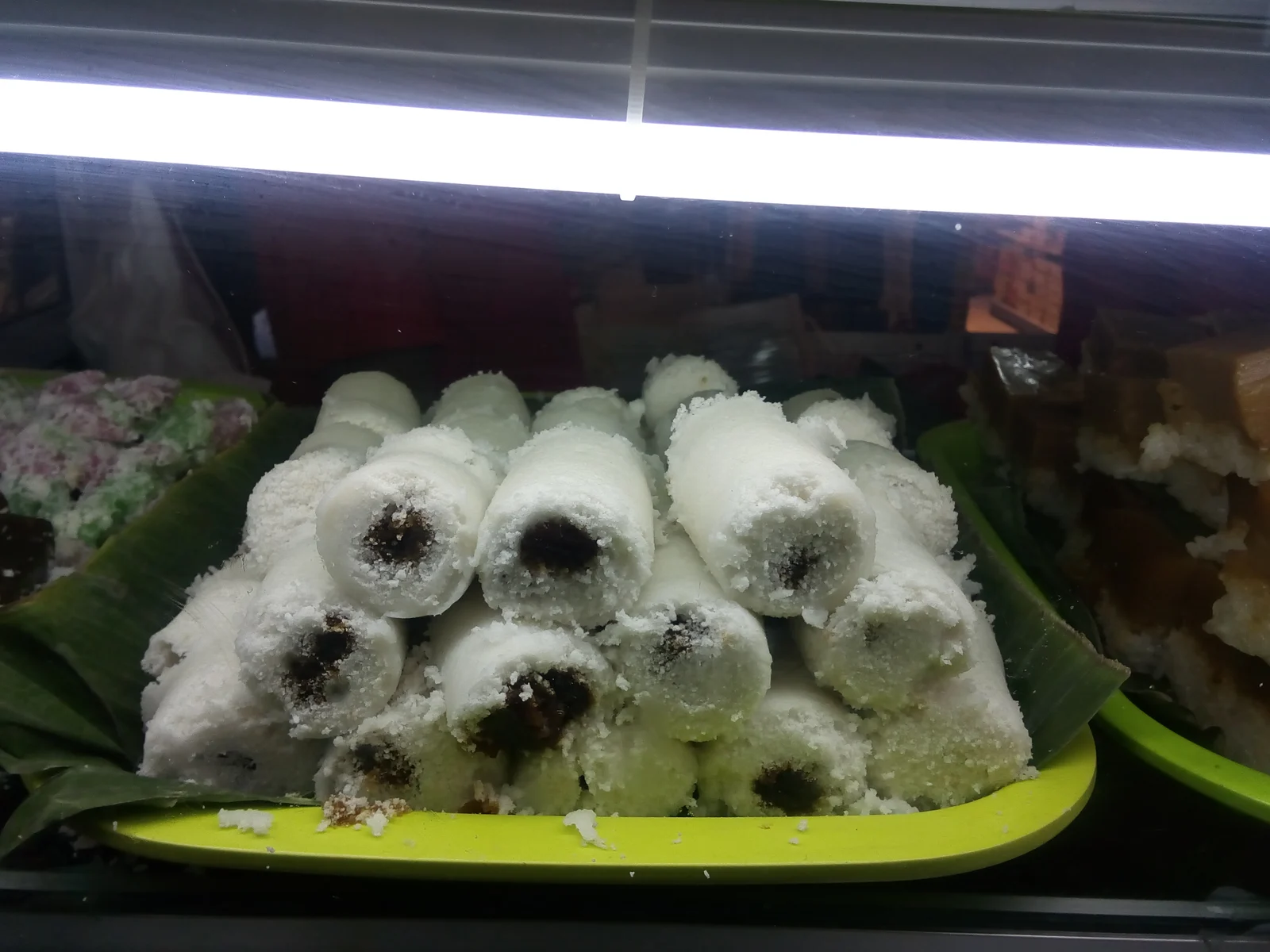
In the Semarang group, there were cases where vendors made their own steamers from square tins and rigid boards even when they could have bought one. If someone does not know how to make one, they make it together and teach, and they also help repair carts. Of the materials bought at the market, the account also records that coconut can be received at the usual stall with the shell already removed, and that pandan is chosen from young leaves for them. The leaves that moisten the rice flour, the stand and steamer, and the bamboo tubes for steaming and serving are all ready before any order is taken.
The same interviews say that customers also had preferences about whether sugar was sprinkled on top or the putu was served on a banana leaf. Some vendors tried fillings of chocolate, cheese, durian and jackfruit, but Sutrisno says many customers chose the traditional version, filled with palm sugar and topped with shaved coconut. Beyond the white and green differences visible at the market, the sugar enclosed within and the coconut served alongside support the flavor customers remember.
Putu Made in a Small Bowl, and the Plate-Shaped Piring
The 2016 reissue of the Indonesian cookbook Mustikarasa (first published 1967) has a formula under the same name, "Kue Putu," using four cups of grated coconut, one cup of glutinous rice flour, half a cup of sugar and salt. The four are mixed together from the start, put in a small bowl or small tube, sprinkled with chopped pandan on top, and steamed in a covered steamer. There is no step of gathering sugar in the middle or serving coconut outside. It is built so that sugar and coconut fibers are in every mouthful, and the aroma of the leaf is transferred from above. Because this formula uses glutinous rice flour, its stickiness can also differ from that of the bamboo-tube version, which binds sifted rice flour grains.
The page in the 2016 reissue instructs the cook to balance the flavors of salt and sugar. Modern home articles also use the same two flavors, but place the saltiness on the coconut side and the sweet sugar in the core of the sweet. Comparing the old small-bowl description, in which chopped leaves are sprinkled on top, with the bamboo-tube method, in which the cooking liquid is absorbed into the flour, shows that the aroma of pandan also differs in where it is placed before steaming. Some vendors make the finished sweet white, so green is not an essential marker for choosing the bamboo-tube version.
A study of the dishes in the Javanese literary work Serat Centhini includes a passage in Volume 12, at Wanamarta, where puthu mayang is set out at a hospitality gathering. It appears alongside jadah, jenang dodol, gembrong and others, and what is given is the name of the sweet. From this record of puthu mayang, it cannot be known when the present-day method of filling rice flour with sugar and steaming it in a bamboo tube began.
In putu piring, as the sweet is called in Singapore, piring means "plate" in Malay. Rice flour is put into a cone-shaped aluminium mold, a spoonful of palm sugar called gula melaka is placed in the center, and it is covered with flour from above. The mold is turned over onto a small plate lined with a thin cloth, covered with a cone-shaped lid, and steamed for a few minutes. The steamed putu is placed on a banana leaf and served with grated coconut. Unlike the cylinder made in a slender bamboo tube, one piece can be held like a flat disc. The Singapore government also distinguishes tutu kueh, which is smaller and uses a peanut or coconut filling.
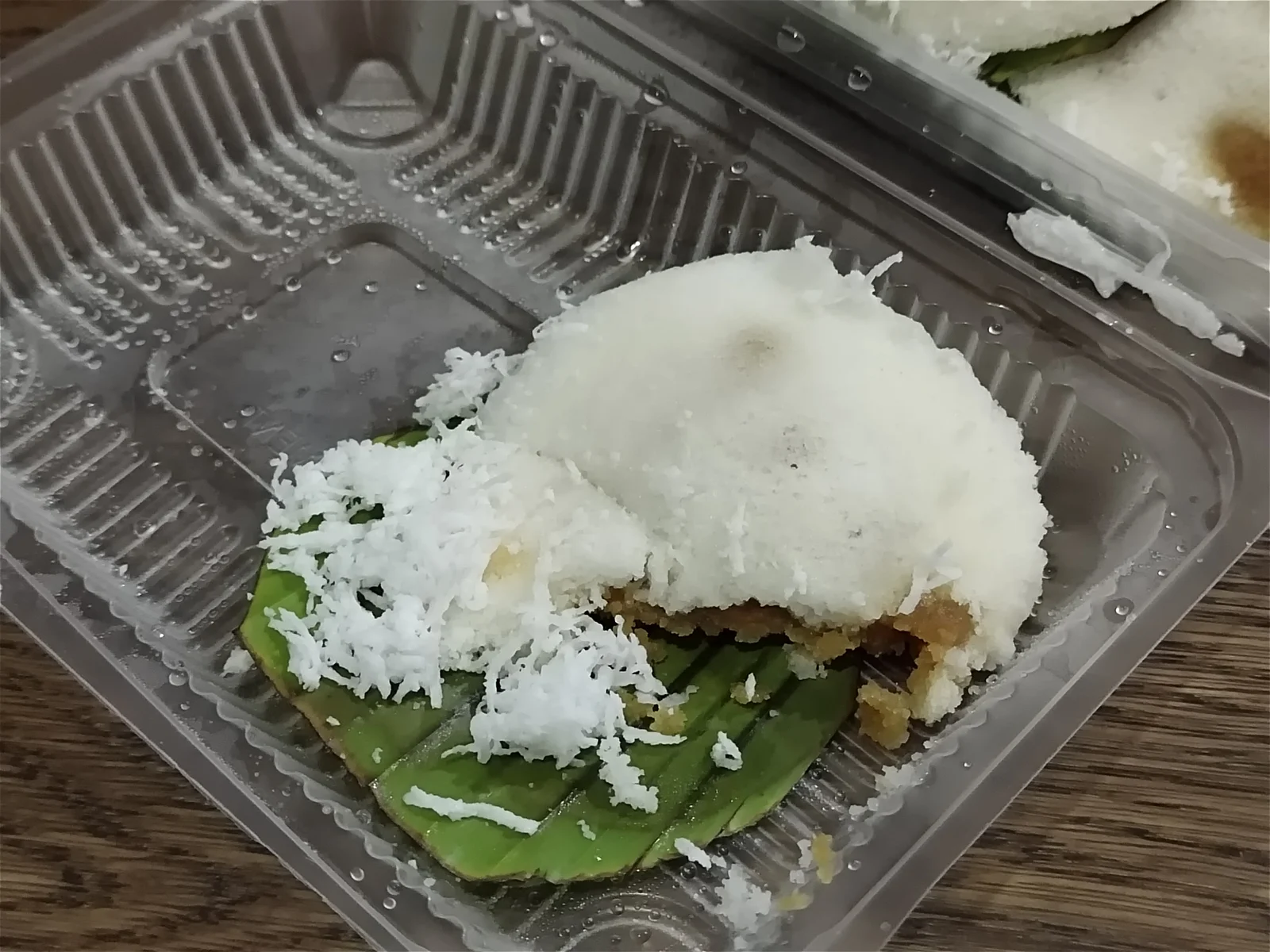
Putu mayang, which appears in the same Singapore guide, is made by pressing rice-flour dough into fine strands, steaming the bundle, and serving it with coconut or sugar. The Singapore National Library’s food-culture journal also has a recollection of buying white mayang, eaten with orange-colored sugar and shaved coconut, from a vendor carrying a basket on his head. The sugar is served alongside the fine strands and is not a core to be taken out by breaking the sweet in the middle. The low plate shape of the piring, the fine strands of the mayang and the cylinder of the bamboo-tube version differ from the place where one picks them up by hand.
The shop on Haig Road introduced by the National Heritage Board is an example of a family and its employees continuing to make piring with gula melaka. According to the Board’s article, the shop’s work began with mobile vending, and it moved to its present Haig Road location in 1994. At the time of the interview, it was using gula melaka ordered from Java. The sweets are alike across the sea in steaming small portions of rice flour and serving them with sugar and coconut. The interview, however, also mentions that some shops try fillings such as durian and chocolate. Vendors in Java also try other fillings, but on Haig Road too the traditional gula melaka version is recorded as selling well. In the cylinder and the plate shape that remain when the sweet is lifted, the tool used to steam it and the way it was released show directly.
Glossary
- Putu bumbung
- The name for putu steamed in a bamboo tube.
- Pandan
- A fragrant leaf. Modern examples use it as a liquid to moisten the flour, and older cookbooks use chopped leaves.
- Palm sugar (gula aren / gula jawa, etc.)
- A brown sugar. In the modern bamboo-tube version, it is finely shaved and placed in the center.
- Putu piring
- A plate-shaped steamed sweet with sugar inside. Singapore’s official guide also distinguishes it from tutu kueh.


