


SweetloreEncyclopedia of World Sweets (834)

Pâté aux prunes
Pâté aux prunes
A whole-plum pastry baked in Anjou in summer
Pies / Anjou, France

Pâté aux prunes is a pastry from Anjou in western France, in which whole round plums are enclosed between a bottom and a top crust and baked. The butter-enriched dough browns in the oven, and steam from the boiling juice inside escapes through a small hole in the lid. When the pastry is cut, the soft fruit and juice that were hidden under the lid come into view. The fruit most often used is the reine-claude (greengage); when the plums are baked with their stones in, the stones are removed at the table. In the department of Maine-et-Loire, the pastry appears in bakery windows from summer, when plums come into season, to early autumn.
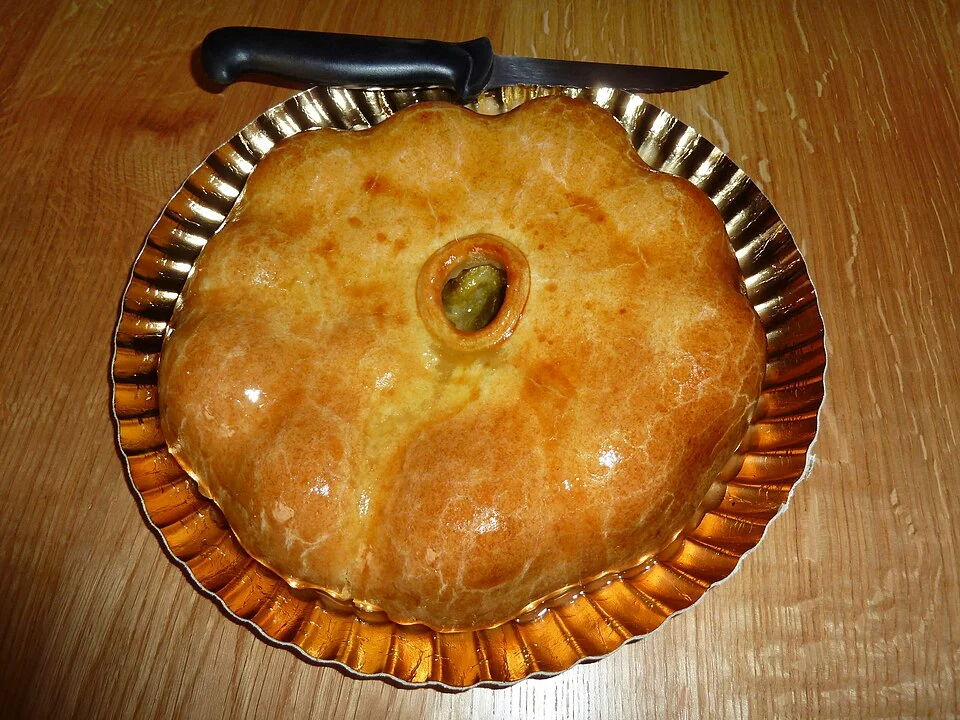
A Dough Lid Over the Fruit, So the Juice Can Bubble
Anjou Tourisme describes the pâté of this pastry as something enclosed in dough. Regional dialects across France also use pâté for fruit-filled pastries of this kind. A form with a dough base, a layer of fruit, and a second sheet of dough over the top is also a covered bake known as a tourte. In the method called pâté pantin in Anjou, the pastry is set directly on a baking sheet, whereas the tourism office’s recipe (ingredients and method) uses a round tart tin. Whether a tin or a baking sheet is used, the fruit is held under a dough covering on top.
When the pastry is shaped in a round tin, the bottom dough is raised up the sides of the tin. The tourism office’s example uses a dough made by bringing flour, sugar, melted butter and egg together by hand and chilling it for 1 hour. The fruit is arranged uncut, the remaining dough is rolled into a circle and laid over it, and the top and bottom are sealed around the edge. One reserved egg yolk is brushed over the surface, a cross about 3 cm across is cut in the center of the lid, and the pastry is baked at 180°C for 40 minutes. The exposed lid takes on the color of the yolk, and around it the bottom dough that holds the juice is continuous with the lid.
The hole in the center is called the cheminée ("chimney") in French. A local fruit-conservation society explains that under the covering of dough the plum juice boils and the aroma becomes concentrated. Because the edge is kept closed and the steam outlet is placed in the center, the egg-glazed dough browns in one continuous sheet when seen from above, even when the fruit is laid over the whole base. The central cross and the sealed seam around it are clues for recognizing a bake in which most of the fruit is hidden. A round hole, as in the photograph, is also seen.
Pastry for 1.5 Kilograms of Fruit
In the recipe from Cuisine de l’Anjou de A à Z ("Anjou Cooking from A to Z"), published in the City of Saumur’s 2021 municipal newsletter, six servings use 1.5 kg of reine-claude. The dough is 500 g flour, 250 g butter, 100 g sugar, 125 g water, 1 whole egg and salt. The dough, rested in a cool place for about 1 hour, is rolled out until its edge overhangs the tin, sprinkled with sugar, filled with fruit and joined to the lid. A cross is cut in the center, and the pastry is baked at 180°C for 35 to 40 minutes. The proportions allow the bottom and lid dough to hold a generous amount of heavy fruit.
The six servings presented by a Loire wine seller also call for the same quantity of reine-claude. The dough, however, contains 50 g of sugar, with another 100 g sprinkled over the fruit. About two-thirds of the dough is used for the bottom; the dough left hanging outside the tin is folded back over the lid and pressed closed with a fork. Although the approach of packing in a lot of fruit is similar, the split between the sugar worked into the dough and the sugar sprinkled directly on the fruit differs from the Saumur example. The shop also suggests cutting the pastry while it is warm and serving it with a Loire sparkling wine.
According to France’s fruit and vegetable technical center, the reine-claude belongs to a group of traditional European plums that also includes the mirabelle and the quetsche. Varieties include the golden-tinged reine-claude dorée and the reine-claude de Bavay. Many Anjou recipes do not narrow the variety further and say only reine-claude. In versions that enclose uncut fruit, each slice contains dough, cooked flesh and juice, and the flesh still holds its stone.
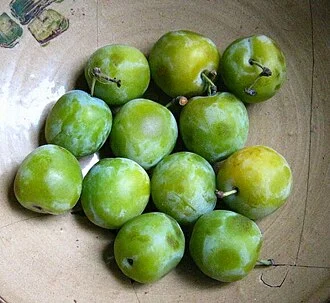
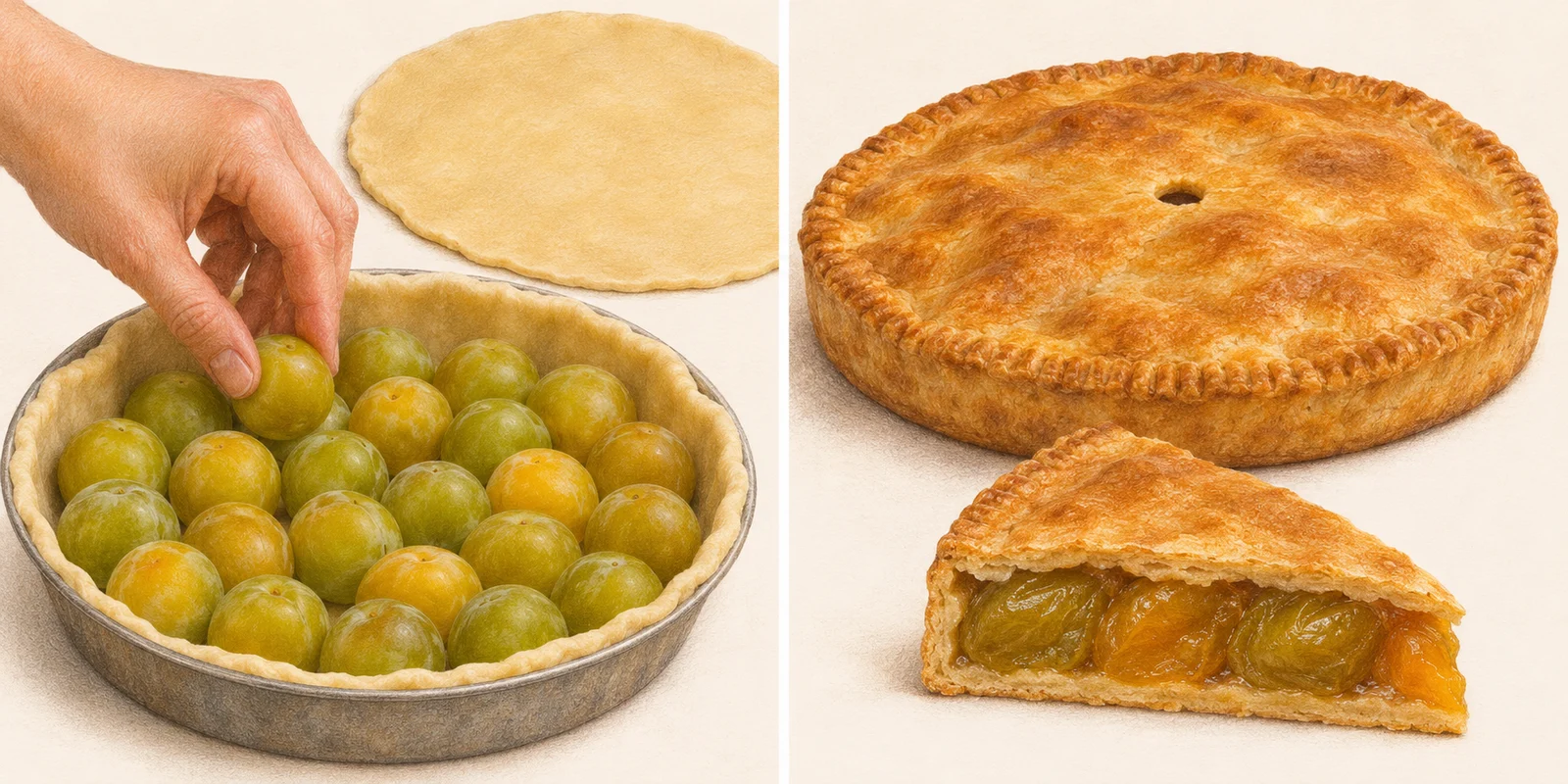
Summer Fruit, from the Farmhouse Oven to the Baker’s Counter
For the reine-claude season, the Anjou Tourisme recipe gives late August to September. The 2026 tourist map says the pastry can be seen in bakeries from mid-July to mid-September. In Beausse, in the Mauges, a July festival features pâté aux prunes alongside rillauds, a pork dish. Tracing the fruit’s season, the time it appears in bakeries and the date of the festival where people gather shows that, within summer, the period in which one encounters the pastry varies in length.
A local fruit-conservation society reports that on farms in the east of Maine-et-Loire, bread was baked when the fruit was ripe, and the dough-wrapped fruit was then put into the oven while it was still hot. According to the recollections of a local writer, after the First World War farms began asking bakers to bake what they had prepared, and after the Second World War bakers also began making and selling the pastry themselves. When it was baked on the farm after the bread, it used the heat of the same oven; when it was taken to a bakery, the person who prepared the fruit and dough and the person who owned the oven were different people. The department’s bakers’ federation states that until 1950 the pâtés aux prunes that were sold were bakers’ products. The place where farmers went to borrow an oven’s fire also became the place that customers went to buy the pastry.
The harvesting of fruit and its making into pastry also appear in literature cited by the dictionary of French regionalisms. On p. 235 of Hervé Bazin’s Vipère au poing (1948), pâté de prunes appears as a great-uncle’s favorite. In a 1995 work by Louis Lebourdais set in the Sarthe, reine-claude plums are set aside every year for a large covered pastry, and on the day of the agricultural show the fruit becomes a pastry in the baker’s window. In each usage, what remains is either the memory of the family who eat the pastry or the work of those who set the fruit aside to make it.
The 1993 edition of Pays de la Loire, in the culinary heritage inventory of the Conseil national des arts culinaires, which the dictionary cites as a source on Angers pastry, has relevant entries on pp. 126–128 and p. 330. In the catalog record of the Bibliothèque nationale de France, it is one volume in a series that collects regional products and traditional recipes. The pâté entry in the dictionary of regionalisms also includes usages for pastries that enclose fruits other than plums. The word kept in the pastry’s name has also been used for the method of baking harvested fruit enclosed in dough.
The 2019 competition announced by the department’s bakers’ federation had separate categories for shop owners, journeymen and apprentices. In the owners’ category, Boulangerie Rose in Trélazé took first place; in the journeymen’s and apprentices’ categories, La Doréenne in Angers placed first. According to a trade magazine, in 2024 nine people selected in July advanced to the final on 29 August, and Sébastien Bérenger of Les Amibroles in Longué-en-Anjou won. Bakers do not only display their products in the fruit season; the competition is also an occasion on which makers in different positions bring the same pastry.
Plum Pastries with a Lid, and Tarts That Show the Fruit
BPA, a manufacturer in Sainte-Gemmes-sur-Loire, shows the process of arranging plums by hand on disks of dough. Its shareable product is labeled as containing 60% whole stone-in plums and 6% butter. The surface is glazed with a nappage containing sugars, pectin and other ingredients. The product’s shine comes from these ingredients, whereas home recipes brush on egg or egg yolk, but the two share the same approach of arranging stone-in fruit and enclosing it.
The company also makes products enclosing apricots, red fruits and caramel-flavored apples. The apricot product contains apricot flesh and purée along with apple compote; in the red-fruit product, blackcurrants, redcurrants, raspberries and other fruit are combined with apple. The plum product contains round pieces of fruit and the juice they release. Even among enclosed pastries of similar shape, the texture of the fruit differs depending on whether round fruit or a layer of purée or compote appears in the cross-section.
Some plum pâtés are made with the stones removed. A 1970 cookbook by Meynier and de Loinsé wraps fruit that has been halved and stoned in a dough of flour, butter, egg, salt and water, with the bottom thicker than the lid. The Touraine example described in a 1980 dictionary of regional cooking uses folded (laminated) dough. For plums with less juice than the reine-claude, the pastry is packed with fruit and more sugar is used. Whether the stones are removed, which fruit is used and how much is packed in, and whether the lid has folded layers all vary under the same name.
An Easter pastry published by a fruit-processing company in northern Deux-Sèvres uses dried prunes with the stones removed; they are simmered to rehydrate, drained, and enclosed in bottom and lid dough. The dough contains sugar and butter and uses a raising agent, and the closed lid is brushed with egg yolk and baked at 180°C. Whereas the Anjou summer pastry encloses raw fruit, this one first simmers dried fruit until soft and then encloses it. The same region’s pâté de Pâques ("Easter pâté") also includes a baked dish enclosing meat and hard-boiled eggs. When a name that marks a season is used as a clue, checking what is enclosed also lets you tell the dishes apart.
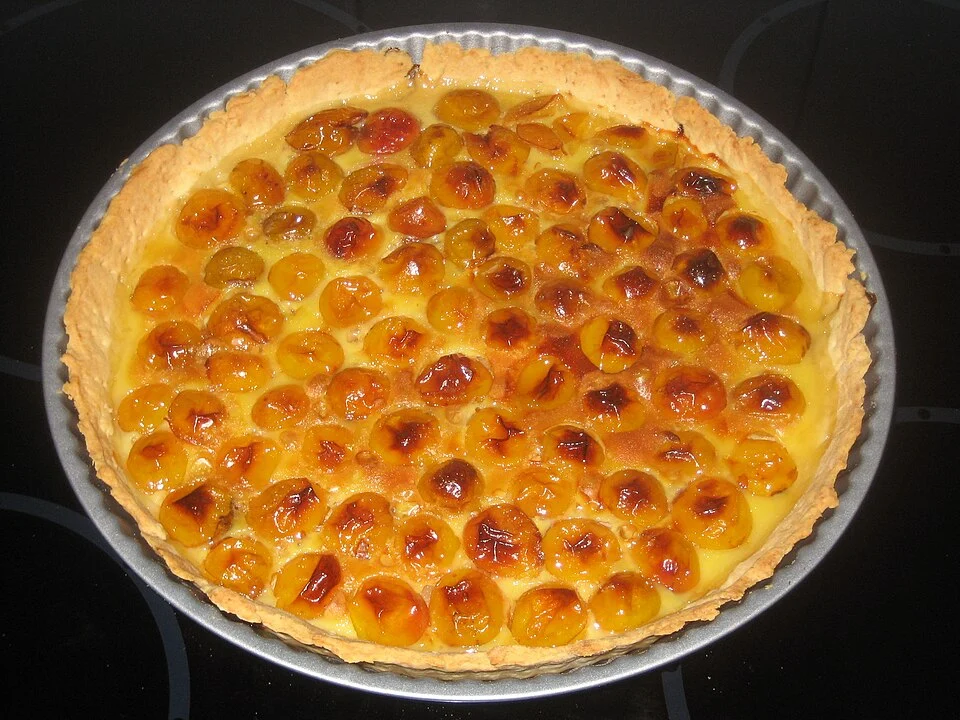
The mirabelle tart in tourist information for Meurthe-et-Moselle in Lorraine uses fruit that is halved, stoned and packed upright in the dough. The top is left open, and in some methods crushed biscuits or breadcrumbs are scattered over the base to absorb the juice. The dough is placed differently where a lid and steam vent keep the juice inside, as in Anjou, and where the fruit stays visible and the base catches the juice. The 2024 trade magazine that reported on the Anjou competition also mentioned, on the same page, a mirabelle tart competition held by the Moselle bakery-pastry federation and the city of Metz, and gave the number of participants as nine. Mirabelle tarts also differ in whether they use laminated dough, mixed dough, egg flan or almond cream.
The quetsche tart presented in the Villé valley in Alsace uses purple-skinned fruit that is halved, stoned and arranged upright on a yeast-raised dough. It is sprinkled with sugar and cinnamon and baked with the top left open. In an example from an Alsace wine-industry body, a flan of egg, sugar and cream is poured over partway through baking. In Anjou the dough that encloses the fruit is on top; in mirabelle tarts there are examples in which something that catches the juice is laid underneath; and in quetsche tarts there are examples in which flan is added between the pieces of fruit. Even among summer plum pastries, the result of baking changes with what is above and below the fruit and what is added in the gaps between the pieces.
Glossary
- Reine-claude
- A plum often used in Anjou recipes. In national fruit and vegetable technical documents, it belongs to a group of traditional European varieties.
- Cheminée
- The steam vent made in the center of the lid. Anjou Tourisme describes cutting it as a cross.
- Pâté pantin
- A method of baking an enclosed pastry on a pastry baking sheet, without a tin.
- Tourte
- A dish baked with a filling enclosed between a bottom dough and a top lid. The term is also used for the Anjou pastry that encloses fruit and for the Easter dish that encloses meat and hard-boiled eggs.


