


SweetloreEncyclopedia of World Sweets (834)

Saskatoon Berry Pie
Saskatoon berry pie
Purple berries from the Canadian Prairies, enclosed in two layers of pastry
Pies / The Prairie provinces, Canada

Saskatoon berry pie is a fruit pie enjoyed in the Prairie region of western Canada. Saskatoon berries are filled into a bottom crust, and a second layer of dough is laid over the top before baking. Cutting through the golden-brown crust reveals deep purple fruit and thickened juice. The berries may be filled in raw, or cooked in a pot first and then filled, and the choice changes both the texture of the berries and how well the filling holds together, even though the fruit is the same. With a lattice top, the baked berries show through the gaps. A warm slice is sometimes served with cold ice cream or whipped cream.
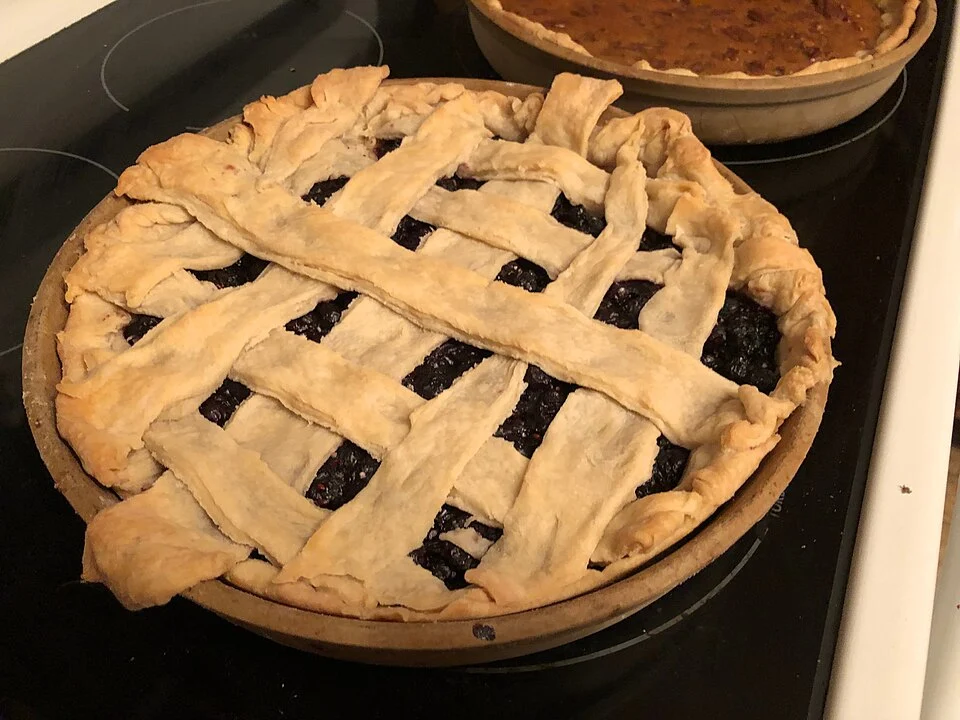
Baking berries and juice inside the crust
The recipe from a gallery café in Saskatchewan uses fresh or frozen saskatoon berries. If frozen, they are not thawed; they are tossed with sugar, cornstarch, and a small amount of minute tapioca and spread over the bottom crust. Berry or grape juice is drizzled over them, small pieces of butter are dotted on top, and lemon juice is sprinkled over. The berries are not cooked in a pot beforehand.
In the oven, the juice is released, and the liquid around the fruit, which contains the flour and tapioca, thickens. In a cooled cross-section, the berries keep their shape, and purple juice fills the spaces between them.
For the café’s crust, sugar, salt, and baking powder are mixed into flour, and shortening is cut in so that some pieces remain. Half of a beaten egg is mixed with white vinegar, and cold water is added to bring the liquid to the full measure. The dough is brought together with this liquid and divided into the bottom and top crusts.
The edge of the bottom crust is lightly moistened, the top crust, with holes cut in it to let steam escape, is laid over, and the edges are pressed together. The remaining beaten egg is brushed over the top. Half of the egg goes into the liquid that binds the dough, and the other half coats the surface before the pie goes into the oven.
The pie is baked at about 177°C (350°F) for around an hour, until the top is golden brown, and left at room temperature for at least an hour before cutting. While enclosed between the bottom and top crusts, the juice is heated, and allowing time for cooling helps the filling hold together when the pie is cut.
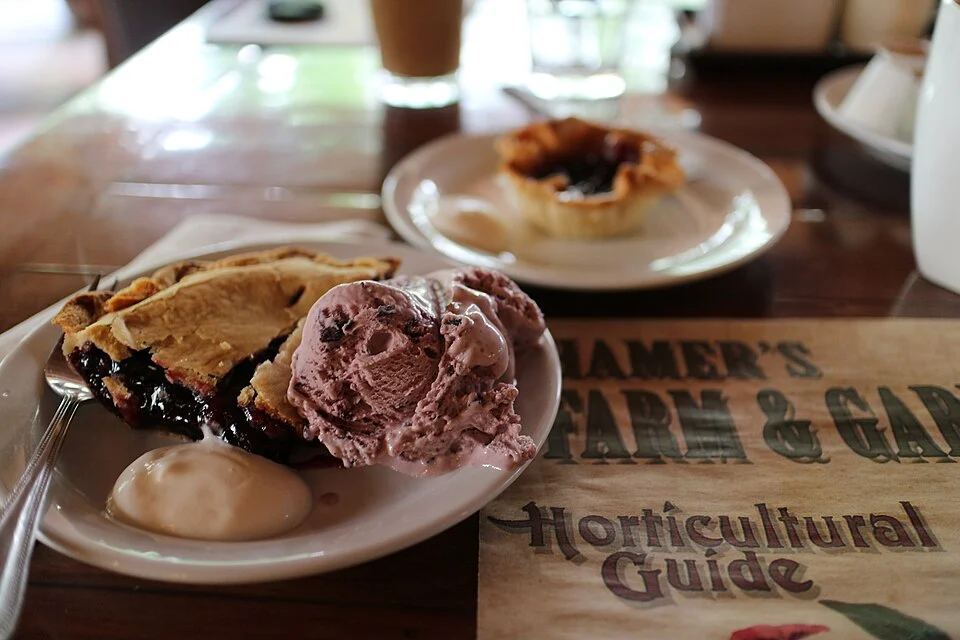
This example also shows a method of freezing the assembled raw pie and baking it after brushing it with egg and putting it straight into the oven. Using frozen berries as an ingredient and freezing a pie after enclosing the filling in pastry are storage at different stages. The café’s recipe sets out the steps so that the pie can be baked from either stage.
In the version by Renée Kohlman, a cook from Saskatchewan, the berries are mixed with sugar and cornstarch, put into the bottom crust, and dotted with butter. Unlike the gallery café’s recipe, no separate juice or tapioca is added. For the top, strips of dough are cut one by one and woven into a lattice, then brushed with egg and sprinkled with sugar. It is baked at about 177°C for roughly 90 to 100 minutes, until the crust is colored and the juice bubbles.
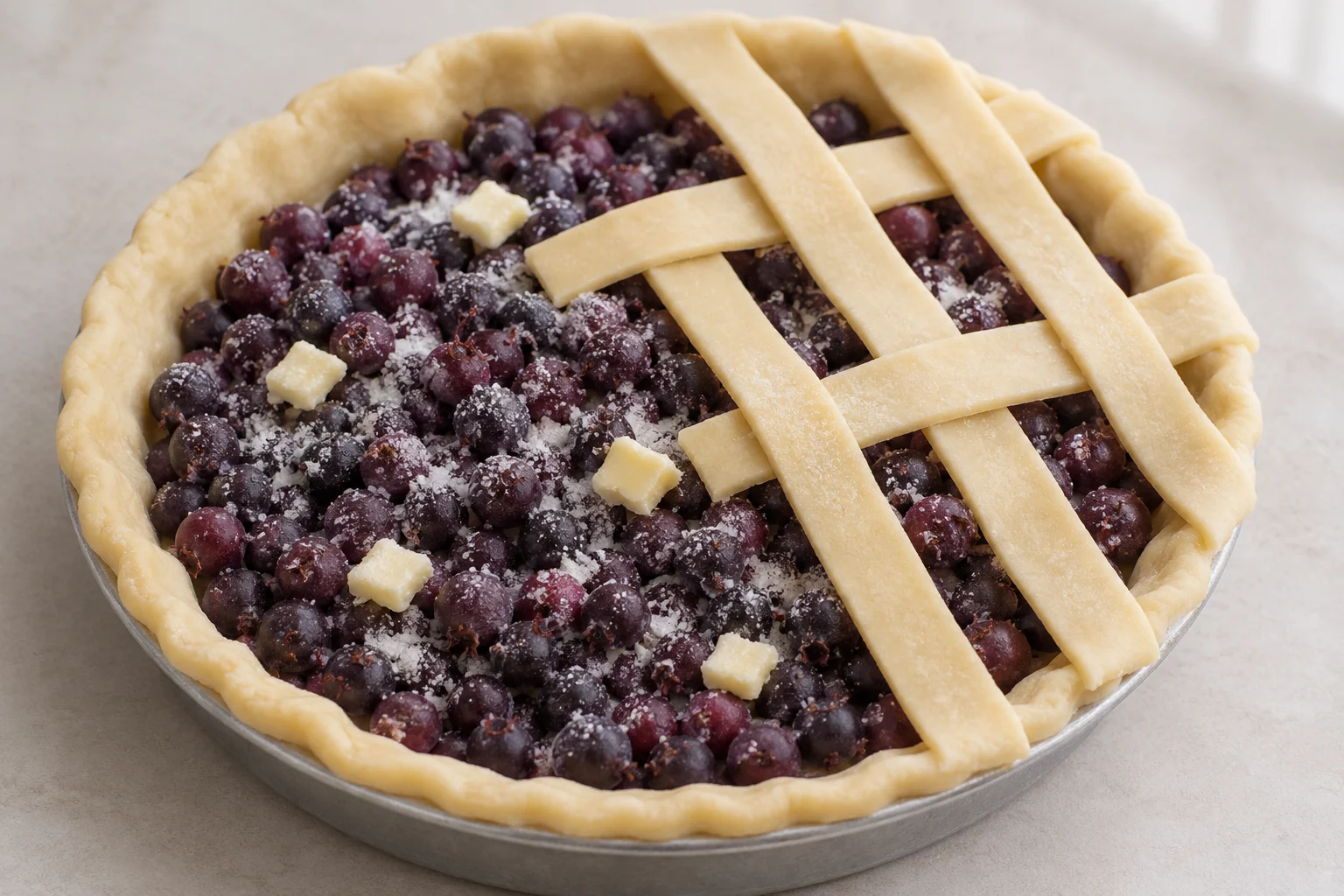
With a single-sheet top crust, steam escapes through the slits; with a lattice, the fruit and juice can be seen through the wide gaps. In both cases the color of the crust is the cue, but with a lattice, bubbling in the filling is also easier to spot.
Kohlman notes that some people add lemon to the juice or a hint of almond. Her own recipe uses fruit, sugar, cornstarch, and butter, and no almond flavoring or lemon. She suggests serving the baked slice warm or at room temperature, with whipped cream or ice cream.
Because the café’s recipe sprinkles lemon juice over the fruit, a tartness is added to the flavor of the berries themselves. In both examples, the cream is not an ingredient enclosed and baked with the fruit; it is added at the point of eating.
Cooking in a pot, and the heat for baking the crust
In the recipe by Pamela Wallin published in the Winnipeg Free Press in 2001, the berries are cooked in a pot with sugar, minute tapioca, and lemon juice. They are heated for 10 to 15 minutes, until the berries soften and the mixture holds together, and then cooled. The crust, made by combining flour and lard, binding it with egg, vinegar, and water, and chilling it overnight, is rolled out and used to enclose the filling top and bottom.
Like the café’s recipe, it uses lemon, but here both the lemon juice and the tapioca go into the pot with the berries, so the juice and starch have already been heated before the filling is poured into the crust.
Wallin’s version is baked at about 204°C (400°F) for the first 10 minutes or so, then at about 177°C for about 30 minutes, until the crust is brown. In a version in which the berries are cooked first, the fruit softened in the pot is heated a second time inside the crust.
In Kohlman’s lattice version, uncooked fruit is filled in and baked for a long time along with the crust. The difference between the recipe that appeared in a Manitoba newspaper in 2001 and the one published by the Saskatchewan cook lies in whether the filling is already cooked when it goes into the oven.
Kohlman describes it as a pie she has eaten since childhood. She writes that, before freezers became common, filling made at harvest time was put up in jars and used for winter pies. The same text also describes spreading washed berries on a baking sheet to freeze them, then mixing in sugar and flour when they are used.
What the methods have in common is that the time the fruit is picked can be separated from the time the pie is eaten. With the method of opening a jar, the juice and fruit have already been cooked together; with the method of starting from frozen berries, the fruit is heated at the baking stage.
In the home recipe published by the Dunlop family, flour rather than cornstarch or tapioca is tossed with the berries, and the flavor comes from grated lemon zest and cinnamon. In addition to butter, heavy cream is drizzled over the fruit. Here the cream is not served alongside the baked slice but is enclosed in the crust with the fruit.
Slits are cut in the top crust, its surface is moistened with milk and sprinkled with sugar, and the pie is done when the filling bubbles up through the slits. Compared with the lemon juice mixed in at the café and the lemon juice that Wallin puts in the pot, this is a recipe that uses the lemon differently, taking its aroma from the zest.
Gathering and storing berries on the Prairies
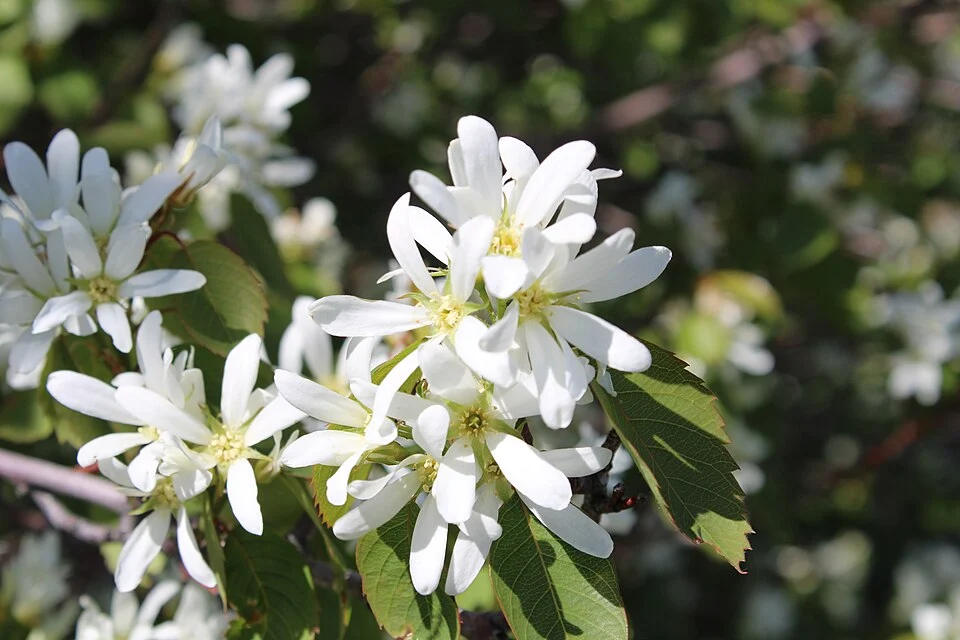
The saskatoon berry is the fruit of Amelanchier alnifolia, a shrub in the rose family. When ripe, it turns from reddish purple to nearly black, and it has seeds within the flesh.
A horticultural resource from the University of Saskatchewan explains that Indigenous peoples ate the berries fresh and also crushed or dried them. Blackfoot Crossing, a Blackfoot cultural site, likewise records that the berries were eaten fresh or dried and combined with dried meat and fat. In these sources, preserved foods made with dried fruit and the pie process of enclosing fruit in a flour crust appear as separate ways of eating.
The Glenbow Museum’s Blackfoot exhibit explains that berries were picked on valley slopes and in the valleys, and that the picking places were changed according to the weather and how the berries were ripening. The exhibit calls the mixture of berries spread out to dry, then crushed and mixed with dried meat and fat, mookimaani (pemmican). They were also used in soups, and the dried berries were stored in containers made from animal tissue.
Knowing where fruit can be found, and gathering and storing it when it is available, is food knowledge that goes back to before baked-goods recipes were printed. The exhibit conveys this knowledge and does not identify who devised the pie itself or when.
The Daily Herald of August 12, 1920, reported that, in a year when wild fruit was plentiful around Prince Albert, saskatoon berries were nearly finished and blueberries were coming in. The article then turns to searching for blueberries across the river, near pines, and in hollows. The page does not treat the two berries as the same thing.
Canada Post materials also describe the saskatoon berry as a fruit with a flavor reminiscent of almond and apple. The fruit that gives the pie its blue-purple color has a name used locally and a harvest season of its own.
The University of Saskatchewan materials also list cultivars, such as the small-fruited Pembina and Martin, which has large fruit that ripens evenly. Flavor and size differ from bush to bush, and the time of fruiting differs by cultivar. Neither the gallery café’s recipe nor Kohlman’s specifies a particular cultivar. The size of the berries in the cut slice depends not only on whether the filling is cooked but also on the fruit itself.
A pie discussed at cooking gatherings and pictured on a stamp
On August 27, 1948, the Prince Albert Daily Herald reported on a meeting of the Canadian Home Economics Association held in Calgary. In a discussion of what dishes exist in different parts of Canada, one participant praised saskatoon pie and spoke of using lemon juice with the Prairie fruit that resembles blueberries.
This page does not carry a full recipe. Even so, it is an example of a Saskatchewan newspaper reporting on a meeting held in Alberta and linking the name of the pie with the taste of the fruit in print. The gallery café’s current recipe also includes the step of sprinkling lemon juice over the berries.
A document published by a British food authority notes that the Canadian cooperative cookbook Cooking the Co-op Way includes a "Saskatoon Pie." Fruit jelly and a jam made with rhubarb are also listed as examples from the same book. According to the bibliographic entry for the 1963 edition published by the University of Alberta Libraries, women’s organizations of the cooperatives in Manitoba, Saskatchewan, and Alberta were involved in this cookbook.
Sources differ in how they give the date of publication, so the year of the first edition and its recipe cannot be determined here. At the least, there are leads for tracing both the practice of also processing the gathered berries into jam and other preserves, and the appearance of the pie’s name in a cooperative’s publication.
On April 17, 2019, Canada Post issued the "Sweet Canada" stamps, which depict sweets from different regions. Saskatoon berry pie is one of the five designs. The stamp notes also record that the artist, Mary Ellen Johnson, baked the chosen sweets herself, photographed them, and then painted them in oils.
The notes link the fruit’s name to the Cree word misâskwatômina and explain that the berry is also connected to the place name Saskatoon. A slice of pie, its dark fruit enclosed in pastry, was carried on mail to places where the fruit is not known.
In versions that fill the crust with berries cooked in a pot and then cooled, the filling comes together before the crust is cut. In versions that use frozen berries as they are, the cook waits in the oven for the juice to be released and the crust to bake. With either method, when the crust is cut, the deep color of berries long gathered on the Prairies appears at the cut edge. Some cooks actually use the lemon trick that was discussed at the 1948 meeting, and others pair the taste of the fruit with a fragrant lattice. From the common point that fruit and crust are eaten together, one can enjoy differences ranging from how the pot is used to the shape of the top crust and how tartness is added.
Glossary
- Saskatoon berry
- The fruit of Amelanchier alnifolia. It contains seeds and darkens as it ripens.
- Minute tapioca
- An ingredient mixed into fruit fillings to thicken them. Some recipes use it together with cornstarch.
- Pemmican
- A preserved food made with dried meat and fat. Blackfoot sources give an example in which crushed dried saskatoon berries are combined with it.
- Prairies
- Here, the grassland region of western Canada. A cookbook produced by the cooperative women’s organizations of Manitoba, Saskatchewan, and Alberta exists.


