


SweetloreEncyclopedia of World Sweets (834)

Rákóczi túrós
Rákóczi túrós
A Hungarian pastry in which waves or a lattice of egg white are piped over túró
Cakes / Hungary

When a fork goes in, the thin baked egg-white surface cracks, followed by tangy cheese and a butter dough that crumbles softly. Rákóczi túrós (Rákóczi-túrós) is a pastry with a thin base of flour and butter, topped with túró, a Hungarian fresh cheese, then decorated with egg white and baked. Versions with a fine lattice filled with apricot jam show a pattern of white and orange. A slice recorded in food-culture materials for Budapest and Pest County connects the plates of homes and cafés with the table of the Hungarian pavilion at the 1958 Brussels World’s Fair.
Par-Baking the Base, Then Layering the Cheese
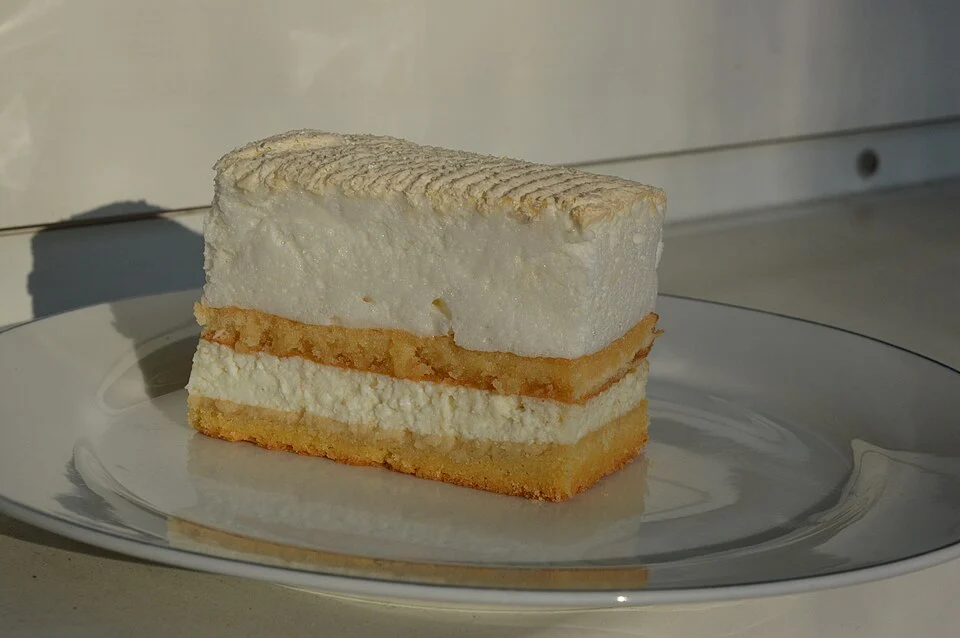
The Hungarian food-culture compendium Hagyományok Ízek Régiók gives a guide size for one slice of 6 or 7 cm square, about 3.5 cm high, and 60–80 g in weight. In the compendium’s example, a wavy pattern of egg-white foam, piped at a slant, decorates the surface.
Seen in cross-section from the bottom, the layers run in this order: a base of flour and butter, a layer of túró, and a layer of egg white. Compared with the method of filling a fine lattice with jam, the two share the white lines of egg white, but differ in how much of the surface the foam covers.
The base uses wheat flour, butter, powdered sugar, egg yolk and similar ingredients. In the compendium’s method, the cold ingredients are kneaded quickly, spread on a baking sheet and par-baked. The source explains that if the work takes long, the warmth of the hands softens the fat in the dough, and it breaks easily when rolled out.
Because the base is baked on its own first, it has already been heated once by the time the túró is placed on it. This step firms up the flour-and-butter layer in advance, before the moist cheese is added and the pastry is baked again. Making a bottom layer that breaks softly in the mouth starts with this first bake.
Túró, the heart of the pastry, is a fresh cheese made by curdling milk and separating the whey. According to the specification published in the Official Journal of the EU for Rögös túró, one variety of it, the curd grains are white to yellowish white, gather like cauliflower florets, and have a fresh, sour taste.
The grainy structure comes from the process of forming the curd and separating the whey. The túró named in pastry sources is the name of an ingredient, whereas the Official Journal deals with the specification of one particular grainy dairy product.
In some versions, the filling is made by adding sugar, egg yolk, sour cream, raisins, lemon zest and the like to sieved túró. In the recipe published by the town of Dombóvár, bread rolls with the crust removed and cut small are also mixed in, and whipped egg white is folded in last.
The layer containing the bread roll and the egg white piped on top are prepared separately. The construction gives the filling thickness while keeping it light, and uses the egg white for the pattern on the surface. Pairing túró with lemon zest lays a citrus aroma over the tang of the milk.
In the compendium’s instructions for professional bakers, the base is par-baked, then baked again with the túró on it. The heat reduces the moisture in the filling and sets the proteins of the egg and milk, and the egg white is piped last.
The order in which the pastry goes into the oven is the order of its cut face read from the bottom up. The par-baked base serves as a support, the cheese is set next, and the foam surface is baked last. When the pastry is cooled and cut, layers of different thickness sit side by side in one slice.
Piping Lines of Egg White and Baking the Surface
The egg-white foam also varies by method. The professional example in the compendium boils part of the sugar with water to 125°C and adds it to the egg white. After piping, powdered sugar is dusted on and the pastry is baked in an oven at 170–180°C without steam. Here 125°C is the temperature of the sugar syrup, and 170–180°C is the oven setting.
In a recipe printed in a 1935 newspaper, powdered sugar and vanilla are folded into firmly whipped egg white, and the mixture is put into a piping bag. Both put foam on the surface, but they differ in the state in which the sugar goes in when the foam is made.
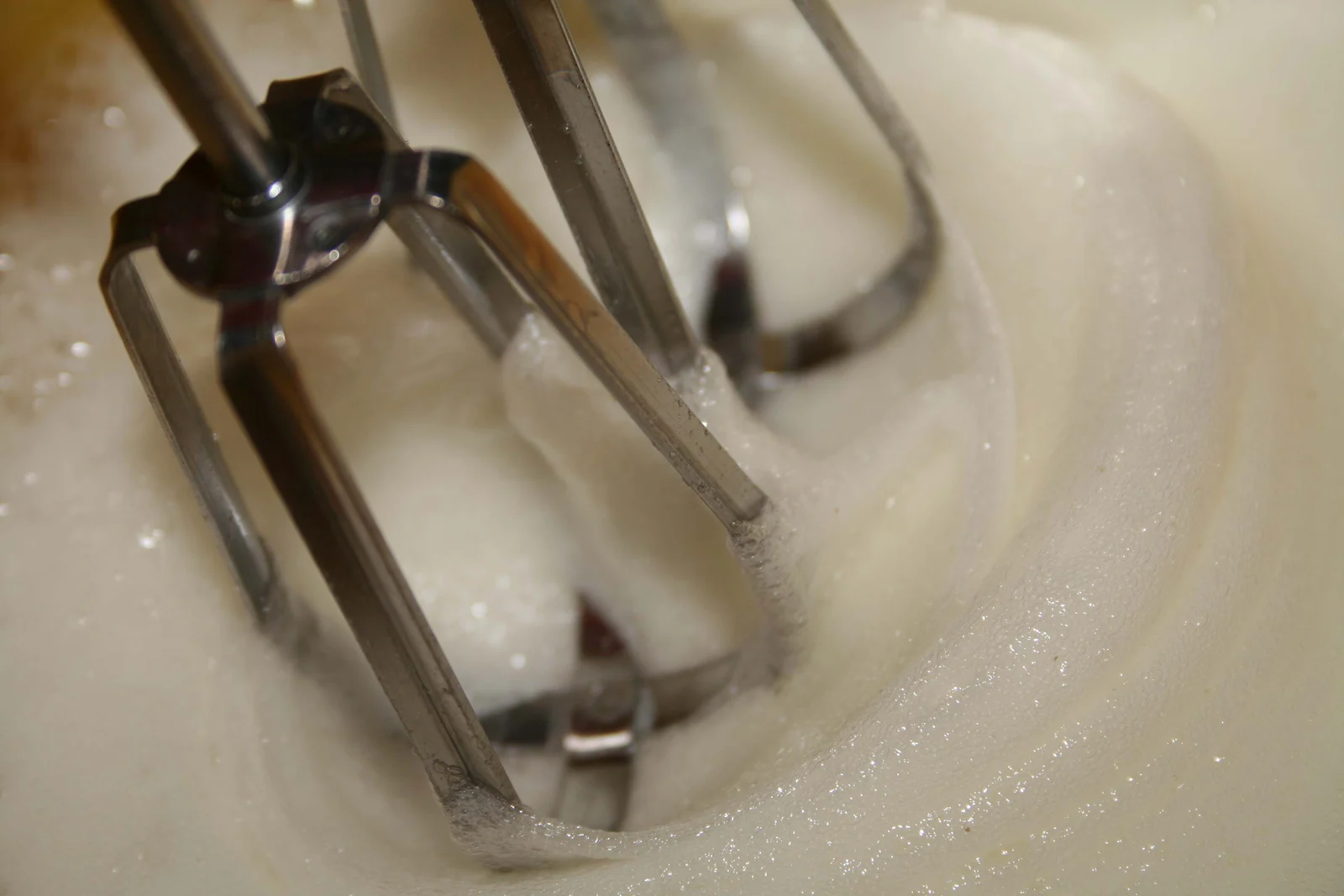
In the professional example, while the foam is still lukewarm, lines are piped diagonally with a star tip. When the pastry is dusted with powdered sugar and baked, a thin, glossy skin forms on the surface; as it begins to color, the oven temperature is lowered slightly and the pastry is baked until the foam sets. Even in a form that uses the foam over a wide area, piping the lines side by side leaves a wave pattern on each slice.
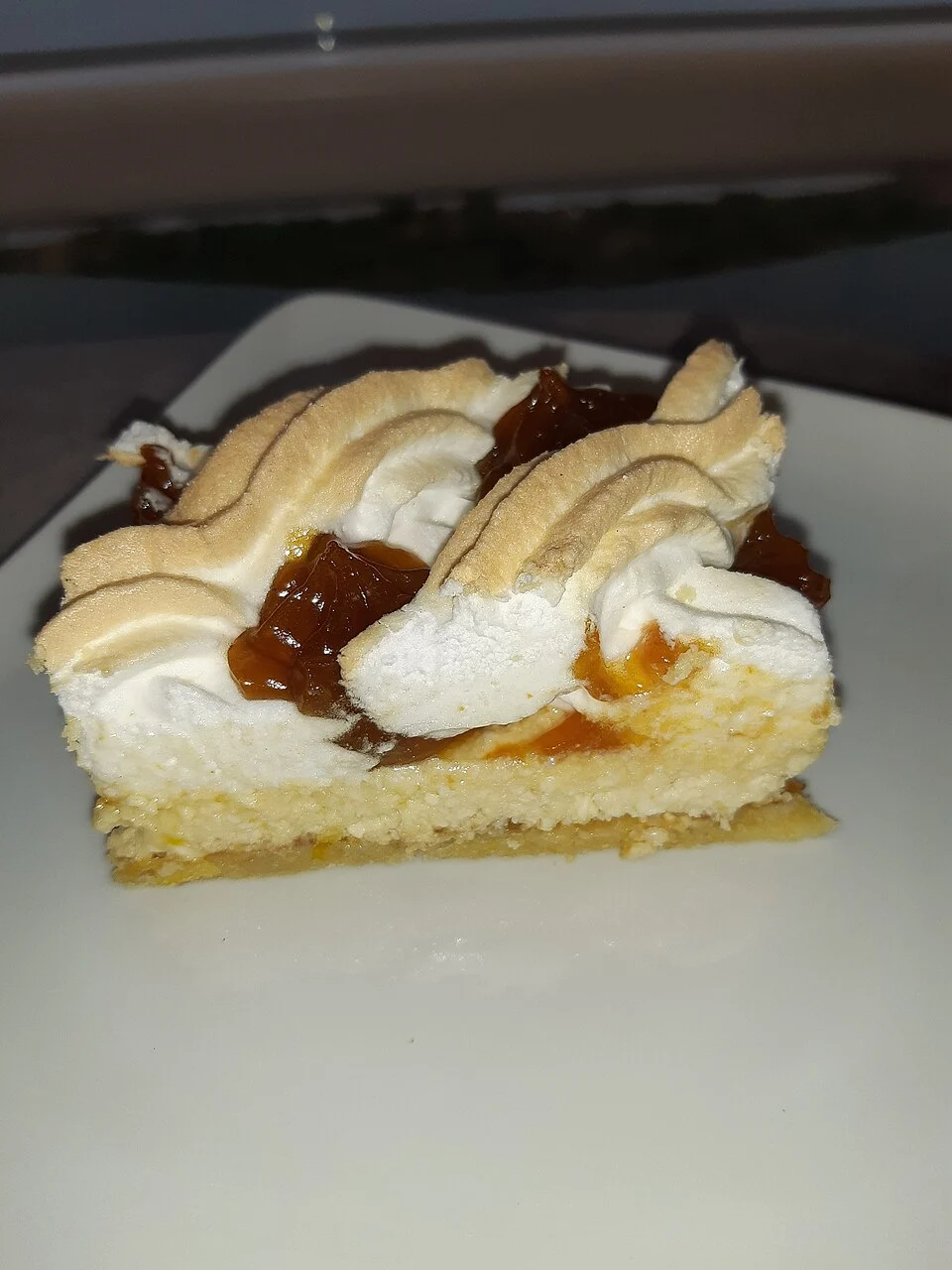
The source also records that some workshops spread smooth apricot jam along the boundaries of the waves after baking. Compared with the version that pipes jam into the open spaces of a lattice, the same ingredients give a different look.
From an Easter Bake to Newspapers of the 1930s
Tracing back from the newspaper recipes of the same name, there is an older way of eating dairy baked on dough. A Hungarian ethnography notes that the Sándor Codex, from the early 16th century, describes an Easter bread that uses dairy products and eggs and is baked with a ring of dough around it. In Makó in the first half of the 19th century, too, the filled béles was recorded among a group of regional baked goods.
These sources show that pastries made with túró were being baked. When checking the name Rákóczi and the formulation in the newspapers, records from the 1930s offer the clues.
A food-culture article and a transcription in a cultural journal confirm that in the newspaper Pesti Napló of 19 November 1933, Elek Magyar, who wrote the cookery column, published a recipe for "Rákóczi túrós." The base is kneaded from butter, flour, sugar, egg and lemon zest, pricked with holes, and par-baked.
A layer of túró, semolina, egg yolk and sugar is spread over it, and then a batter is spread on top, made by mixing egg yolk, sugar, flour and hot butter into whipped egg white. The recipe has it baked, cooled completely, and then cut.
What the 1933 recipe spreads on top differs in ingredients from today’s lattice, which is piped from egg white with sugar added. Because egg yolk, flour and butter go in as well, the construction adds a fresh layer of batter to the surface. No instruction to add jam can be found either.
In addition, the two transcriptions do not agree on the figures for the semolina and for the butter in the upper layer. What can be read in common is that the túró is combined with semolina and egg yolk, and that the upper layer, made with egg white, contains flour and butter. There is room to resolve the difference in formulation by going back to the newspaper page itself.
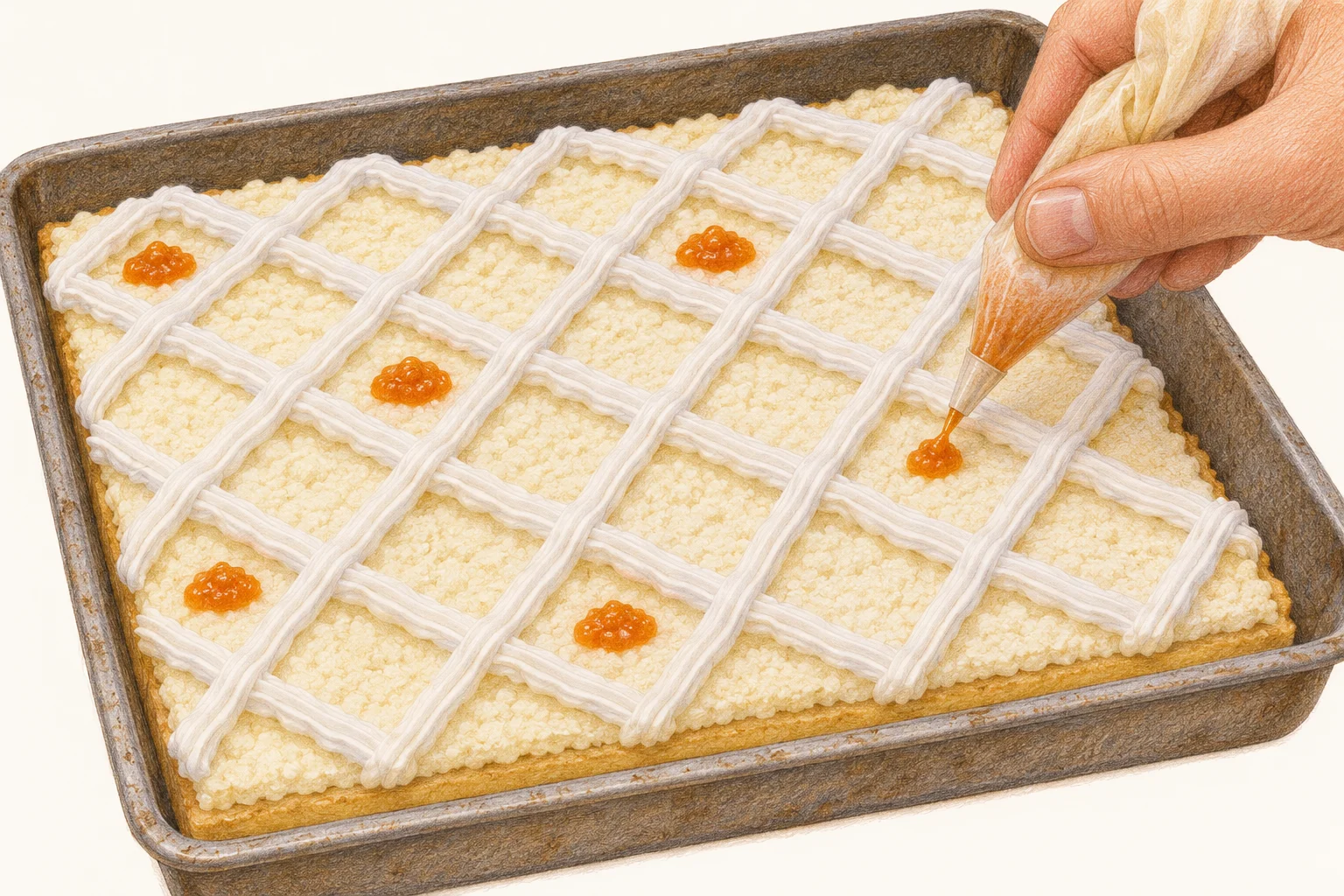
In the recipe that the cook Sándor Újvári contributed to Újság in 1935, semolina is scattered over a par-baked base, and a layer of túró and raisins is spread about a finger thick. It is baked with the filling on for 12–15 minutes, and then a lattice is piped with whipped egg white. Red jam is piped between the lines of the baked lattice.
The procedure of letting the cheese layer settle on the base and only then making the lattice is an example in which one can see, step by step, how the egg-white upper layer changed.
The food-culture compendium and the town of Dombóvár state that a recipe was also printed in 1937 in the culinary trade journal Magyar Szakács. The compendium gives the December issue.
The 1933 newspaper, the 1935 newspaper and the 1937 trade journal each point to a separate publication. If the year the pastry first appeared were fixed from the trade-journal record alone, the two earlier newspaper recipes would drop out of view. Before 1937, bakes of the same name with different upper layers had already been presented.
A Chef’s Name Attached, and a Place at the Expo Table
The Hungarian value inventory links the chef János Rákóczi to the name of the pastry. It says that in the 1930s he led the kitchen at Gundel’s restaurant in the Hotel Gellért in Budapest, and that at the 1958 Brussels World’s Fair he was in charge of the Hungarian restaurant.
According to the food-culture compendium, the pastry appeared on the expo menu in the section for Hungarian-style flour dishes. When the country’s cooking was served to overseas visitors, the túró pastry was among the items.
Sources treat the question of who first made the pastry differently. The town of Dombóvár presents Rákóczi as its creator.
By contrast, the culinary-history site Gasztrorégész finds earlier examples in the menu of a Debrecen hotel in 1933 and in newspapers, and points out that doubts remain about the evidence that he invented it himself. According to the site, what he included in his 1964 cookbook was a version that uses jam. How the chef’s name became attached to the pastry, and whether a particular person devised it first, need to be checked against separate sources.
The 1964 book is introduced in a Hungarian library journal as a cookbook published at the time. In the culinary-history site’s comparison, the recipe in his own cookbook has sour cream in both the base and the filling, and jam is used as well.
The upper layer in the 1933 newspaper is a foam with flour and butter added, while the 1935 newspaper has an egg-white lattice and jam. Even when an old name is researched using the formulation of a later cookbook, tracing when and in which publication each formulation appeared shows the differences in how the same pastry looked.
A Slice in the Café, and the Home Baking Sheet
The food-culture compendium says that the pastry is sold not only in town confectioneries but also in cafés, and is chosen for an afternoon snack or for Sunday and holiday meals. It also notes that the pastry loses its shape easily when carried, and is often eaten on the spot.
For the home, the compendium gives examples of baking it as a second course after a hearty soup, or as a dessert. A confectioner’s slice is cut and shaped beforehand, whereas on a home baking sheet the whole pastry is baked together and divided at the table.
The position of the apricot jam is not fixed even in contemporary versions. The food column "chili&vanília" gives an example in which it is spread over the base and one in which it is filled between the egg-white lattice lines on top. Filling the lattice brings orange to the surface, while spreading it on the base shows a fruit layer in the cut face.
A variation in the same column stacks crêpes, places túró and jam between the layers, and tops them with foam. Even with a changed base, the combination of cheese, jam and foam keeps the pastry recognizable by name.
Besides the baked pastry, the Dombóvár page also gives a version served in a glass. Crushed biscuits, apricot jam and túró cream are layered, and jam and biscuits are placed on top as well.
In a pastry layered on a baking sheet, the base supports each slice and the foam on top gives it shape. In a glass, the vessel holds the shape, so the biscuits need not be baked into a firm sheet and can be used as crushed crumbs. The same ingredients are arranged in a different order, and how deep the spoon goes changes the amount of dairy and fruit.
When eating a home slice, the ratio of foam on top to the cheese layer changes the impression. A Hungarian report comparing contemporary versions covers a range from a shop’s thickly piped foam to dome-shaped individual pastries, glass desserts and ice cream.
The compendium’s example holds three layers in a height of about 3.5 cm and shows the wave pattern of the foam. Even under the same name, looking at where the apricot goes and how thick the túró is shows what a shop put at the center of its flavor.
Glossary
- Túró
- A fresh cheese made by separating the whey from curd. The Rögös túró mentioned in the text is the grainy kind.
- Lepény
- Here, a name for a pastry baked flat on a baking sheet or similar. The compendium also lists Rákóczi túrós lepény as a name for the same pastry.
- Semolina (búzadara)
- Wheat ground into granules. It is used in the filling or the base in 1930s recipes.


