


SweetloreEncyclopedia of World Sweets (834)

Turrón de Doña Pepa
Turrón de Doña Pepa
A Lima confection of baked sticks laid crosswise and layered with syrup
Baked Sweets / Lima, Peru

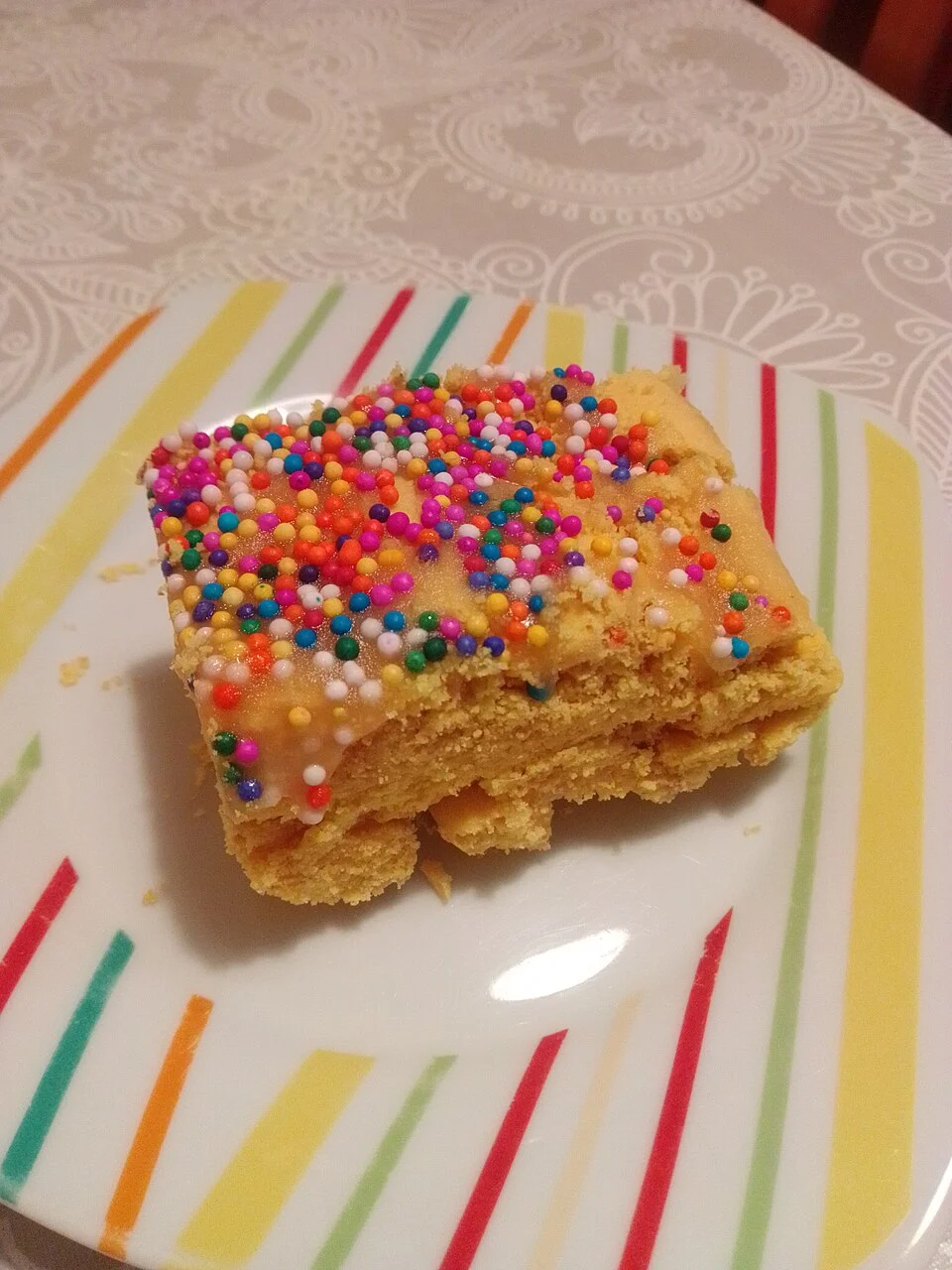
Turrón de Doña Pepa is a confection from Lima, Peru, made by baking long, anise-scented strips of dough and assembling them with a sweet syrup. Cut into a piece, it shows the baked sticks and the syrup that has pooled in the gaps between them. Small colored sweets are scattered on top, so the syrup-moistened interior, the brittle dough and the decorations that knock against the teeth all come together in one mouthful. In October, when devotees in purple robes process through the city, turrón cut into portable pieces is sold in shops and on the streets.
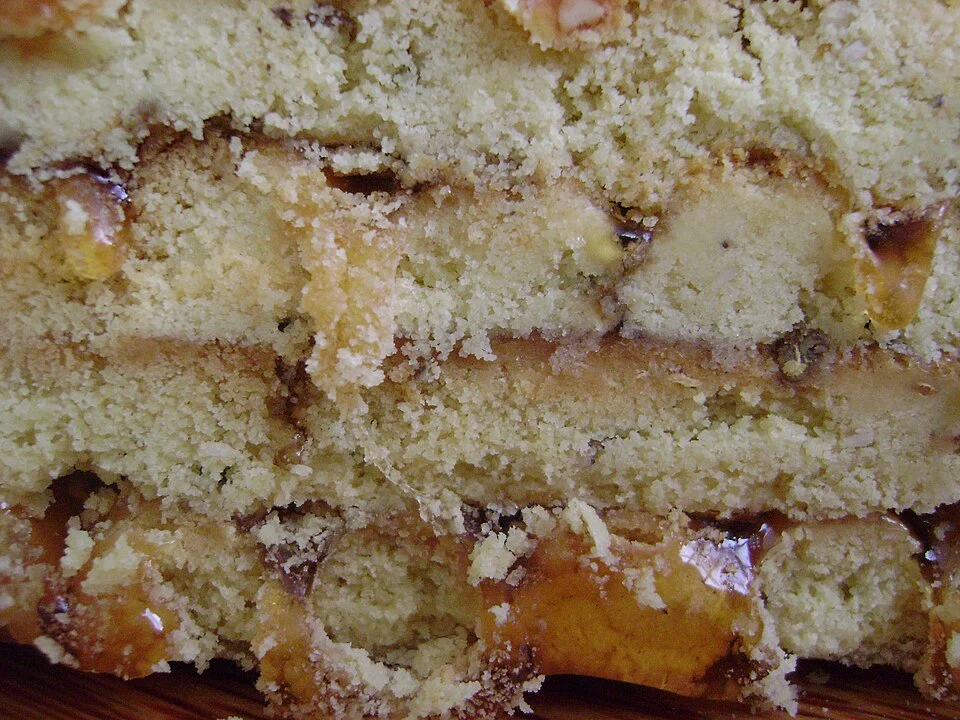
Long baked strips of dough, assembled into the cross-section
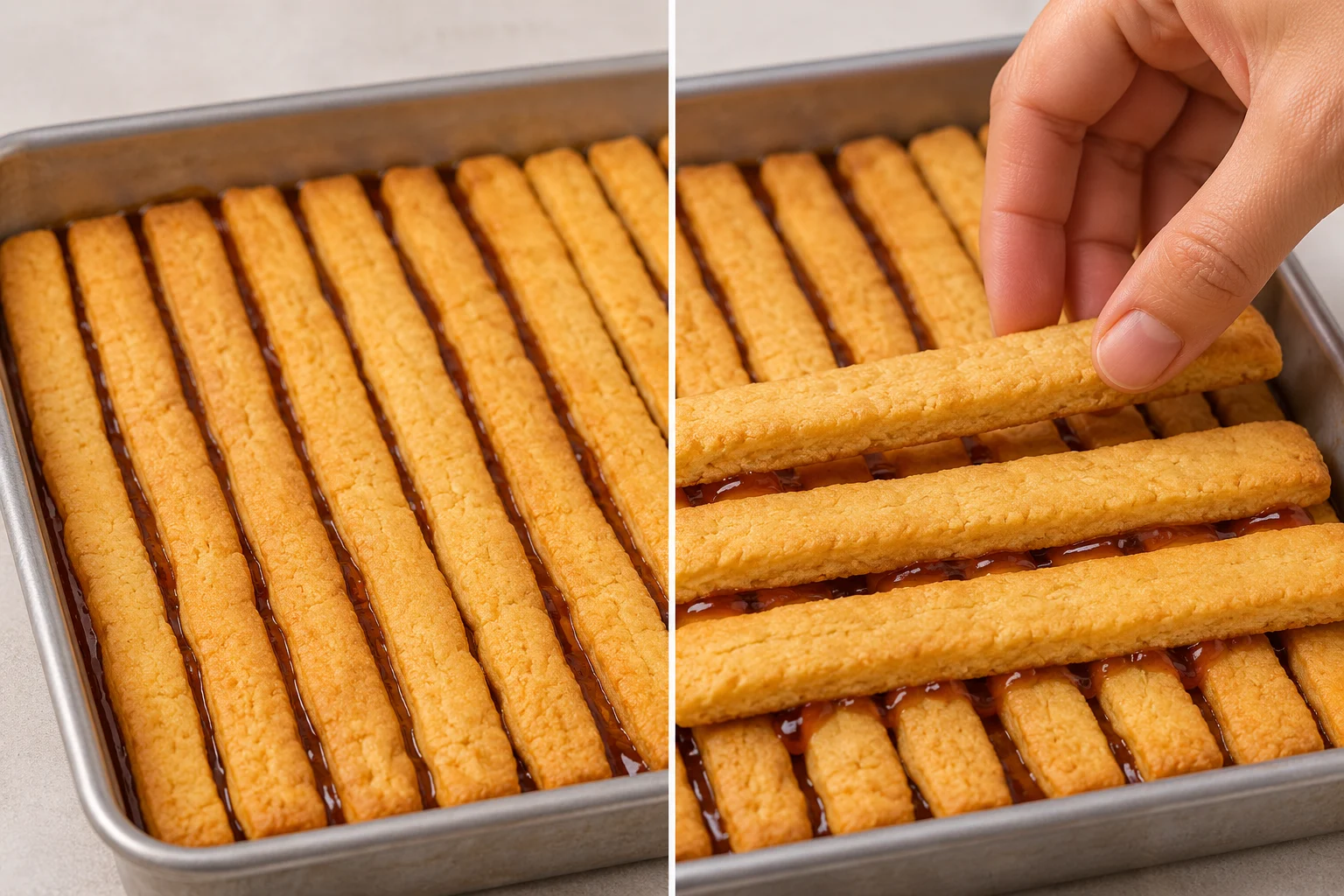
The woven pattern in the cross-section comes from rearranging the baked sticks. First, the sticks are packed in the same direction in a rectangular base or dish, and syrup is poured over them. The next layer is laid at right angles to the one below, so that the joints do not line up from one layer to the next and each upper stick spans several of those beneath. Because the direction changes with every layer, a single piece shows, depending on how it is cut, both the long faces of the sticks and ends that look like round slices. The way the layers connect, as seen in cross-section, is different from that of layered confections built by stacking sheets of baked dough one at a time.
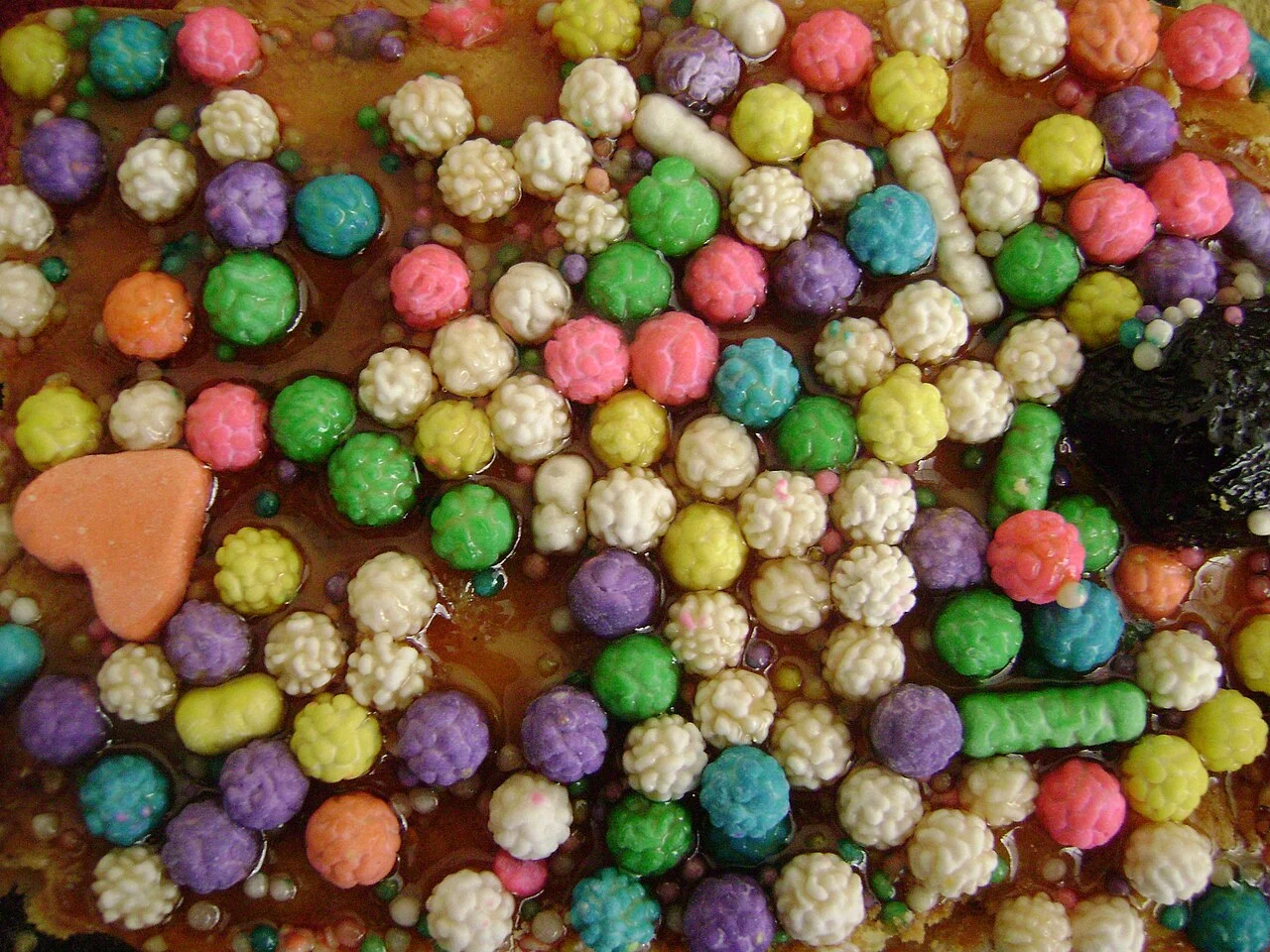
Sticks that break during baking serve as material for filling gaps when the turrón is assembled. In the Cumanana recipe, the sticks are built up in three or four layers and left for at least 2 hours; once the syrup has soaked in, the edges are trimmed. The turrón is then decorated with confections called grageas, which vary in color and size. Even when the syrup that joins the upper and lower sticks and the syrup that holds the decoration in place are made from the same ingredients, they serve different purposes depending on where they are applied. What the teeth meet before the soaked dough is the hard pieces heaped on top.
The dough is made from wheat flour and fat, combined with eggs and other ingredients. In the recipe published in 2021 in Cumanana, the magazine of Peru’s Ministry of Foreign Affairs, 5 cups of flour are used with 500 grams of vegetable fat and 6 eggs, and toasted anise and sesame are mixed in. The fat and the aromatic seeds remain inside the sticks after the dough is baked. Other sources describe it differently: the tourism register of the city of Lima says it contains milk, and the Ministry of Culture document describes the use of egg yolks and anise water. The structure of baked dough sticks is common to all of them, but the recipes in these sources differ in the dairy, in which part of the egg is used, and in the liquid used to add fragrance.
In the Cumanana recipe, the dough is chilled for at least 1 hour and then shaped into sticks about 30 centimeters long. The sticks spread as they bake, so they are placed on the baking sheet with space between them. They are baked in an oven preheated to 300°F (about 149°C) until they take on color, then cooled thoroughly before being used in the assembly. Unlike a method in which a single sheet of dough is spread over the whole tray, each stick has its own sides and can be handled one by one after baking. Assembling the turrón once the sticks have cooled means that syrup is not poured over sticks that are still hot and easily lose their shape.
Syrup that soaks into the sticks, and confections that crackle on top
In some recipes, the syrup that binds the confection uses chancaca, a sugarcane sugar. The Cumanana recipe prepares two syrups in separate pots: one made by dissolving chancaca in orange juice, and one made from the liquid in which fruit has been cooked. The fruit pot holds apple, orange, quince, pineapple, banana, lemon and spices. This is not a confection in which pieces of fruit are packed as they are between the sticks. The liquid is strained, then boiled down with sugar and combined with the chancaca syrup, so what spreads between the sticks is a sugar syrup carrying the flavor of the fruit.
The same recipe uses toasted anise in the dough and star anise, cinnamon and cloves in the syrup. Anise and star anise are known by names that suggest similar aromas, but they are spices of different shapes, and in this recipe they enter at different points. The aroma that comes from the parts where only the stick is bitten and the aroma that comes from the parts covered in syrup overlap. The reason citrus and quince notes remain within the intense sweetness of the sugar is that the fruit is used in the cooking stage, not only as a finishing decoration.
The Ministry of Culture’s Patrimonio cultural inmaterial afroperuano lists fig, peach, orange, pineapple, lemon and other fruits among the ingredients of the syrup, and states that the choice of fruit varies from maker to maker. A recipe from 1924 cited in the same work mentions sugarcane juice and chancaca, and later sources include examples that use brown sugar. The Cumanana recipe uses both chancaca and white sugar in a single confection. Rather than assuming that one fixed type of sugar has been used since long ago, looking at which sugar is dissolved in which liquid shows how the sweetness and aroma are constructed in each recipe.
Among the confections called turrón in Spain are some in which almonds are set with sugar, honey or similar ingredients. The framework of the Lima turrón de Doña Pepa is instead sticks of flour that have been baked beforehand. The two are similar in that something sweet is formed into slabs and cut, but unlike a form in which nuts are mixed into sugar and the whole mass is set, here the baked dough overlaps in changing directions. In comparing confections sold under the same name, the difference becomes clear not only from the sweetening ingredients but also from what forms the layers when the confection is cut.
The procession in purple robes and the streets where the confection is sold
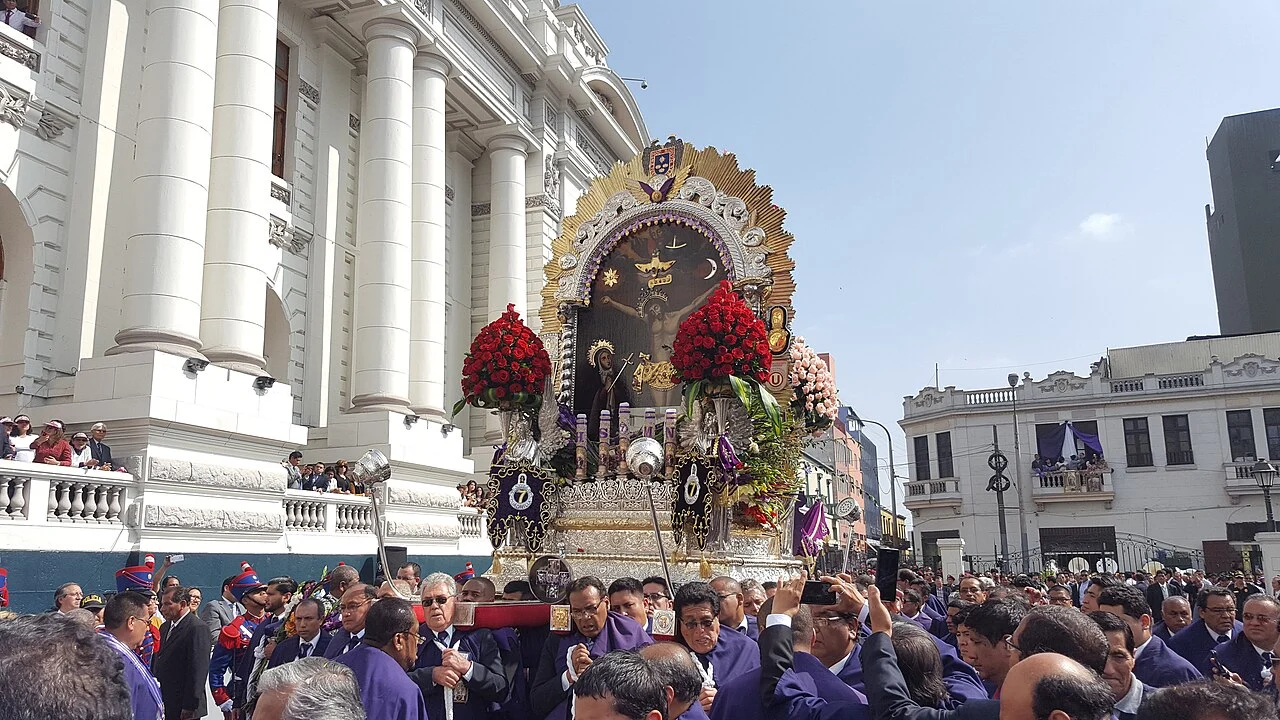
In Lima, October is called the “purple month” (mes morado). This is because devotees wear purple robes in the procession that carries the image of the Señor de los Milagros, the Lord of Miracles. According to the Ministry of Culture’s record, people who carry the image, people who burn incense, singers, and sellers of sweets and food appear on the same streets. Turrón is bought as a confection of this season, and the many-layered dough is cut into sizes that fit on a shop counter or in a package to take home. Even though some shops sell it year-round, the month of the procession is when people gather in the city to buy a piece.
Peru’s national cultural institution designated this festival as national cultural heritage by a resolution dated 27 October 2005. The subject is the festival of the Señor de los Milagros in Lima; the document does not recognize any single recipe for a confection. The confection is sold within the festival that was the subject of the resolution, and serves as a means of learning about that culture. Researching the ingredients of local sugar confections and researching in which procession they were sold require different sources.
Teaching materials from Peru’s Ministry of Education describe a procession in which groups of devotees take turns carrying the heavy platform bearing the image, singers sing alongside, and the procession moves along streets strewn with flowers. The repeated appearance of the area around the Nazarenas convent in records of where the confection was sold is connected not only to its being a place with many restaurants but also to this kind of event, in which devotees and onlookers gather in the streets. In the process by which a confection made indoors comes to be eaten in the street, the city’s welcome of the procession also plays a part.
Sellers of turrón displayed their goods on boards or used handcarts. The current tourism register of the city of Lima gives examples, such as specialty shops in the old town near the Nazarenas convent, where it can still be bought after October. Setting the records of street sellers beside the locations of shops reveals two ways of selling: a confection bought during the procession season, and a product of shops that sell all year. The Ministry of Culture document’s mention of the area around Tacna Street is also related to the fact that places to buy it were concentrated near the church.
The method of making one thick slab, trimming the edges, and cutting off the portions needed can be used both for a confection handed to many people in the street and for one sold in shops to take home. In the Cumanana recipe, the stacked sticks and syrup are left to settle before cutting, so the direction of the sticks can be seen in the cross-section and the colors of the decoration remain on top. Whichever piece is cut, it contains a spiced stick, fruit-scented syrup and the sweets placed on top. The colors that catch the eye during the procession season are added only at the very end of the process of assembling the syrup and sticks.
The Lima register also notes that Arturo Montoya’s Romancero de las calles de Lima describes turrón being sold on the Nazarenas street during the procession. This is an example of a seller’s trade remaining in a literary work as a memory of Lima’s streets. Taken together with the record in Variedades that reported on the confection’s reputation, texts from different periods show both the product known by the name of Doña Pepa and the place where it was sold.
Two Josefas and the printed record of the confection’s name
One widely told story in Lima is that Josefa Marmanillo, who lived in the Cañete valley, lost the use of her arms and set out for Lima to pray to the Señor de los Milagros. Out of gratitude for the recovery of her arms, she is said to have made a confection and offered it in the procession, and to have brought it every year afterward. The story links the work of Afro-Peruvian cooks who were enslaved in the colonial period with the act of offering a confection out of faith. The tourism register of the city of Lima also presents this account as a tradition.
The Peruvian Ministry of Culture’s museum materials also present a story in which the recipe was taught in a dream. The story that she set out hoping for recovery and devised the confection in thanks, and the story that she received the recipe in a dream, differ in the moment at which the confection is conceived. What they have in common is that they explain why Doña Pepa’s confection is tied to the religious procession. Neither has come down as a record by the person who first wrote down the method.
Separately, Josefa Pierola is named as another figure connected with Lima’s confectionery shops. An article in the newspaper El Comercio, citing the account of a researcher who examined a register of 1880, says that she ran a confectionery shop in the city. The tradition of Marmanillo, who came from Cañete to the procession, and the name of Pierola, which appears in a business record, are both called Josefa, but the nature of the sources differs. Even taking the fact that she ran a shop as a clue, it does not allow us to decide who first made a particular recipe.
According to the Ministry of Culture document, references appear in the 19th century to syrup turrón accompanying the procession and to its sellers. The specific issue the same work cites is No. 34 of the magazine Variedades, October 1908, which says that among turróns made with egg yolks, the one bearing the name Doña Pepa had a good reputation. What is recorded there is that the name was in use at the time and that the product had a reputation. That a trade in selling the confection is visible earlier, and that a name can be verified in print, are separate clues to its history.
A university in Lima that holds confectionery materials also has a catalog of manuscripts and transcriptions organized under the title “Turrón de Doña Pepa.” The catalog describes the recipe as taken from a confectionery notebook made in 1828 for María Mercedes Picoaga, while naming the 20th-century Carlota Oriarte de Ocampo as the author of the organized material. The year of the notebook cited as the source and the title given by the current catalog must be read separately. Whether the name was written on the 1828 paper can be judged only by checking the heading in the original document.
Glossary
- Chancaca
- A sugar made by concentrating and solidifying sugarcane juice. It is combined with fruit juice and spices and used in the syrup that binds the sticks.
- Grageas
- Small confections scattered on the surface. Grains of various colors and sizes are used as decoration.
- Señor de los Milagros
- An image of Christ venerated in Lima. In October, the procession carrying the image and the sale of the confection are linked.
- Mes morado (purple month)
- The name for October in Lima, after the procession of devotees wearing purple robes.


