


SweetloreEncyclopedia of World Sweets (834)

Douillon d’Elbeuf
Douillon d'Elbeuf
The names and memories of fruit-wrapped sweets in Normandy
Baked Sweets / France, Normandy

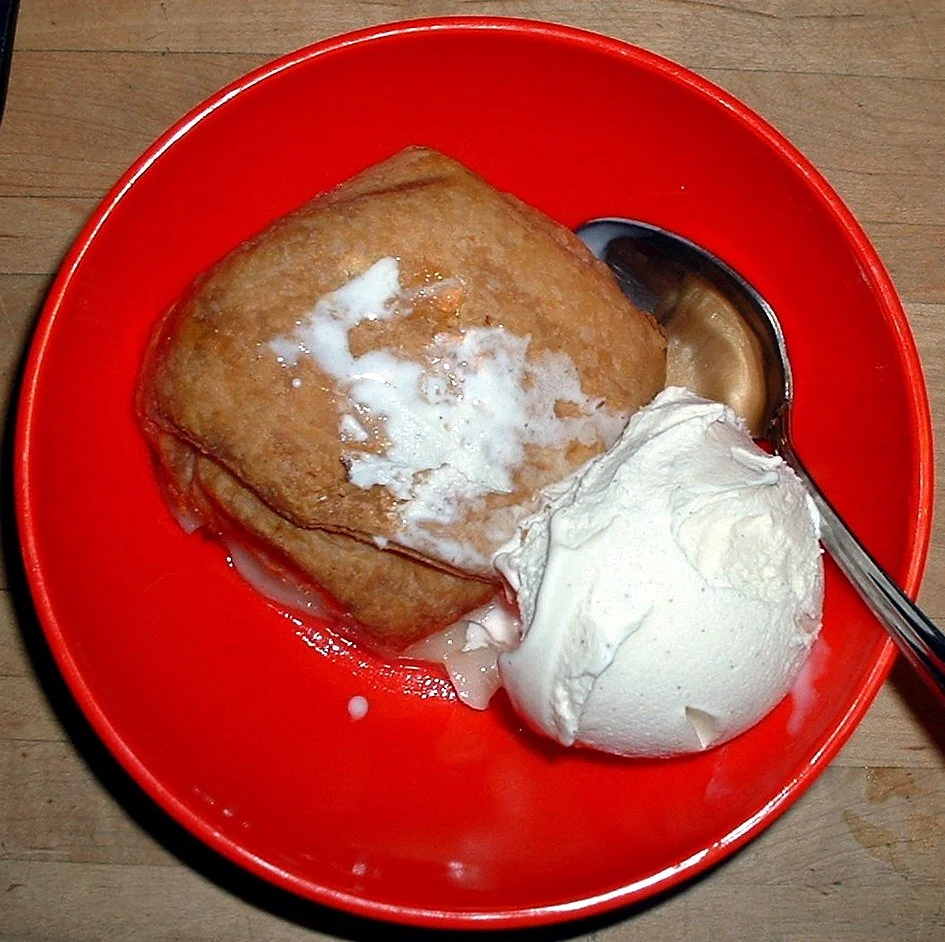
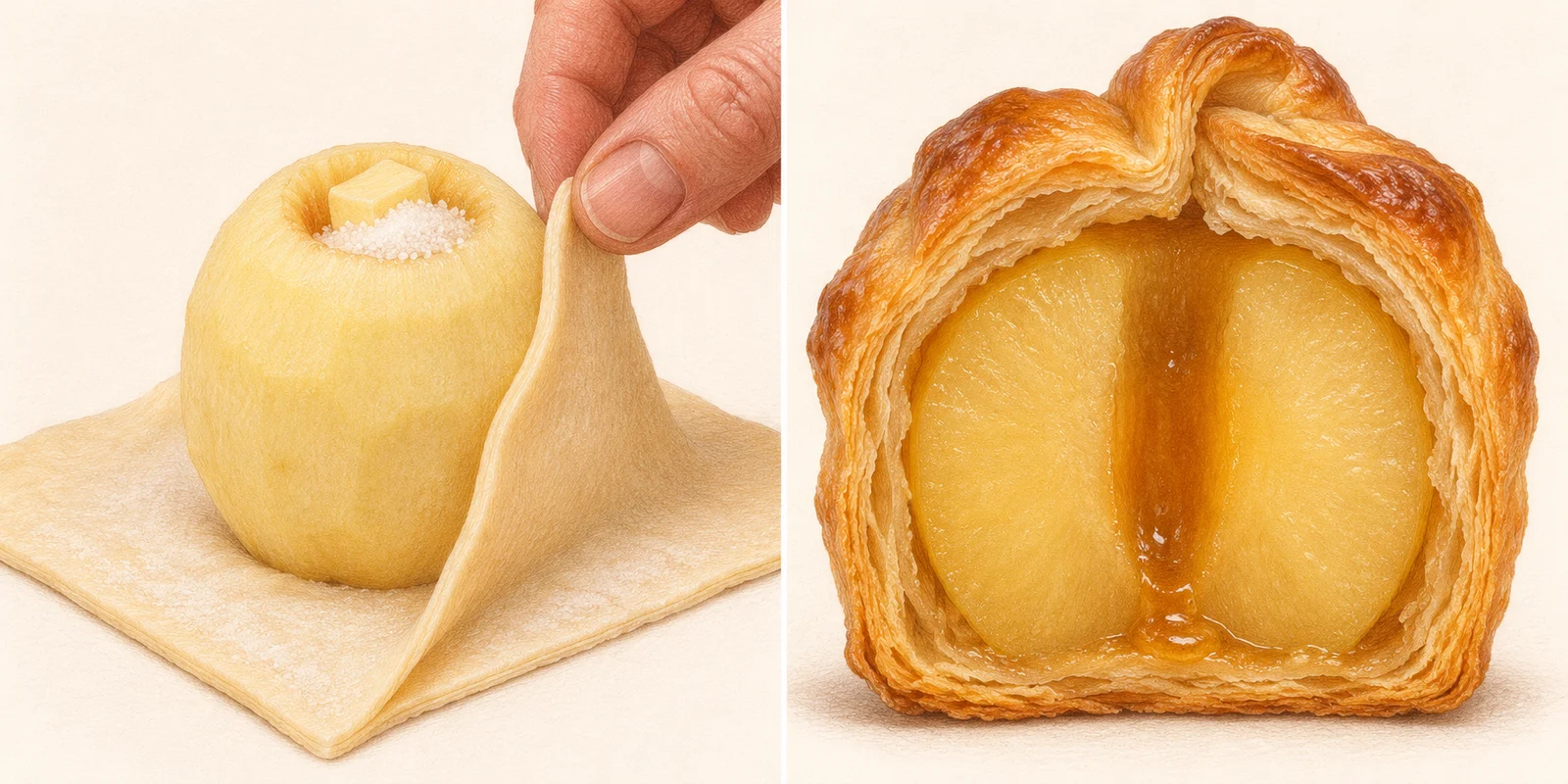
Cut into the round, browned pastry and the outline of a softly baked apple appears. This is the Douillon d’Elbeuf (Douillon d’Elbeuf) of Elbeuf, in Normandy in northwestern France. In the example from the Rouen tourist office, the raw apple is not chopped: butter and sugar go into the hole left by coring, and each fruit is wrapped individually in puff pastry. The pastry that comes out of the oven and the apple, which stays moist, have different textures even though they were made into a single parcel before baking. A whole apple sits inside a piece small enough to be placed in a box or on a plate as one serving.
A Cored Apple, Closed in a Square or Circle of Pastry
In the tourist office’s method, the apple may be peeled or left unpeeled. The cored fruit is set on a square or circle of puff pastry cut large enough to cover it entirely. A knob of butter and granulated sugar go into the hole, and the edges of the pastry are pulled up and closed over the fruit. The relationship between flesh and pastry differs from that of a tart, in which cut fruit is spread over the pastry. Because the pastry is lifted up the full height of a single fruit, the size needed depends on the fruit’s width and height. Once the parcel is closed, you cannot see from the outside how far the flesh extends.
The magazine of the Rouen Normandy metropolitan area presents the method of Fabien Delamare, a baker in Elbeuf. An apple is set on a round of pastry, and 10 g of butter and sugar go into the core cavity. The egg yolk brushed on after the fruit is wrapped and closed is for browning the surface. The oven is set to 180°C, and the baking time is about 35–40 minutes. The sugar and butter are already inside the cored fruit before anything is brushed, to taste, on the outside of the pastry. While juice is released and the apple softens, the outer pastry, brushed with egg yolk, browns first.
In the tourist office’s photographs, you can see the cored apple set on the pastry and a display of golden parcels lined up for sale. Even after coring, the outer part of the fruit remains, and once the edge is closed, that position does not show on the surface of the pastry. Unlike spreading pastry flat to make a dish for the flesh, this form keeps the juice inside the parcel even while it bakes. Because the pastry is closed first, rather than laid over apple that has already been baked raw, the fruit stays out of sight until you pick up a single piece at the counter.
Delamare chooses Wellant apples from an orchard in Bardouville. The 2021 magazine says he designed the sweet around the roughly eight weeks, from the end of September to November, when this apple ripens. What supports the shape of the baked sweet is not a mass of finely chopped flesh but the single apple chosen that day. If another shop obtains a different variety, the period in which it can be made also changes. The Rouen tourist office gives the season for the regional sweet as September to the end of winter. The eight weeks of an artisan working with an orchard and the season in which the sweet can be found in town differ in length.
The artisan’s example presents it eaten warm, and the tourist office lists it both as a dessert after a meal and as an afternoon snack. Because hot apple lies between the layers of pastry, and steam and juice come out where the parcel is opened, the spot where the teeth meet at the first bite differs from the spot where the flesh is scooped. When pastry and fruit are served together, the texture of the outside and the warm apple fit into a single mouthful on one plate.
Between Douillon and Bourdelot, the Fruit Behind the Name Switches
In Normandy, the name bourdelot is also used for sweets in which apples or pears are wrapped and baked. The Dictionnaire des régionalismes de France gives either fruit as the filling and lists douillon as a regional synonym. In a 1991 article that the dictionary cites, bourdelot generally means the apple version and douillon the pear version. By contrast, the account of Haute-Normandie in the regional magazine Patrimoine Normand matches douillon with apple and bourdelot with pear. Both fruits can be wrapped in the same pastry, but which fruit the name is tied to differs from record to record.
The dictionary cites a usage example from an 1877 dictionary for bourdelot, which shows that the apple-wrapped sweet was commonly eaten in several parts of Normandy, especially near Caen. Examples called bourdon or rabotte also appear in the same source. Another record of a different dish describes wrapping apples or pears in bread dough, brushing them with egg yolk and baking them. Larousse defines douillon as an apple or pear combined with butter and cinnamon and wrapped in shortcrust pastry. The broad sense in the dictionary, the households that use bread dough and Elbeuf’s puff pastry all overlap in wrapping the whole fruit, while the treatment of the outer pastry changes.
Among the items that the baking trade paper presents under the town’s name, both an apple and a pear “fisé” appear. In another Normandy tourist guide, pears produced in places such as northern Seine-Maritime and the Pays de Bray bear the name Fisée (Fisée, Fizet, etc.). The other regional pie it presents boils the pears in red wine and sugar before wrapping them. Even though the spellings are similar, the trade paper’s brief description does not show that it means the same variety, nor that pears are poached before going into the Elbeuf version. The method of wrapping raw apples that the tourist office gives, by contrast, can be verified from the wrapping stage.
For Pears, Some Examples Leave the Stem Showing
In the pear douillon in a Suisse Normande tourist document, the pear is peeled and its stem is left on. A square of butter puff pastry is cut, honey, sugar and cinnamon are placed with the pear, and the parcel is closed with the stem sticking out. It is brushed with egg yolk and baked at 200°C for about 30 minutes, then served warm with crème fraîche. The City of Reims cooking booklet likewise leaves the stem on, but puts butter and sugar into the cavity from which the core was removed from below, and wraps the pear in pâte brisée instead of puff pastry. This version is brushed with egg yolk and baked at 210°C for 20–25 minutes. Even though the stem sticks out in both, the position where sweetness enters the flesh and the pastry that forms the exterior differ between the two examples.
The pears at a restaurant in Le Havre are peeled and steeped for 24 hours in red wine with sugar, vanilla, citrus peel and cinnamon. The liquid is brought to a boil and the fruit simmered for about 10 minutes, then drained and wrapped in sablé dough. The remaining steeping liquid is reduced into a sauce. Compared with the Elbeuf example, which wraps apples raw, the fruit here is heated twice, before and after wrapping. Before the outer pastry is baked, there is the step of adjusting the pear’s aroma and texture with the steeping liquid.
There are differences among apple examples, too. In a recipe from the Bresse region of Burgundy, sugar or currant jelly is put into the core of a peeled apple, which is set on a thin square of shortcrust pastry. The four corners are brought together at the top and joined with cold water, a leaf-shaped piece of dough is placed on top, and the pastry is brushed with egg yolk and baked. Read alongside Elbeuf’s round of puff pastry, this shows that even when a single fruit is wrapped in each case, what goes into the core hole and the decoration placed where the corners meet are not fixed into one form regardless of town.
A Family Who Left Town in a Novel, and an Artisan Who Baked It Again in His Shop
According to the Rouen tourist office, the sweet is also remembered as something eaten in Elbeuf’s cinemas between screenings. In Hector Malot’s novel Baccara, a family from Elbeuf crosses the forest on a summer Sunday, comes out to La Bouille on the Seine, and eats douillons and matelote, a fish stew. The setting is not only the family’s home in Elbeuf but a meal at a place they travel to from town. The novel does not describe the type of pastry or how it was wrapped, but, apart from the town’s name and the year the sweet was invented, it preserves a scene of eating away from home.

From the novel we learn that the family’s walks took them to the rocks and forest of Orival, and that in summer they went as far as La Bouille by way of the castle of Robert le Diable. The flow of time into which a single sweet fits differs between a place reached across the forest in order to eat and a place where one ate between screenings at the town cinema. A literary work in which the name appears as a choice of meal and the tourist office’s record of where townspeople ate connect the same name to different places.
According to a 2016 interview, the baker Francis Burtin began looking for the old method in 2004. Malot leaves the name of the sweet that was eaten but does not write how the fruit was wrapped. The interview also cites as a clue Maupassant’s short story “The Old Man” (Le Vieux), in which a single apple is wrapped in thin dough. Burtin chose a firmer reinette that keeps its shape when baked and baked it in puff pastry. To remake in a present-day shop the single piece that survives in literature, the artisan has to decide what firmness of apple to choose and what dough to wrap it in.
In the 2016 interview, Burtin explains that he chooses reinettes that are neither too large nor too small, and the article says that apples of this type are available from October to April. Compared with Delamare’s eight weeks using Wellant, the choice of variety alone, judged by whether the fruit can be baked while wrapped, makes a difference to the season in which a shop makes the sweet. The same article includes, besides serving it with ice cream, a way of eating it in which a hole is made in the pastry and Calvados is added. Both are ways of preparing the baked, opened parcel once more before eating.
Elbeuf’s commerce association took up the task of making known a sweet that had gradually disappeared from the town’s shops. The trade paper writes that on 5 October 2011 a charter was signed with representatives of the region’s bakers and pastry makers, among others. The tourist office says that an association of enthusiasts was formed and that the first competition was held in October 2012. The records that can be read preserve who began promoting the sweet and when, and how the work of local makers was tied together again. How individual ingredients were decided from the charter’s clauses does not appear in the articles.
In the 2021 metropolitan-area magazine, Delamare says that the town encouraged him to resume making it. A 2023 municipal article presented how the same bakery received a regional commerce and industry award, renovated its sales area and the room where sweets and bread are made, and worked with local suppliers. It also carries the shop’s statement that it uses apples from an organic orchard in Bardouville and that the wheat milled into flour is grown within 100 km. The work of choosing the fruit, baking the parcels to suit the shop’s oven and selling them one at a time at the counter connects the sweet to the point where it can be eaten in town. In the Rouen tourist office’s guide, two Elbeuf bakeries are also listed on the page that carries the recipe. Knowing the differences in season and shop, you can compare the piece you bought that day with versions baked at home.
Glossary
- Puff pastry
- Dough in which dough and butter are layered and folded so that layers form when it is baked. In French, pâte feuilletée.
- Bourdelot
- A regional name in Normandy for a sweet in which fruit is wrapped in dough and baked. How it is distinguished from douillon differs by source.
- Hector Malot
- Author of the novel Baccara. The tourist office says that douillon appears in it.


