


SweetloreEncyclopedia of World Sweets (834)

Nakshi Pitha
Nakshi pitha
Rice Dough Carved with Flowers and Birds, Fried for Celebrations
Baked Sweets / Bangladesh

Fine lines spread like leaf veins, and small notches run along the edge. Nakshi pitha (Nakshi Pitha, নকশি পিঠা) is a Bangladeshi sweet made by patterning rice dough and deep-frying it. The maker presses the surface with a thin needle and lifts the cut areas slightly with a date palm thorn. Some versions are soaked in sugar syrup after frying, while others are simply dusted with powdered sugar. The lines and flower outlines that catch the eye before anyone takes a bite are the marks of hands that kneaded rice flour and shaped each small form one at a time. How do those lines survive until the pitha reaches a plate at a wedding or a harvest celebration?
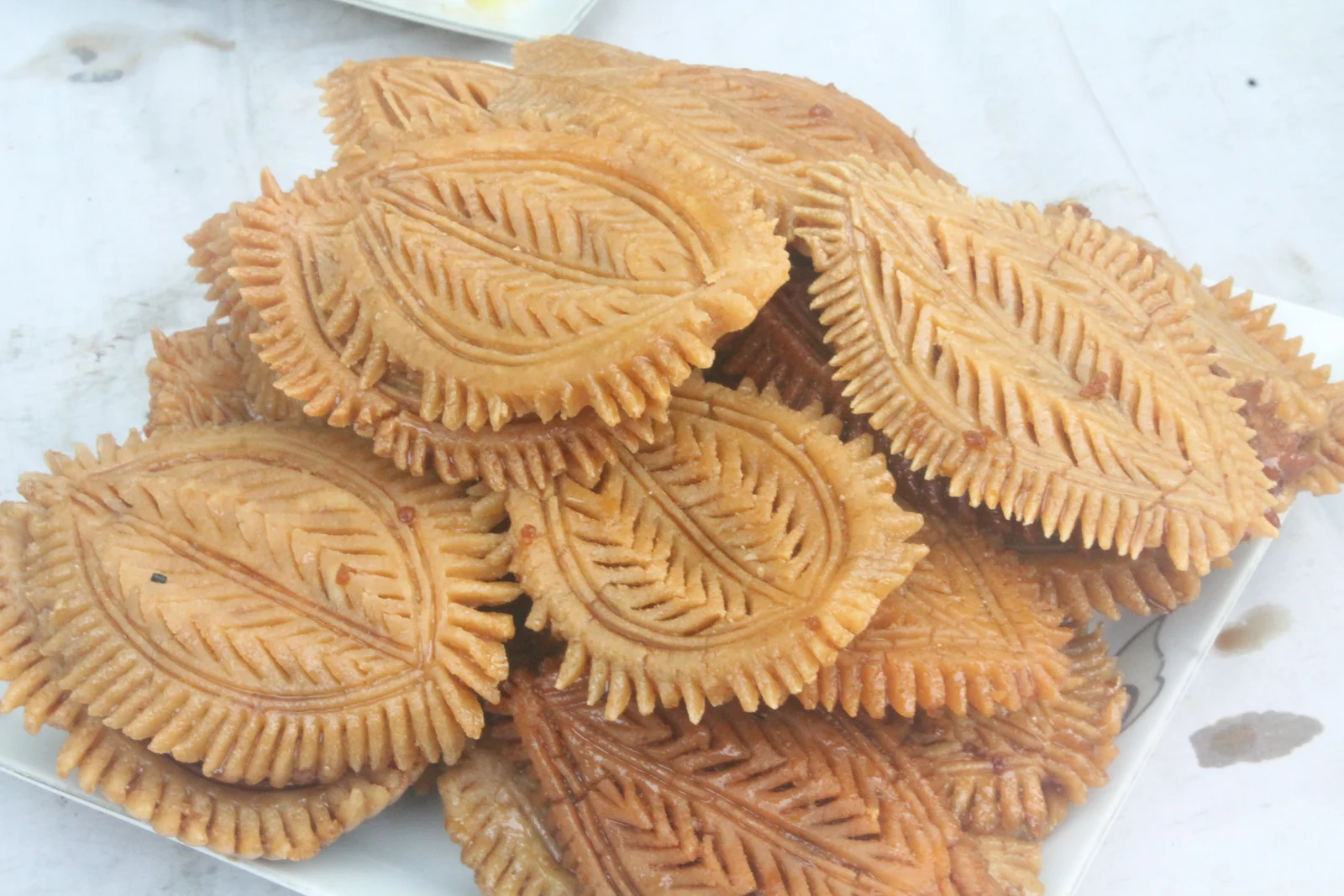
Kneading First, Then Rolling to a Thickness That Takes an Impression
The cultural heritage record uses flour made from atap rice. Atap rice is rice that has not been parboiled, a process in which the paddy is steamed or otherwise treated before milling. The record gives an example in which the flour is added to boiling water and cooked over heat for 20 to 30 minutes. The dough is prepared so that it can be shaped once heated, and it is covered with a damp cloth. Only after that is it divided. What the record describes is not just the heating time but the whole sequence of steps that brings the flour, after it goes into the water, to a state in which it can take a pattern.
In the home method conveyed by Shubhagata Debashish, the proportions are 2 cups of rice flour to 1½ cups of water. Salt and rice flour are added to boiling water, and the mixture is cooked covered over medium heat for about 1 minute. It is then kneaded well and divided into three or four portions. Each portion is rolled into a round, leaving a thickness of about ½ inch. This is the surface on which lines will be drawn with a fine tool and cuts made along the edge. The heritage record and this home method differ in heating time, but both set aside time for handling the flour by the fire and time for rolling out each piece by hand.
In Shayla Sharmin’s recipe for the Bengali New Year, salt and baking powder are combined with warm water and rice flour. The rolled-out dough is cut into any shape desired, and the pattern is then added with a toothpick. A side view of an unfried pitha with a three-dimensional pattern shows a flat, disc-like area and a raised, ring-like area at the same time. If the dough is given a thick base, it is possible to make both the places where cuts are made and the places that stay high. The recipe behind the photographed example and this home recipe are separate records.
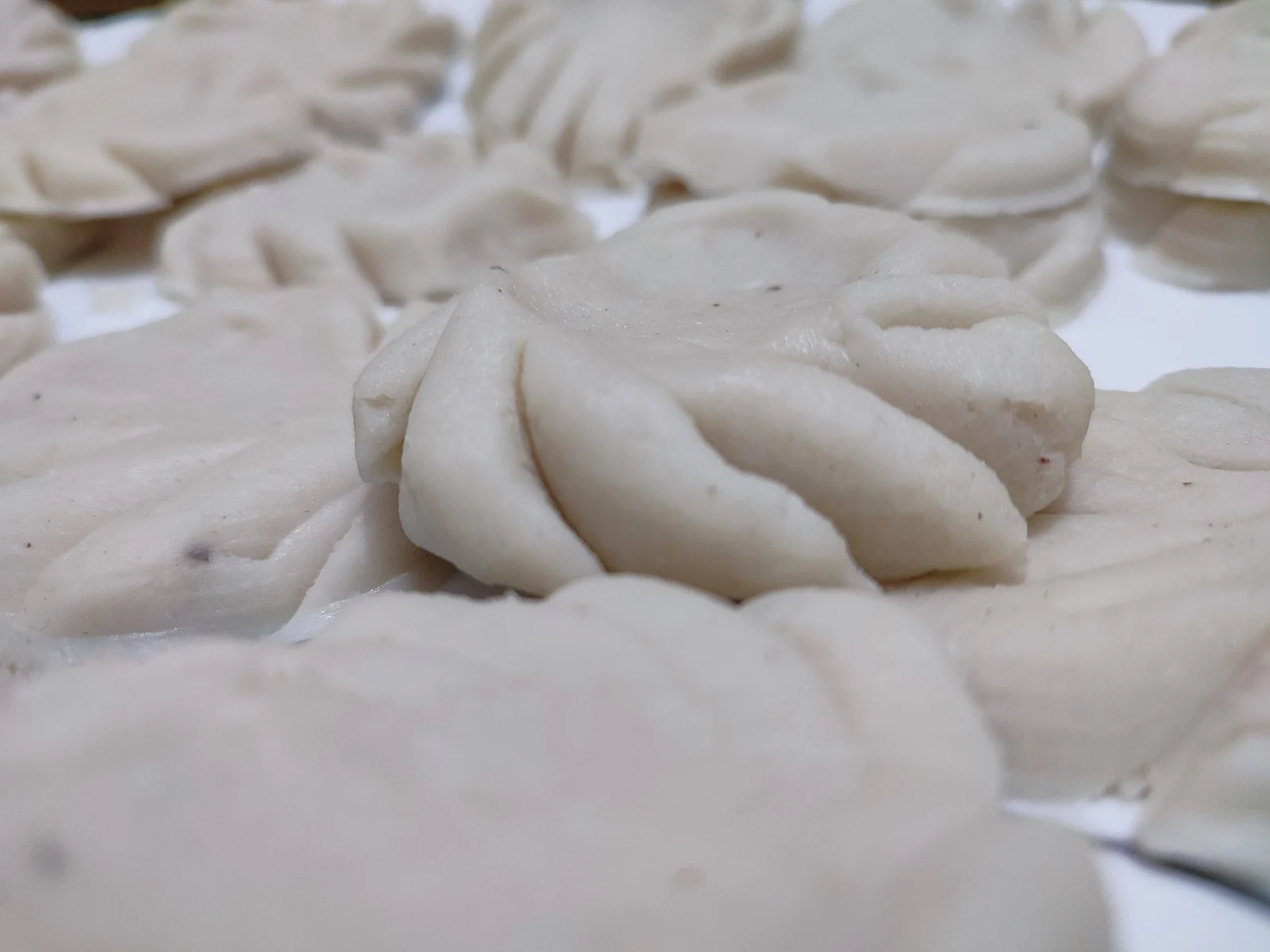
Needles That Lift the Cuts, and Moulds That Carry the Pattern
The sources that record the tradition mention the banana leaf on which the divided dough is placed, and the tools used to make the lines: date palm thorns, bamboo skin, hairpins, needles, jute stalks and twigs. The dough is set on a spread leaf, and dots and lines are strung together with a fine-tipped tool. Some pitha are wrapped in banana leaves and steamed, but in this method the leaf is used only at the stage when the dough is spread out on the work surface. Once the pattern is made, the leaf is removed and the rice dough goes into the oil.
For Debashish’s round pitha, the edge is cut with a knife or a thorn and pointed, and lines are then drawn on the inside with a thicker needle or thorn. A thorn is inserted again into the drawn lines and lifted lightly, which opens a thin gap and makes the design stand out. The same tool that defined the outline of the circle is now used to raise the edges of the lines. In photographs of the finished pitha, the shadows that fall between the projections show that the surface sits at different heights. Photographs do not show which implement the maker applied, but in the article’s example the pressing motion and the lifting motion follow one another.
Besides adding lines by hand, there is also a method of transferring a pattern to the dough from a mould carved in advance. The heritage materials include an example using clay into which children had pressed patterns. Banglapedia lists moulds of wood, clay and stone, and gives an example in which artisans made the wooden moulds and village women made the clay ones. When drawing with a fine tool, the lines must be drawn on each piece of rice dough. With a mould, a single flower made on the mould’s face can be transferred to separate pieces of dough. The finished pitha vary in shape as well: some have cut edges, and others have corners or round holes.
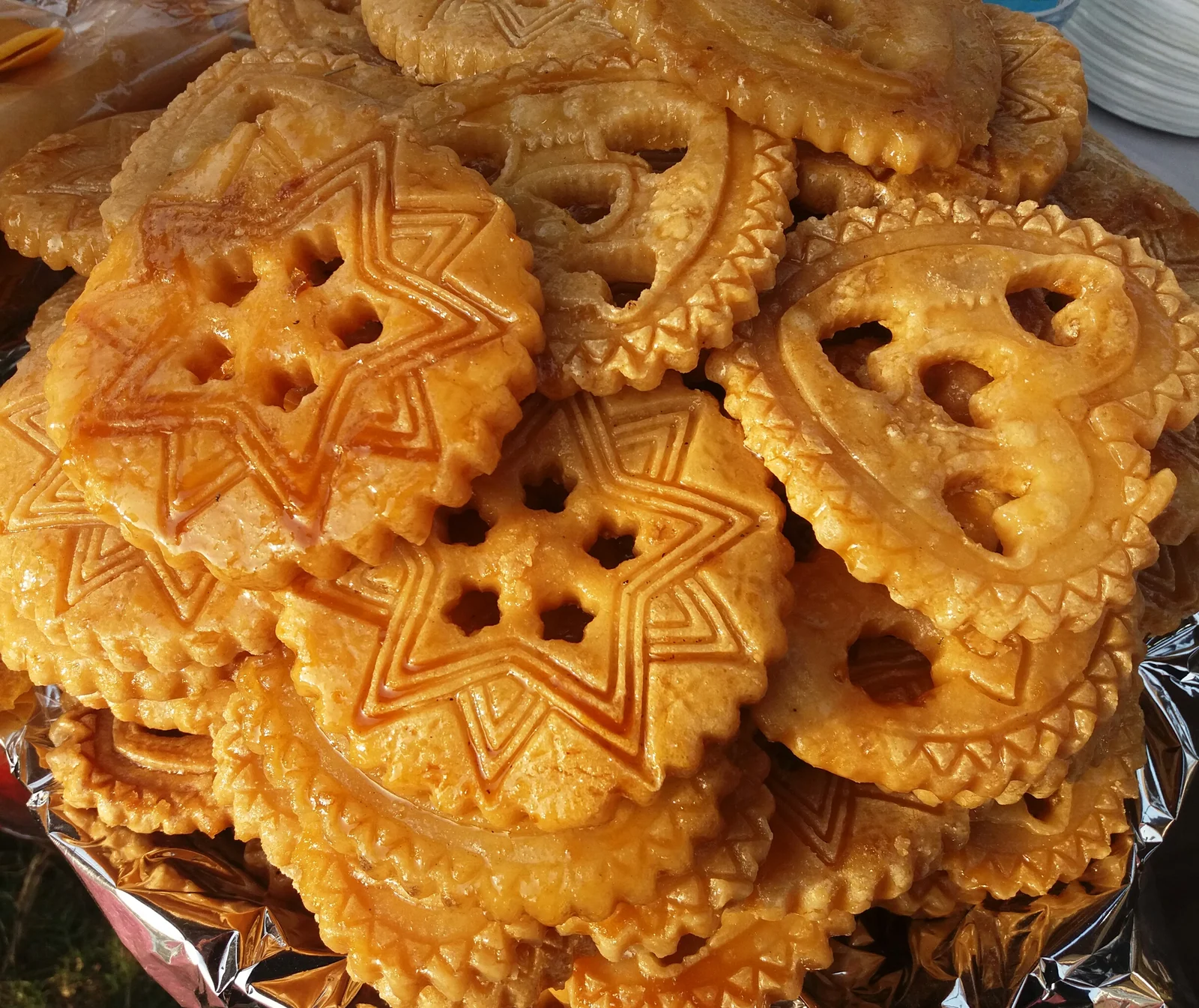
In addition to flowers, creepers, birds, fish, wheels and geometric shapes, Banglapedia also lists the betel leaf design. The direction in which the needle moves differs between layering small circles inside a circle and lining up vein-like lines along one side. In the heritage records from Narayanganj and elsewhere, women add the patterns, and men also gather materials and tools. The records name Rahima Akter and Sufia Begum. The preparation of the sweet moves forward through those who know which lines to draw and those who prepare the rice and tools so that the lines can be drawn.
Nakshi kantha is a Bengali handcraft in which layers of worn cloth are stitched through with thread to make pictures. The lotus, birds and creepers are subjects that Banglapedia lists for kantha, and they also appear on pitha. On pitha, the height of the rice dough changes where the needle tip enters it, while on kantha cloth the thread that the needle has drawn through remains. Even if the same bird is chosen, the steps differ depending on whether the thread is coloured or the feathers are shown through ridges and hollows in the rice dough. The patterns on the plate preserve both subjects shared with other Bengali handcrafts and a manner of drawing suited to a dough that is fried and eaten.
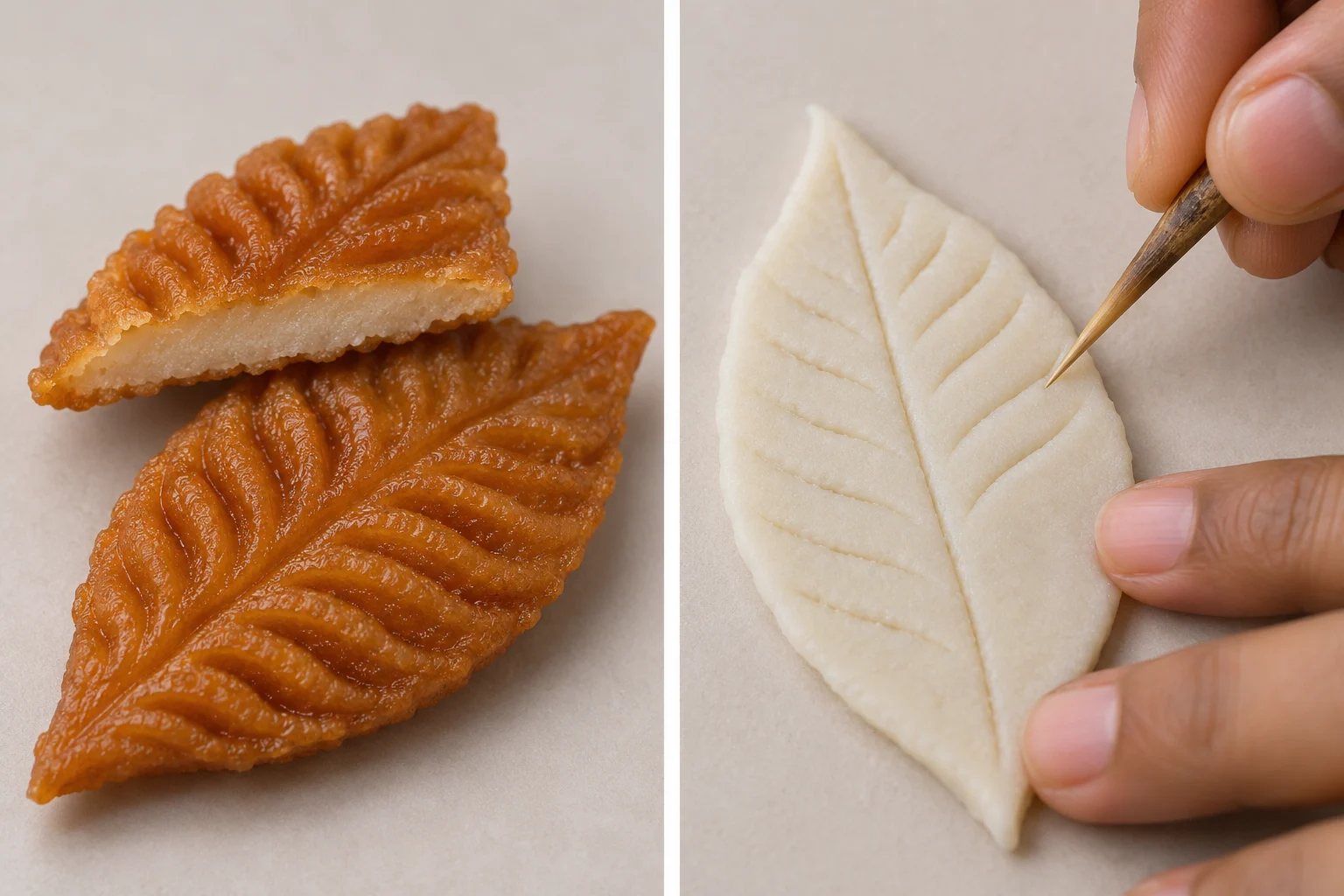
Lifting from the Oil, Soaking Sweetness In from Outside
In Debashish’s example, the patterned dough is left exposed to the air for 2 to 3 hours and then lightly fried in warmed oil over low heat. Sharmin puts the shaped dough into hot oil and fries it until brown. The two examples differ in whether a resting period is taken and in the colour to which the dough is fried. Because each pattern is finished one piece at a time before the dough goes into the oil, nothing is added to decorate it in the pan, and the shapes already made are simply cooked. The cultural heritage record includes examples that use oil such as soybean oil.
The sweet liquid is prepared in a separate pan. The heritage record lists a syrup made with molasses. Sharmin boils sugar with water and soaks the fried pitha in it for a while before moving them to a plate. Debashish uses 2 cups each of water and sugar, adds cardamom and cinnamon, and simmers over low heat. The water used here is separate from the hot water used to knead the flour and salt. The sweet liquid touches the outside of the fried pitha, and also reaches the grooves drawn with the needle and the gaps made by lifting the cuts.
Mrityunjoy Roy, who visited a maker in Digda village in Gazipur District, recorded eating a pitha that had been fried in oil and soaked in sugar syrup, and noted its light, crisp texture. In the village he also heard of eating the pitha freshly fried with powdered sugar sprinkled on it, and of examples eaten without added sweetness. In some cases a little ghee was added to the oil to give fragrance. Up to the frying of the patterned surface the methods are shared, but before the pitha is set in front of a guest there is a choice: to let the syrup’s fragrance soak in, to dust it with white powder, or to leave the aroma of the oil.
Pitha Named for Flowers, Pitha Named for Patterns
The same entry in the cultural heritage inventory also carries the name phul pitha, which refers to flowers. When The Daily Star reported from various regions in 2011, it presented Narsingdi’s phul pitha and Mymensingh’s nakshi pitha separately. The former is shaped like a flower and soaked in molasses, while the latter is made by putting intricate patterns on rice flour dough and frying it. The ranges described by the two names overlap: some pitha have a flower outline, and others are called by the pattern on their surface. The account of the visit to Digda village says that phul pitha is also the name used in Rangpur, Dinajpur and Bogura, and that in parts of Mymensingh the pitha is called মছমছিয়া পিঠা.
The main areas named in the heritage record are Narayanganj, Narsingdi, Kishoreganj and Comilla. In Banglapedia, it appears as a pitha made for wedding hospitality in Dhaka and Mymensingh. Where it began and when it spread elsewhere are not known. Sheela Begum, who makes pitha for weddings, recalls that she began making it herself at the age of ten after watching the women of her household shape flowers, birds, boats and other forms. Nakshi pitha and jamai pitha were sweets served on the plates that welcomed the bridegroom and his family. What these accounts preserve is not the name of the first person to make it, traced back through the years, but how the shapes were learned in the household kitchen.
From the Harvest-Rice Season to Markets Where You Meet the Makers
Besides weddings, there are examples of nakshi pitha being prepared for Eid, for Nabanna, the festival of the new rice, for the Bengali month of Paus festivals, and for aqiqah, which celebrates the birth of a child. According to Banglapedia, the pitha-making season begins when the rice harvest starts in late autumn. In winter, date palm sap and boiled-down sugar also become available. Sharmin presented this recipe as a dish for the Bengali New Year. Some households make it in the season when freshly harvested rice is ground, and others knead rice flour for different occasions.
Occasions to compare pitha outside the home have also been created. According to the encyclopedia, an exhibition held by the Bangladesh Shishu Academy in 1991 gathered 106 kinds of pitha in all. At the festival of the University of Dhaka’s Department of Linguistics on 5 December 2024, students set up stalls by year of study and offered homemade nakshi pitha, bhapa pitha, patishapta and other kinds. Visitors went around several stalls, and the department awarded the students after looking at the pitha and the stall arrangements. A photograph from a pitha fair in Rajshahi in 2018 also shows patterned sweets being sold with names and prices attached.
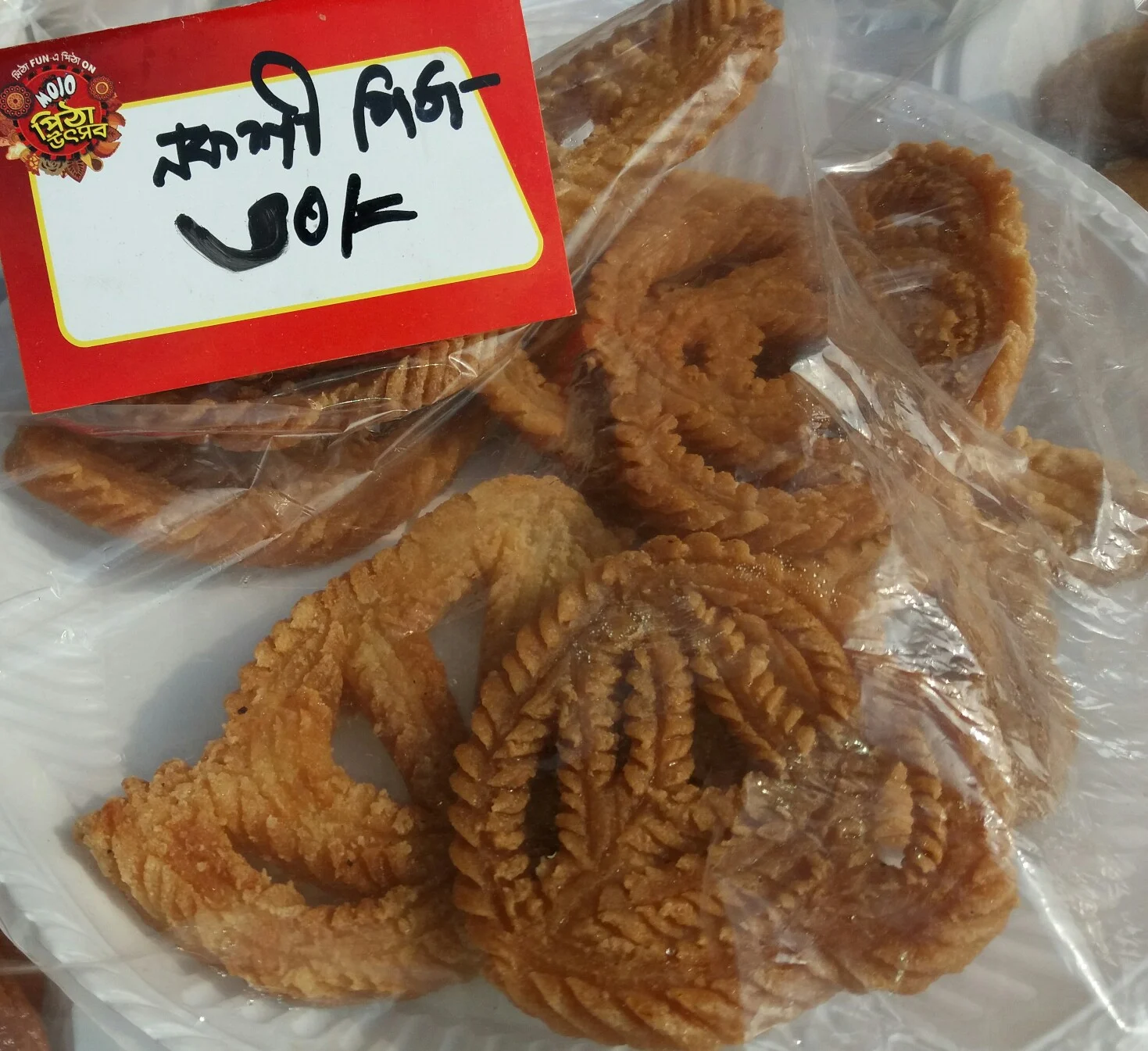
When a tag with the name "nakshi pitha" and a price stands near the bagged sweets, buyers can choose by looking at them and take them home to share with their families. In the 2018 Rajshahi photograph, the tag on this one bag reads 30 taka. ICH Pedia, which documented the heritage, gives 10 September 2022 as the date of its interview with the maker and notes that the pitha continues to be made for family events and that displays make the method more widely known. A pitha laid out away from the home can be a place to buy a familiar dish, or a place to learn a name only after seeing it beside other kinds.
In town shops, the way of ordering also changes. In a report on Monsur, who runs Jamai Shoshur Pitha Ghor in Siddhirganj, Narayanganj District, about thirteen kinds of items, including nakshi pitha, were on display; he sold pitha for nine months of the year and did other work during the remaining three. One customer interviewed said he had come to eat pitha that people make at home less often than before. At Jashimuddin Pithaghar in Uttara, Dhaka, nakshi pitha is one of about twenty items. The shop also offers steamed and rolled pitha, and customers can choose the patterned, deep-fried kind.
Mosholof, who sells pitha in Lalbagh, Dhaka, following his father, displays nakshi pitha and malpoa at his shop front and, on request, goes to venues such as weddings to make pitha there. The interview does not give a breakdown of what is made on site, but specialist shops also take on the work of preparing pitha for days when people are invited. The heritage record lists aman rice, bamboo skin and thorns, and treats pitha festivals as occasions for passing on the technique. The angle and pressure with which a needle enters the dough can be learned by watching the maker. A single piece on a household plate or at a festival carries the marks left by that hand. The shape of the sweet can be learned by the next person in the making or in the eating.
Glossary
- Pitha (pitha, পিঠা)
- A group of sweets and snacks made in Bengali homes. Rice flour and other flours are used, and depending on the kind, the pitha may be fried, steamed or baked.
- Atap rice (atap rice, আতপ চাল)
- Rice whose paddy has not been parboiled. In the heritage record it is ground into flour for the dough.
- Nakshi kantha (nakshi kantha, নকশি কাঁথা)
- A Bengali handcraft in which layers of cloth are stitched through with thread to form patterns.
- Phul pitha (phul pitha, ফুল পিঠা)
- A pitha shaped like a flower. In the cultural heritage inventory it appears under the same entry as nakshi pitha.
- Betel leaf (betel leaf)
- A plant whose leaf is used. One example of a nakshi pitha pattern.
- Nabanna (Nabanna, নবান্ন)
- A Bengali festival celebrating the harvest of new rice.
- Paus (Paus, পৌষ)
- A winter month of the Bengali calendar.
- Aqiqah (aqiqah)
- An Islamic observance connected with the birth of a child. In the heritage record it is listed among the occasions when pitha are made.


